Industry-Verified Manufacturing Data (2026)

Concentration Column

Based on aggregated insights from multiple verified factory profiles within the CNFX directory, the standard Concentration Column used in the Chemical Manufacturing sector typically supports operational capacities ranging from standard industrial configurations to heavy-duty production requirements.

Technical Definition & Core Assembly

A canonical Concentration Column is characterized by the integration of Column Shell and Distillation Trays/Packing. In industrial production environments, manufacturers listed on CNFX commonly emphasize Stainless steel (e.g., 304L, 316L) construction to support stable, high-cycle operation across diverse manufacturing scenarios.

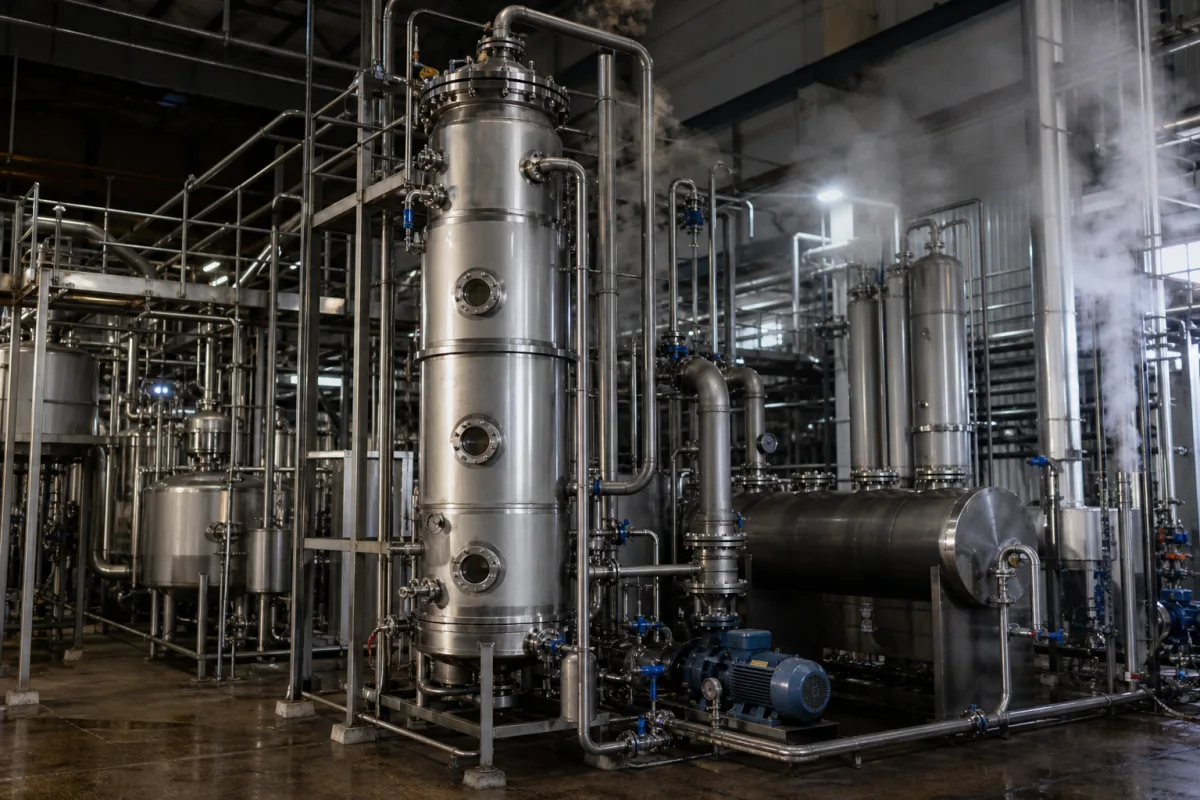
A vertical distillation column used to concentrate dilute nitric acid by separating water from the acid solution.

Product Specifications

Technical details and manufacturing context for Concentration Column

Definition
The concentration column is a critical component within the Integrated Nitric Acid Production and Concentration System, specifically responsible for increasing the concentration of nitric acid from its initial dilute state (typically 50-60%) to a commercial-grade concentration (typically 68-70% or higher). It operates as a distillation unit where heat is applied to vaporize water and some nitric acid, with the vapors then condensed and refluxed to achieve the desired acid strength in the bottom product.
Working Principle
The column operates on the principle of fractional distillation. Dilute nitric acid is fed into the column, typically at an intermediate tray. Heat is supplied at the bottom (reboiler) to vaporize the mixture. Due to differences in volatility, water vaporizes more readily than nitric acid. The vapor rises through the column, contacting descending liquid (reflux) on trays or packing. This counter-current contact allows for mass transfer: water concentrates in the vapor phase moving upward, while nitric acid concentrates in the liquid phase moving downward. The vapor leaving the top is condensed; part is returned as reflux to control separation, and the rest is removed as overhead product (dilute acid or water). Concentrated nitric acid is drawn from the bottom. The process often operates under vacuum or atmospheric pressure, depending on the design, to manage temperatures and prevent excessive decomposition of nitric acid.
Common Materials
Stainless steel (e.g., 304L, 316L), Special alloys (e.g., high-silicon iron, zirconium for high concentrations), Ceramic packing (if packed column)
Technical Parameters
  • Column diameter and height, which determine capacity and separation efficiency. (mm) Customizable
Components / BOM
  • Column Shell
    Main pressure vessel containing the distillation process.
    Material: Stainless steel
  • Distillation Trays/Packing
    Provide surface area for vapor-liquid contact to enhance separation efficiency.
    Material: Stainless steel or ceramic
  • Reboiler
    Supplies heat at the bottom to vaporize the liquid, driving the distillation.
    Material: Stainless steel
  • Condenser
    Cools and condenses vapor from the top of the column, producing reflux and overhead product.
    Material: Stainless steel
  • Feed Inlet Nozzle
    Entry point for dilute nitric acid feed into the column.
    Material: Stainless steel
  • Product Outlet Nozzle
    Exit point for concentrated nitric acid from the bottom.
    Material: Stainless steel
Engineering Reasoning
0.1-0.5 bar absolute pressure, 30-90°C temperature, 40-70% nitric acid concentration
Material failure occurs at 0.8 bar internal pressure (316L SS yield strength), 120°C thermal degradation of PTFE gaskets, or 85% nitric acid concentration causing accelerated corrosion
Design Rationale: Stress corrosion cracking from chloride contamination at >50 ppm Cl- in feed, thermal fatigue from >20°C/min temperature cycling, or nitric acid decomposition at >95°C forming NOx gases
Risk Mitigation (FMEA)
Trigger Feed stream contamination with >50 ppm chlorides from cooling water leakage
Mode: Stress corrosion cracking in 316L stainless steel packing material within 2000 operating hours
Strategy: Install duplex 2205 stainless steel structured packing and implement online chloride ion monitoring with <10 ppm alarm
Trigger Reboiler temperature control failure causing >95°C bottom temperature
Mode: Nitric acid thermal decomposition generating NO2 gas pressure exceeding 1.2 bar design limit
Strategy: Implement triple-redundant thermocouples with 2oo3 voting logic and emergency quench system activated at 90°C

Industry Taxonomies & Aliases

Commonly used trade names and technical identifiers for Concentration Column.

Industrial Ecosystem & Supply Chain DNA

Complementary Systems
Downstream Applications
Specialized Tooling

Application Fit & Sizing Matrix

Operational Limits
pressure: Vacuum to 5 bar (operating pressure range)
flow rate: 1-100 m³/h (liquid feed rate capacity)
temperature: 50-200°C (typical operating range for nitric acid concentration)
slurry concentration: Not applicable (handles liquid solutions only)
Media Compatibility
✓ Stainless Steel 304L (for dilute nitric acid) ✓ Stainless Steel 316L (corrosion resistant) ✓ PTFE-lined materials (for high purity applications)
Unsuitable: Hydrofluoric acid or fluoride-containing environments (causes severe corrosion)
Sizing Data Required
  • Feed flow rate (m³/h)
  • Nitric acid concentration in feed (% by weight)
  • Desired product concentration (% by weight)

Reliability & Engineering Risk Analysis

Failure Mode & Root Cause
Corrosion-induced wall thinning
Cause: Exposure to corrosive process fluids (e.g., acids, chlorides) at elevated temperatures and pressures, leading to material degradation and loss of structural integrity.
Internal tray/packing collapse or fouling
Cause: Accumulation of solids, scaling, or polymerization on trays/packing due to impurities, improper feed composition, or inadequate cleaning cycles, disrupting mass transfer efficiency.
Maintenance Indicators
  • Visible external corrosion, weeping, or leaks at welds or shell seams
  • Abnormal pressure drop fluctuations or reduced separation efficiency indicated by process instrumentation
Engineering Tips
  • Implement regular ultrasonic thickness testing (UTT) at corrosion-prone areas and apply protective coatings or upgrade to corrosion-resistant alloys based on fluid analysis.
  • Optimize feed pre-treatment (e.g., filtration, pH control) and establish routine chemical cleaning or steaming procedures to prevent fouling and maintain tray/packing performance.

Compliance & Manufacturing Standards

Reference Standards
ISO 9001:2015 - Quality management systems ASME BPE-2019 - Bioprocessing equipment ASTM E11-20 - Standard specification for woven wire test sieve cloth and test sieves
Manufacturing Precision
  • Concentration gradient uniformity: +/- 2% across column length
  • Internal diameter tolerance: +/- 0.5mm for columns >100mm diameter
Quality Inspection
  • Pressure testing to 1.5x maximum operating pressure for 30 minutes
  • Material composition verification via X-ray fluorescence (XRF) analysis

Factories Producing Concentration Column

Verified manufacturers with capability to produce this product in China

✓ 98% Supplier Capability Match Found

P Project Engineer from Singapore Jan 09, 2026
★★★★★
"Reliable performance in harsh Chemical Manufacturing environments. No issues with the Concentration Column so far."
Technical Specifications Verified
S Sourcing Manager from Germany Jan 06, 2026
★★★★★
"Testing the Concentration Column now; the technical reliability results are within 1% of the laboratory datasheet."
Technical Specifications Verified
P Procurement Specialist from Brazil Jan 03, 2026
★★★★★
"Impressive build quality. Especially the technical reliability is very stable during long-term operation."
Technical Specifications Verified
Verification Protocol

“Feedback is collected from verified sourcing managers during RFQ (Request for Quote) and factory evaluation processes on CNFX. These reports represent historical performance data and technical audit summaries from our B2B manufacturing network.”

14 sourcing managers are analyzing this specification now. Last inquiry for Concentration Column from USA (1h ago).

Supply Chain Compatible Machinery & Devices

Continuous Flow Reactor System

Automated chemical synthesis system for continuous production.

Explore Specs →
Modular Distillation Column System

Pre-engineered modular system for continuous separation of chemical mixtures via distillation.

Explore Specs →
Automated Batch Crystallization System

Automated system for controlled crystallization of chemical compounds in batch processes.

Explore Specs →
Automated pH Monitoring and Dosing System

Automated system for continuous pH monitoring and chemical dosing in process streams.

Explore Specs →

Frequently Asked Questions

What materials are recommended for nitric acid concentration columns?

Stainless steel (304L/316L) for standard concentrations, special alloys like high-silicon iron or zirconium for high concentrations, and ceramic packing materials for packed column designs.

What are the key components of a concentration column?

Essential components include the column shell, condenser, distillation trays/packing, feed inlet nozzle, product outlet nozzle, and reboiler for efficient separation of water from nitric acid.

How does a concentration column work in nitric acid production?

It operates as a vertical distillation unit where dilute nitric acid is heated, causing water to evaporate and separate from the acid solution, resulting in concentrated nitric acid output.

Can I contact factories directly on CNFX?

CNFX is an open directory, not a transaction platform. Each factory profile provides direct contact information and production details to help you initiate direct inquiries with Chinese suppliers.

Get Quote for Concentration Column

Request technical pricing, lead times, or customized specifications for Concentration Column directly from verified manufacturing units.

Your business information is encrypted and only shared with verified Concentration Column suppliers.

Thank you! Your message has been sent. We'll respond within 1–3 business days.

Need to Manufacture Concentration Column?

Connect with verified factories specializing in this product category

Add Your Factory Contact Us
Previous Product
Compression Fitting
Next Product
Condensate Recovery System