Industry-Verified Manufacturing Data (2026)

Feed Preheater

Based on aggregated insights from multiple verified factory profiles within the CNFX directory, the standard Feed Preheater used in the Chemical Manufacturing sector typically supports operational capacities ranging from standard industrial configurations to heavy-duty production requirements.

Technical Definition & Core Assembly

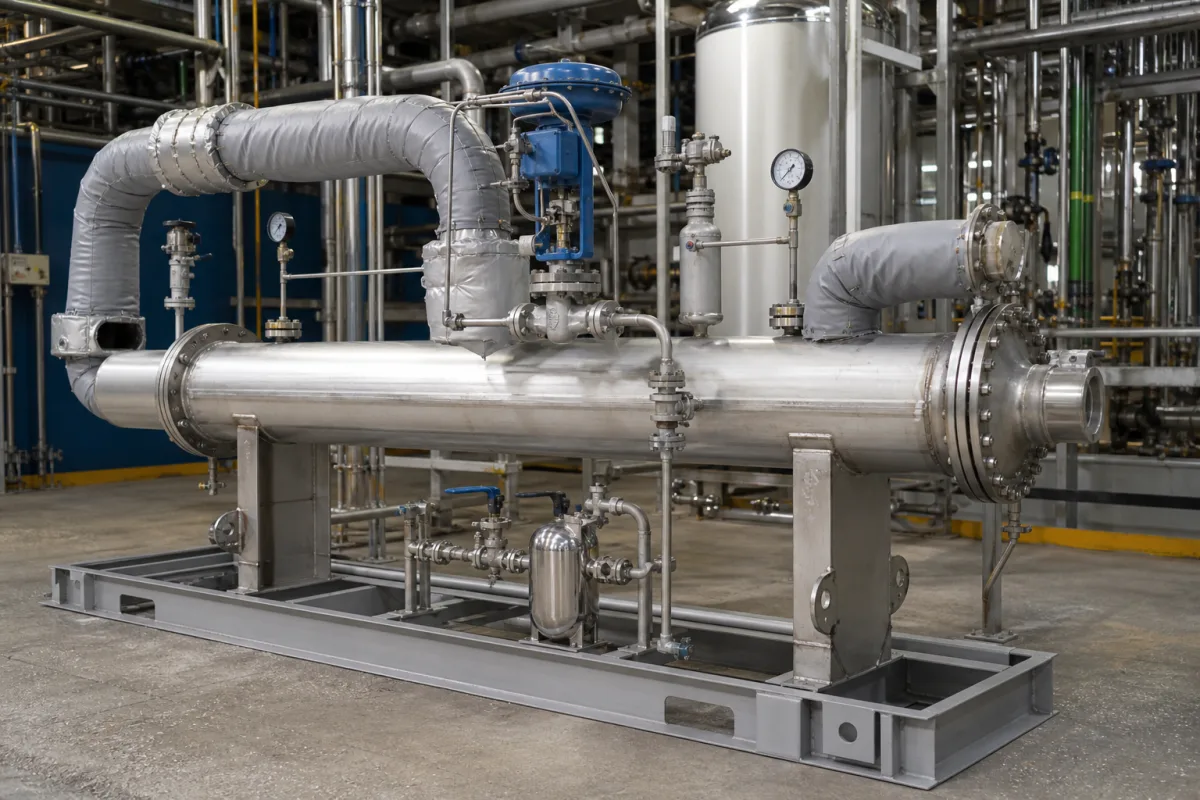
A canonical Feed Preheater is characterized by the integration of Heat Exchanger Core and Insulation Jacket. In industrial production environments, manufacturers listed on CNFX commonly emphasize Stainless Steel construction to support stable, high-cycle operation across diverse manufacturing scenarios.

A component that raises the temperature of incoming material before it enters the main processing stage of an industrial system.
Product Specifications

Technical details and manufacturing context for Feed Preheater

Definition
The Feed Preheater is a critical component within an Industrial System designed to elevate the temperature of raw or intermediate feed material. Its primary role is to prepare the material thermally, ensuring it meets the optimal temperature requirements for subsequent processing stages, thereby improving overall system efficiency, reaction kinetics, product quality, and energy consumption.
Working Principle
The Feed Preheater physically functions by transferring thermal energy from a heat source (e.g., hot gases, steam, electrical elements, or thermal fluid) to the incoming feed material. This is typically achieved through direct contact (e.g., mixing with hot gases) or indirect contact (e.g., flow through jacketed pipes, shell-and-tube heat exchangers, or plate heat exchangers). The material absorbs heat as it passes through the preheater, increasing its temperature to a predetermined setpoint before being discharged into the next stage of the Industrial System.
Common Materials
Stainless Steel, Carbon Steel
Technical Parameters
  • The target outlet temperature of the material after preheating. (°C) Customizable
Components / BOM
  • Heat Exchanger Core
    The primary surface area where thermal energy is transferred from the heating medium to the feed material.
    Material: Stainless Steel Tubes/Plates
  • Insulation Jacket
    Minimizes thermal losses to the environment, improving energy efficiency.
    Material: Mineral Wool or Ceramic Fiber
  • Temperature Sensor
    Monitors the outlet temperature of the preheated material for process control.
    Material: Stainless Steel Housing with Thermocouple
Engineering Reasoning
150-450°C, 0.1-2.5 MPa
Material yield strength at 500°C: 185 MPa for 316L stainless steel
Design Rationale: Thermal fatigue from cyclic heating (ΔT=300°C) exceeding material endurance limit (σ_e=140 MPa at 10^6 cycles)
Risk Mitigation (FMEA)
Trigger Scale deposition exceeding 5 mm thickness (CaCO₃, SiO₂)
Mode: Heat transfer coefficient reduction from 500 to 150 W/m²·K
Strategy: Integrated ultrasonic descaling system with 40 kHz transducers
Trigger Thermal shock from 50°C/min heating rate
Mode: Tube wall cracking at stress concentration factor K_t=3.2 locations
Strategy: Gradual heating control with maximum 15°C/min ramp rate

Industry Taxonomies & Aliases

Commonly used trade names and technical identifiers for Feed Preheater.

Applied To / Applications

This component is essential for the following industrial systems and equipment:

Industrial Ecosystem & Supply Chain DNA

Complementary Systems
Downstream Applications
Specialized Tooling

Application Fit & Sizing Matrix

Operational Limits
pressure: Up to 25 bar (standard), high-pressure variants up to 100 bar
flow rate: 0.5-500 m³/h (liquid), 100-50,000 Nm³/h (gas)
temperature: Up to 400°C (typical), custom designs up to 650°C
slurry concentration: Up to 60% solids by weight, particle size <5mm
Media Compatibility
✓ Process water/steam ✓ Hydrocarbon liquids (crude oil, naphtha) ✓ Industrial gases (air, nitrogen, CO2)
Unsuitable: Highly corrosive media (e.g., concentrated acids, chlorine gas) without specialized lining
Sizing Data Required
  • Required thermal duty (kW)
  • Inlet/outlet temperature differential (°C)
  • Media physical properties (density, viscosity, specific heat)

Reliability & Engineering Risk Analysis

Failure Mode & Root Cause
Thermal stress cracking
Cause: Rapid temperature cycling from frequent startups/shutdowns or uneven heating, leading to material fatigue and crack propagation in heat exchanger tubes or refractory linings.
Fouling and scaling
Cause: Accumulation of process deposits (e.g., salts, carbon, ash) on heat transfer surfaces, reducing efficiency and causing localized overheating or flow restriction.
Maintenance Indicators
  • Abnormal temperature differentials across the preheater (indicating reduced heat transfer efficiency)
  • Unusual vibrations or audible knocking from thermal expansion issues or internal component failure
Engineering Tips
  • Implement controlled heating/cooling rates during startups and shutdowns to minimize thermal shock, using automated ramp controls where possible.
  • Establish regular chemical cleaning or mechanical descaling protocols based on feed analysis, combined with inline monitoring of pressure drop and temperature profiles.

Compliance & Manufacturing Standards

Reference Standards
ISO 9001:2015 - Quality Management Systems ASME BPVC Section VIII - Pressure Vessels EN 13445 - Unfired Pressure Vessels
Manufacturing Precision
  • Wall Thickness: +/-2% of nominal thickness
  • Nozzle Alignment: +/-1.5° from design axis
Quality Inspection
  • Hydrostatic Pressure Test
  • Radiographic Testing (RT) of Welds

Factories Producing Feed Preheater

Verified manufacturers with capability to produce this product in China

✓ 96% Supplier Capability Match Found

S Sourcing Manager from Australia Jan 24, 2026
★★★★★
"Reliable performance in harsh Chemical Manufacturing environments. No issues with the Feed Preheater so far."
Technical Specifications Verified
P Procurement Specialist from Singapore Jan 21, 2026
★★★★☆
"Testing the Feed Preheater now; the technical reliability results are within 1% of the laboratory datasheet. (Delivery took slightly longer than expected, but technical support was excellent.)"
Technical Specifications Verified
T Technical Director from Germany Jan 18, 2026
★★★★★
"Impressive build quality. Especially the technical reliability is very stable during long-term operation."
Technical Specifications Verified
Verification Protocol

“Feedback is collected from verified sourcing managers during RFQ (Request for Quote) and factory evaluation processes on CNFX. These reports represent historical performance data and technical audit summaries from our B2B manufacturing network.”

14 sourcing managers are analyzing this specification now. Last inquiry for Feed Preheater from Vietnam (1h ago).

Supply Chain Commonly Integrated Components

Reaction Module

A modular unit within a continuous flow pharmaceutical reactor where chemical reactions occur under controlled conditions.

Explore Specs →
Temperature Control Unit

A precision thermal management component that regulates and maintains specific temperature conditions within a continuous flow pharmaceutical reactor system.

Explore Specs →
Process Analytics

Real-time monitoring and analysis system for pharmaceutical manufacturing processes

Explore Specs →
Dust Containment System

A safety and environmental control system designed to capture, contain, and prevent the escape of airborne pharmaceutical powder particles during blending operations.

Explore Specs →

Frequently Asked Questions

What are the main benefits of using a feed preheater in chemical manufacturing?

Feed preheaters improve process efficiency by raising incoming material temperature before main processing, reducing energy consumption in downstream stages, enhancing reaction rates, and preventing thermal shock to equipment.

How do I choose between stainless steel and carbon steel construction for a feed preheater?

Stainless steel offers superior corrosion resistance for aggressive chemical environments, while carbon steel provides cost-effective durability for less corrosive applications. Material selection depends on process chemistry, temperature requirements, and budget considerations.

What maintenance is required for feed preheater components like the heat exchanger core and insulation jacket?

Regular inspection for fouling or scaling in the heat exchanger core, checking insulation integrity for thermal efficiency, and calibrating temperature sensors annually. Cleaning schedules depend on process materials and operating conditions.

Can I contact factories directly on CNFX?

CNFX is an open directory, not a transaction platform. Each factory profile provides direct contact information and production details to help you initiate direct inquiries with Chinese suppliers.

Get Quote for Feed Preheater

Request technical pricing, lead times, or customized specifications for Feed Preheater directly from verified manufacturing units.

Your business information is encrypted and only shared with verified Feed Preheater suppliers.

Thank you! Your message has been sent. We'll respond within 1–3 business days.

Need to Manufacture Feed Preheater?

Connect with verified factories specializing in this product category

Add Your Factory Contact Us
Previous Product
Exhaust Fan
Next Product
Feed Pump