Industry-Verified Manufacturing Data (2026)

Reboiler

Based on aggregated insights from multiple verified factory profiles within the CNFX directory, the standard Reboiler used in the Machinery and Equipment Manufacturing sector typically supports operational capacities ranging from standard industrial configurations to heavy-duty production requirements.

Technical Definition & Core Assembly

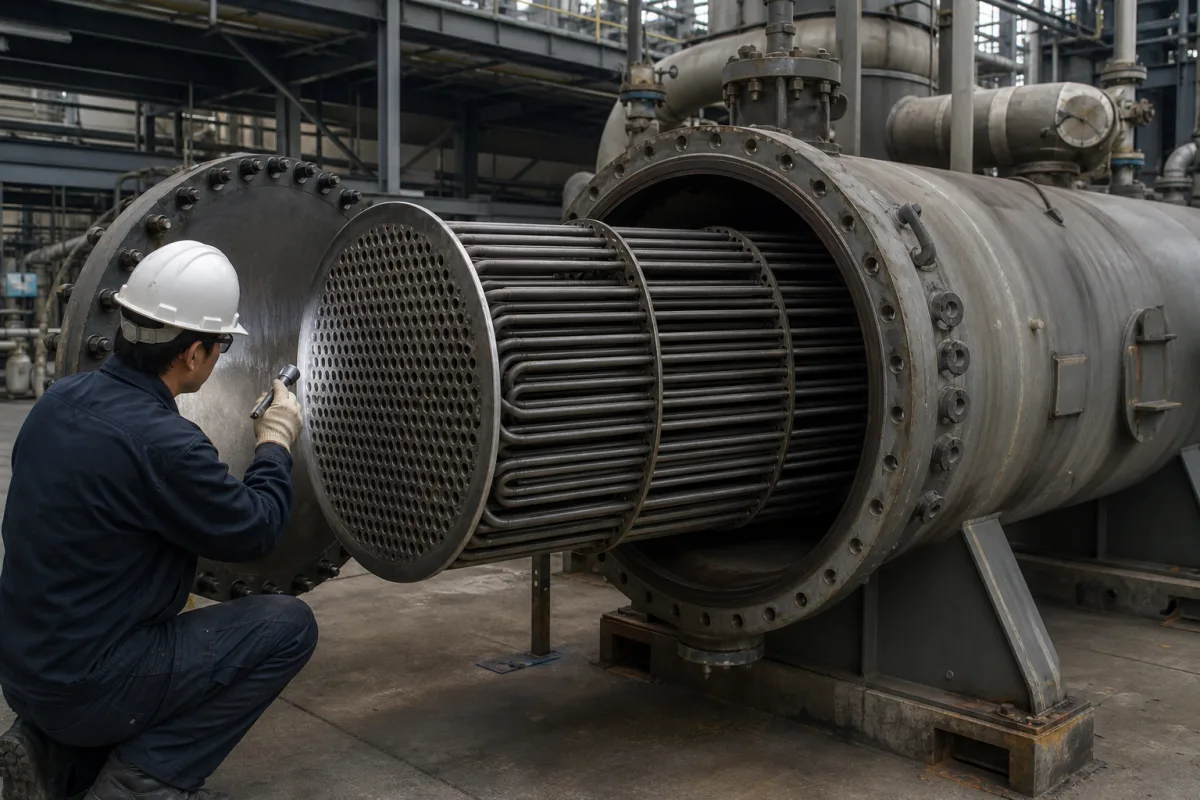
A canonical Reboiler is characterized by the integration of Tube Bundle and reinforced mechanical structures. In industrial production environments, manufacturers listed on CNFX commonly emphasize Carbon Steel construction to support stable, high-cycle operation across diverse manufacturing scenarios.

A heat exchanger component that provides the necessary heat to vaporize a portion of the liquid from the bottom of a distillation column or other separation process.
Product Specifications

Technical details and manufacturing context for Reboiler

Definition
Within an Industrial System, particularly in distillation and separation processes, the reboiler serves as a critical component that supplies thermal energy to the system. It receives liquid from the bottom of the column, applies heat to partially vaporize it, and returns the resulting vapor-liquid mixture to the column. This continuous vaporization provides the upward vapor flow essential for the mass transfer and separation occurring within the column, making the reboiler fundamental to the system's energy balance and operational stability.
Working Principle
The reboiler physically functions by transferring heat from a hot utility stream (e.g., steam, hot oil, or process fluid) to the colder column bottom liquid across a heat transfer surface. This heat input raises the liquid's temperature to its boiling point, causing a portion to vaporize. The generated vapor, along with the remaining liquid, is then separated and returned to the column. Common configurations include kettle-type (where boiling occurs in a shell-side pool) and thermosiphon-type (where natural circulation drives the liquid through tubes).
Common Materials
Carbon Steel, Stainless Steel
Technical Parameters
  • Heat transfer area of the reboiler (m²) Standard Spec
Components / BOM
  • Tube Bundle
    Provides the primary heat transfer surface where the heating medium flows and transfers energy to the process liquid.
    Material: Typically carbon steel or stainless steel tubes.
Engineering Reasoning
0.1-3.0 MPa (1-30 bar) at 150-350°C
Tube wall temperature exceeding 450°C for carbon steel or 550°C for stainless steel, causing creep rupture
Design Rationale: Thermal stress-induced creep deformation from Arrhenius equation kinetics: ε̇ = Aσⁿexp(-Q/RT), where Q=250 kJ/mol for carbon steel, leading to Larson-Miller parameter P = T(20+log t)×10⁻³ > 35 for failure
Risk Mitigation (FMEA)
Trigger Fouling accumulation exceeding 5 mm thickness with thermal conductivity λ=0.2 W/m·K
Mode: Heat transfer coefficient reduction from 500 to <100 W/m²·K, causing ΔT>100°C temperature gradient
Strategy: Installing online cleaning system with 0.5 MPa backflush every 72 hours using Reynolds number Re>10⁴ turbulent flow
Trigger Two-phase flow maldistribution creating vapor lock with void fraction α>0.8
Mode: Localized dryout causing heat flux exceeding critical heat flux CHF=1.2 MW/m²
Strategy: Implementing distributor plate with 5 mm orifice diameter maintaining Weber number We>30 for proper phase distribution

Industry Taxonomies & Aliases

Commonly used trade names and technical identifiers for Reboiler.

Applied To / Applications

This component is essential for the following industrial systems and equipment:

Industrial Ecosystem & Supply Chain DNA

Complementary Systems
Downstream Applications
Specialized Tooling

Application Fit & Sizing Matrix

Operational Limits
pressure: Standard designs up to 100 bar, high-pressure designs up to 300 bar
flow rate: Varies by design: kettle-type 5-500 m³/h, thermosiphon 10-1000 m³/h, forced circulation 20-2000 m³/h
temperature: Typically -50°C to 400°C, with specialized designs up to 600°C
slurry concentration: Limited to <5% solids for standard designs; specialized designs handle up to 30% solids with erosion-resistant materials
Media Compatibility
✓ Hydrocarbon processing (crude oil, naphtha, kerosene) ✓ Chemical processing (solvents, acids, bases) ✓ Refrigeration systems (ammonia, refrigerants)
Unsuitable: Highly corrosive environments with chlorides above 50 ppm at elevated temperatures (>200°C)
Sizing Data Required
  • Heat duty required (kW or BTU/hr)
  • Temperature difference between heating medium and process fluid (ΔT)
  • Process fluid properties (viscosity, specific heat, latent heat of vaporization)

Reliability & Engineering Risk Analysis

Failure Mode & Root Cause
Tube fouling/scaling
Cause: Accumulation of process deposits, corrosion products, or biological growth reducing heat transfer efficiency and increasing pressure drop
Tube wall thinning/corrosion
Cause: Chemical attack from process fluids, erosion-corrosion from high velocity flow, or galvanic corrosion in tube-to-tubesheet joints
Maintenance Indicators
  • Significant increase in differential pressure across reboiler (≥15% above design)
  • Audible water hammer or vibration noises during operation indicating improper drainage or steam trap failure
Engineering Tips
  • Implement regular tube-side chemical cleaning program based on fouling analysis and maintain proper water treatment for shell-side if steam heated
  • Install corrosion coupons/monitoring points at critical locations and consider upgrading to corrosion-resistant materials in high-wear areas

Compliance & Manufacturing Standards

Reference Standards
ISO 13706:2011 (Petroleum, petrochemical and natural gas industries - Air-cooled heat exchangers) ASME BPVC Section VIII (Boiler and Pressure Vessel Code) EN 13445 (Unfired pressure vessels)
Manufacturing Precision
  • Tube-to-tubesheet weld: Full penetration with no undercut exceeding 0.5mm
  • Flatness of tube sheet: 1.5mm per meter or 3mm overall, whichever is less
Quality Inspection
  • Hydrostatic Pressure Test (1.5 times design pressure for 30 minutes)
  • Radiographic Testing (RT) of critical welds

Factories Producing Reboiler

Verified manufacturers with capability to produce this product in China

✓ 94% Supplier Capability Match Found

T Technical Director from United Arab Emirates Jan 26, 2026
★★★★★
"The technical documentation for this Reboiler is very thorough, especially regarding technical reliability."
Technical Specifications Verified
P Project Engineer from Australia Jan 23, 2026
★★★★☆
"Reliable performance in harsh Machinery and Equipment Manufacturing environments. No issues with the Reboiler so far. (Delivery took slightly longer than expected, but technical support was excellent.)"
Technical Specifications Verified
S Sourcing Manager from Singapore Jan 20, 2026
★★★★★
"Testing the Reboiler now; the technical reliability results are within 1% of the laboratory datasheet."
Technical Specifications Verified
Verification Protocol

“Feedback is collected from verified sourcing managers during RFQ (Request for Quote) and factory evaluation processes on CNFX. These reports represent historical performance data and technical audit summaries from our B2B manufacturing network.”

12 sourcing managers are analyzing this specification now. Last inquiry for Reboiler from India (1h ago).

Supply Chain Commonly Integrated Components

Drive Motor

Electric motor that provides rotational power to drive the blending mechanism in pharmaceutical powder blending equipment

Explore Specs →
Vision System

An optical inspection subsystem that uses cameras, lighting, and image processing to detect defects in pharmaceutical vials.

Explore Specs →
Coating Pan

A rotating vessel used to apply uniform coating layers to pharmaceutical tablets through controlled spraying and drying processes.

Explore Specs →
Spray System

A precision fluid delivery subsystem that atomizes and applies coating solutions onto pharmaceutical tablets within an automated coating system.

Explore Specs →

Frequently Asked Questions

What is the primary function of a reboiler in industrial processes?

A reboiler provides the necessary heat to vaporize a portion of the liquid from the bottom of a distillation column or other separation process, enabling continuous operation and efficient separation of components.

What materials are commonly used for reboiler construction and why?

Reboilers are typically constructed from carbon steel for cost-effective general applications or stainless steel for corrosive environments. Both materials offer durability and efficient heat transfer properties suitable for industrial machinery manufacturing.

How does the tube bundle affect reboiler performance?

The tube bundle is a critical BOM component that determines heat transfer efficiency. Proper tube bundle design maximizes surface area for heat exchange, ensuring optimal vaporization rates and energy efficiency in distillation and separation processes.

Can I contact factories directly on CNFX?

CNFX is an open directory, not a transaction platform. Each factory profile provides direct contact information and production details to help you initiate direct inquiries with Chinese suppliers.

Get Quote for Reboiler

Request technical pricing, lead times, or customized specifications for Reboiler directly from verified manufacturing units.

Your business information is encrypted and only shared with verified Reboiler suppliers.

Thank you! Your message has been sent. We'll respond within 1–3 business days.

Need to Manufacture Reboiler?

Connect with verified factories specializing in this product category

Add Your Factory Contact Us
Previous Product
Reading Head
Next Product
Receiver