Industry-Verified Manufacturing Data (2026)

Cooling Coils/Jacket

Based on aggregated insights from multiple verified factory profiles within the CNFX directory, the standard Cooling Coils/Jacket used in the Chemical Manufacturing sector typically supports operational capacities ranging from standard industrial configurations to heavy-duty production requirements.

Technical Definition & Core Assembly

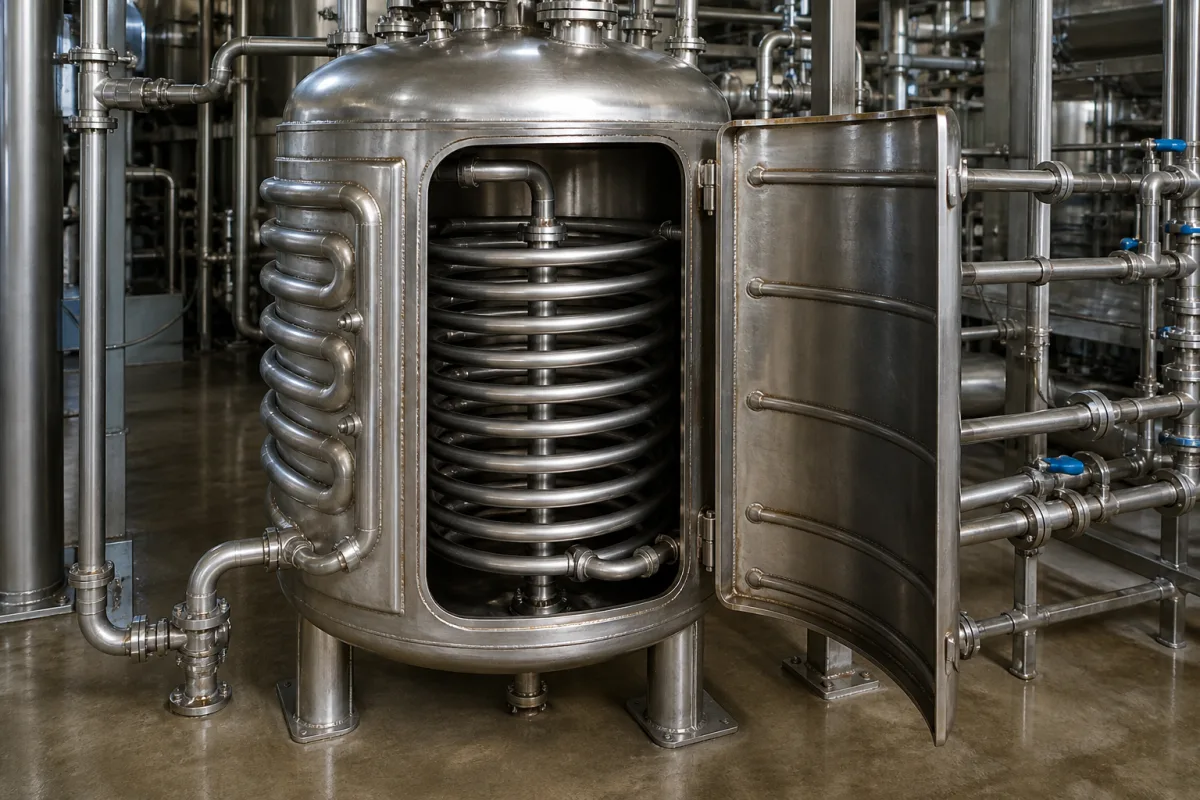
A canonical Cooling Coils/Jacket is characterized by the integration of Cooling Coil Tubes and Jacket Shell. In industrial production environments, manufacturers listed on CNFX commonly emphasize Stainless Steel 316L construction to support stable, high-cycle operation across diverse manufacturing scenarios.

Heat exchange component for temperature control in chemical reactors

Product Specifications

Technical details and manufacturing context for Cooling Coils/Jacket

Definition
A cooling coils/jacket is an integral heat exchange component of a neutralization reactor designed to remove excess heat generated during exothermic neutralization reactions. It maintains optimal reaction temperatures by circulating cooling fluids through coils or within a jacket surrounding the reactor vessel, ensuring process safety, product quality, and reaction efficiency.
Working Principle
Cooling fluid (typically water, glycol, or thermal oil) is circulated through coils immersed in the reactor contents or through an external jacket surrounding the reactor vessel. Heat from the exothermic neutralization reaction is transferred to the cooling fluid through conduction and convection, maintaining the reaction mixture within the desired temperature range.
Common Materials
Stainless Steel 316L, Hastelloy C-276, Titanium
Technical Parameters
  • Coil diameter and jacket thickness specifications (mm) Per Request
Components / BOM
  • Cooling Coil Tubes
    Primary heat exchange surface for fluid circulation
    Material: Stainless Steel 316L
  • Jacket Shell
    External enclosure for cooling fluid containment
    Material: Carbon Steel with corrosion-resistant lining
  • Inlet/Outlet Manifolds
    Distribution and collection of cooling fluid
    Material: Stainless Steel 304
Engineering Reasoning
0.5-15.0 bar differential pressure, -40°C to 250°C fluid temperature
18.5 bar differential pressure causing tube wall rupture, 280°C causing material yield strength reduction to 50% of design value
Design Rationale: Thermal fatigue from cyclic temperature gradients exceeding 150°C/min, stress corrosion cracking from chloride concentration >25 ppm at temperatures >60°C
Risk Mitigation (FMEA)
Trigger Coolant flow interruption for >120 seconds
Mode: Localized boiling and vapor lock formation in coil tubes
Strategy: Dual redundant coolant pumps with automatic switchover at 30% flow reduction
Trigger Scale accumulation exceeding 2.5 mm thickness on heat transfer surfaces
Mode: Thermal resistance increase causing 40% reduction in heat transfer coefficient
Strategy: Automated chemical cleaning system activated when ΔP increases by 1.8 bar from baseline

Industry Taxonomies & Aliases

Commonly used trade names and technical identifiers for Cooling Coils/Jacket.

Applied To / Applications

This component is essential for the following industrial systems and equipment:

Industrial Ecosystem & Supply Chain DNA

Complementary Systems
Downstream Applications
Specialized Tooling

Application Fit & Sizing Matrix

Operational Limits
pressure: Up to 10 bar (150 psi)
flow rate: 0.5 to 50 L/min per coil
temperature: -40°C to 200°C
slurry concentration: Up to 30% solids by weight
Media Compatibility
✓ Water-glycol mixtures ✓ Thermal oils (e.g., Dowtherm) ✓ Process fluids with pH 5-9
Unsuitable: Highly corrosive media (e.g., concentrated acids, strong oxidizers)
Sizing Data Required
  • Required heat transfer duty (kW)
  • Reactor volume and geometry
  • Inlet/outlet temperature differential of cooling media

Reliability & Engineering Risk Analysis

Failure Mode & Root Cause
Corrosion
Cause: Chemical attack from process fluids or atmospheric exposure, leading to material degradation and leaks, often accelerated by improper material selection or contamination.
Fouling
Cause: Accumulation of scale, debris, or biological growth on coil surfaces, reducing heat transfer efficiency and increasing pressure drop, typically due to poor water quality or inadequate filtration.
Maintenance Indicators
  • Visible leaks or moisture around coil connections or jackets indicating corrosion or seal failure
  • Abnormal temperature differentials or reduced cooling capacity signaling fouling or flow restriction
Engineering Tips
  • Implement regular water treatment and filtration to control scaling, corrosion, and biological growth, maintaining fluid quality within specified parameters
  • Establish predictive maintenance routines using infrared thermography and vibration analysis to detect early signs of fouling, corrosion, or mechanical stress before failure occurs

Compliance & Manufacturing Standards

Reference Standards
ISO 9001:2015 - Quality Management Systems ASME B31.3 - Process Piping EN 13445 - Unfired Pressure Vessels
Manufacturing Precision
  • Tube Wall Thickness: +/-0.1mm
  • Coil Pitch Variation: +/-2% of design specification
Quality Inspection
  • Hydrostatic Pressure Test (1.5x design pressure)
  • Helium Leak Test (for closed-loop systems)

Factories Producing Cooling Coils/Jacket

Verified manufacturers with capability to produce this product in China

✓ 93% Supplier Capability Match Found

T Technical Director from Germany Feb 15, 2026
★★★★★
"Standard OEM quality for Chemical Manufacturing applications. The Cooling Coils/Jacket arrived with full certification."
Technical Specifications Verified
P Project Engineer from Brazil Feb 12, 2026
★★★★☆
"Great transparency on the Cooling Coils/Jacket components. Essential for our Chemical Manufacturing supply chain. (Delivery took slightly longer than expected, but technical support was excellent.)"
Technical Specifications Verified
S Sourcing Manager from Canada Feb 09, 2026
★★★★★
"The Cooling Coils/Jacket we sourced perfectly fits our Chemical Manufacturing production line requirements."
Technical Specifications Verified
Verification Protocol

“Feedback is collected from verified sourcing managers during RFQ (Request for Quote) and factory evaluation processes on CNFX. These reports represent historical performance data and technical audit summaries from our B2B manufacturing network.”

10 sourcing managers are analyzing this specification now. Last inquiry for Cooling Coils/Jacket from India (1h ago).

Supply Chain Compatible Machinery & Devices

Automated Batch Crystallization System

Automated system for controlled crystallization of chemical compounds in batch processes.

Explore Specs →
Automated pH Monitoring and Dosing System

Automated system for continuous pH monitoring and chemical dosing in process streams.

Explore Specs →
Automated Powder Dispensing and Blending System

Automated system for precise dispensing and homogeneous blending of powdered chemicals.

Explore Specs →
Automated Solvent Recovery and Purification System

Automated system for recovering and purifying industrial solvents.

Explore Specs →

Frequently Asked Questions

What materials are best for cooling coils in corrosive chemical environments?

For highly corrosive environments in chemical manufacturing, Hastelloy C-276 offers superior resistance to chlorides and acids, while Titanium provides excellent performance against oxidizing agents. Stainless Steel 316L is cost-effective for moderate corrosion applications.

How do cooling jackets differ from cooling coils in chemical reactors?

Cooling jackets surround the reactor vessel exterior, providing uniform temperature control across the entire surface. Cooling coils are immersed directly in the reactor media, offering more efficient heat transfer but requiring more complex installation and maintenance.

What specifications should I consider when selecting cooling coils for chemical reactors?

Key specifications include material compatibility with your chemical process, heat transfer coefficient, pressure rating, temperature range, surface area, and connection types. Always consider corrosion resistance, thermal expansion, and cleanability requirements for your specific application.

Can I contact factories directly on CNFX?

CNFX is an open directory, not a transaction platform. Each factory profile provides direct contact information and production details to help you initiate direct inquiries with Chinese suppliers.

Get Quote for Cooling Coils/Jacket

Request technical pricing, lead times, or customized specifications for Cooling Coils/Jacket directly from verified manufacturing units.

Your business information is encrypted and only shared with verified Cooling Coils/Jacket suppliers.

Thank you! Your message has been sent. We'll respond within 1–3 business days.

Need to Manufacture Cooling Coils/Jacket?

Connect with verified factories specializing in this product category

Add Your Factory Contact Us
Previous Product
Conveyor or Robotic Arm
Next Product
Cooling Nozzle Array