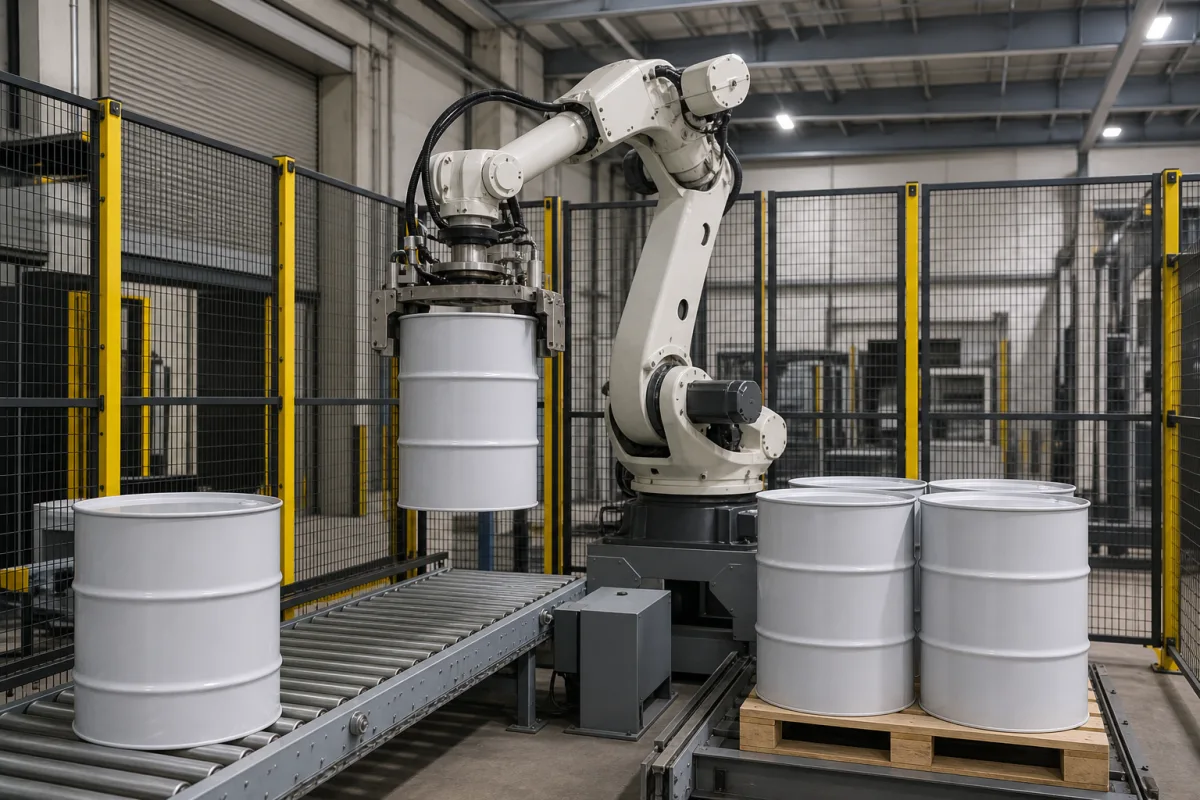
Conveyor and robotic arm cell for drums: a robot that takes steel drums off an infeed conveyor and builds them into pallet layers inside a guarded cell
Robotic drum palletizing cells · Drum infeed, orientation and spacing conveyors, layer-forming end-of-arm tools, pallet dispensing and exchange, and the fences, light curtains, door switches and reduced teaching speed that guard the robot
This page covers robotic palletizing cells for steel, plastic and fibre drums: an infeed conveyor that orients and spaces the drums, an industrial robot with an end-of-arm tool that picks one or more drums and builds pallet layers, pallet dispensing and exchange conveyors, and the guarding around the cell. Ask three things first: the drum weight and rim type the tool must hold, the drums per minute and layer pattern the cell must reach, and how people are kept out of the robot's space during automatic running and teaching.
Robotic palletizing cells for steel, plastic and fibre drums, including drum infeed and orientation conveyors, robots, drum end-of-arm tools, pallet dispensing and exchange conveyors and cell guarding. Conveyor systems and modular conveyor sections are covered on the Conveyor systems and Conveyor section pages, and drum filling scales on the Weighing platform for drum filling page. Manual drum handlers, robots sold alone and drum cleaning machines are outside this page.
CNFX editorial research · Sources checked October 12, 2026 · 3 sources
Drum infeed, orientation and layer forming in a 20-drums-per-minute cell
Modern Materials Handling describes a cell built by Lambert Material Handling for Greif's steel drum plant in Alsip, Illinois, which replaced manual palletizing of empty drums: a chain-driven live roller conveyor brings pallet stacks to a dispenser that separates single pallets, 20 drums per minute arrive from upstream at an orientation station that rotates and positions them for automatic filling by the end user, and the robot infeed spaces the drums before picking. When two drums are oriented and accumulated, the robot's vacuum end-of-arm tool picks and places four drums to form one layer; the full pallet leaves and an empty one enters in about 4 seconds. The article reports that the cell handles a variety of pallet and drum configurations and exceeds the required throughput at 75% capacity. [1]
Editorial calculation: at 20 drums per minute and four drums per layer, the robot completes one layer pick every 12 seconds on average, so a 4-second pallet exchange takes a third of one layer cycle. [1]
Give the supplier the drum types (steel, plastic, fibre), diameters and heights, empty and full weights, rim and closure type, drums per minute, pallet size and layer pattern, labelling or code reading, interlayer sheets, the space available and whether drums are full or empty.
02
Gripping the drum: vacuum tools on empty drums and rim jaws on full ones
The Greif cell palletizes empty drums with a vacuum end-of-arm tool. [1] For full drums, Morse describes its 825H drum handler-palletizer, a manual-handling counterpart, whose jaws grip the rim of steel, plastic or fibre drums mechanically and lift drums up to 800 lb (363 kg), powered by AC, battery or hand pump, with an on-board scale and a V-shaped base that straddles pallet corners over a 104 cm width. [3]
Editorial note: the robot's rated payload has to cover the heaviest full drum plus the mass of the gripper; ask the supplier for both figures, how the tool confirms a secure grip before lifting, and what happens to a drum held by vacuum or jaws if air or power fails.
03
Fences, light curtains, door switches and reduced speed while teaching
In the Greif cell, light curtains, safety-painted steel wire mesh fencing and Class 3 safety switches at the door openings keep people from the robot and ancillary equipment while it runs. [1] OSHA's technical manual chapter on industrial robots names ANSI/RIA R15.06-2012 as the safety standard for robots and robot systems, lists presence-sensing devices, fixed perimeter guards and interlocked barrier guards as safeguarding, states that the operator should never be exposed to hazards in automatic mode, and recommends robot speeds of 250 mm/s (10 in/s) or less during teaching. [2]
OSHA's chapter cites an incident in which a worker entered the restricted space of a material handling robot application during automatic operation and was pinned between the manipulator and a post, with inadequate perimeter guarding that did not cause a protective stop named as a possible cause. [2]
04
Send the drums, rate and cell layout together
Paste it into your enquiry below or into an email to a maker, then replace every bracket.
Drums: [type; size; empty and full weight; rim]
Rate: [drums per minute; shifts]
Pallets: [size; pattern; layers; interlayer sheets]
Tool: [vacuum or rim jaws; grip check]
Cell: [infeed; orientation; pallet dispensing; exchange]
Safety: [fencing; light curtains; door interlocks; standard]
Explore company information and manufacturing capabilities, then discuss the scope of your project with a relevant supplier.
Share this page
Compiled and source-reviewed by the CNFX editorial team.
Each manufacturer above links to the page on that company's own website where the product is listed, with the date we checked it. How we source and review
· Page last updated 13 October 2026
Buyer questions
How fast can a robot palletize drums?
One steel drum maker's cell, described by Modern Materials Handling, takes 20 drums per minute, places four per layer and changes pallets in about 4 seconds, exceeding its required throughput at 75% capacity. [1]
How heavy a drum can a rim gripper lift?
Morse's 825H drum handler grips the rim of steel, plastic or fibre drums and lifts up to 363 kg (800 lb); a robot tool must be rated for the full drum plus its own mass. [3]
How should a drum palletizing robot cell be guarded?
With fencing, light curtains and interlocked doors so no one is exposed in automatic mode; OSHA also recommends 250 mm/s or less during teaching, citing ANSI/RIA R15.06-2012. [1][2]
Sources and what still needs a direct check
Sources checked 2026-10-12. Modern Materials Handling reports one installed drum palletizing cell; OSHA's technical manual covers robot safeguarding; Morse describes its own drum handler.