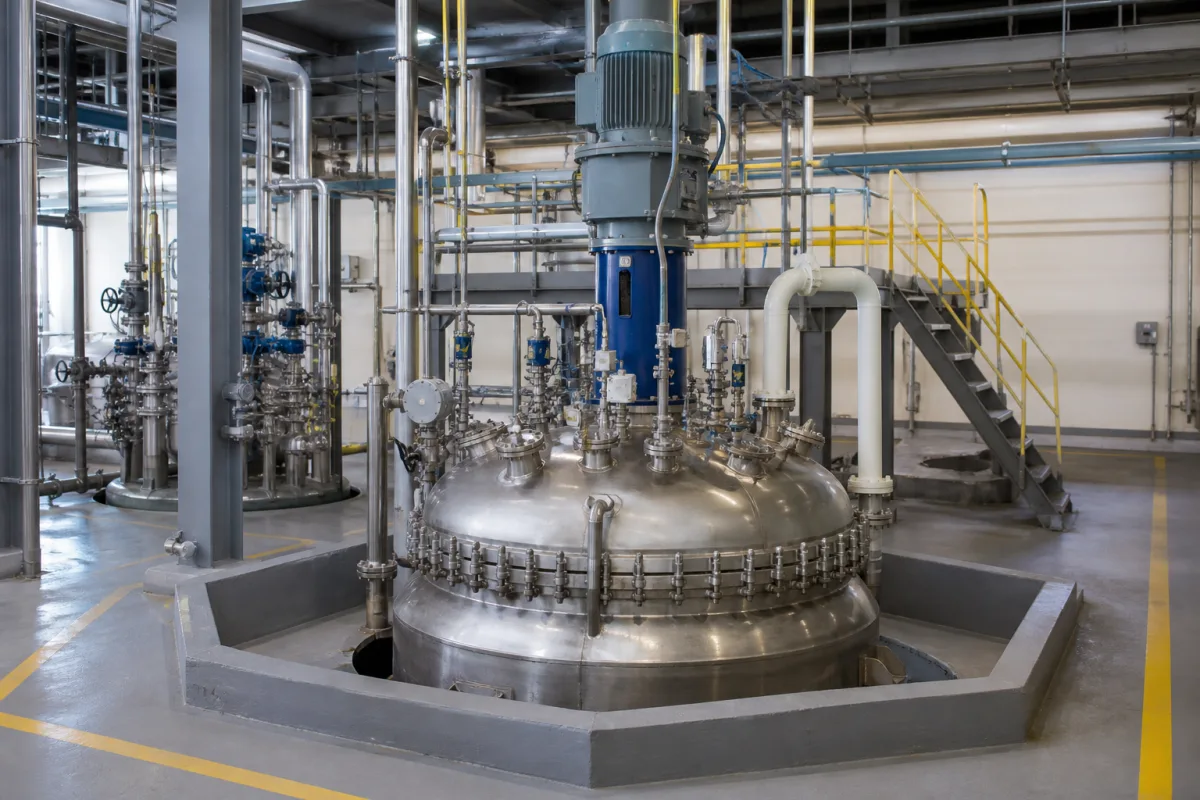
Neutralization reactor (caustic neutralizer for sulfonated and sulfated surfactant acids after an SO3 film reactor)
Neutralization reactors after SO3 sulfonation and sulfation · caustic loop or agitated neutralizer for LESA/SLES, AOS and sulfated alcohols, heat of neutralization, buffered pH, dioxane stripping under vacuum, pH measurement in hot caustic service
In a detergent raw-material plant the neutralization reactor sits straight after sulfonation or sulfation: the acid from the film reactor meets caustic soda (or ammonia) and water, gives off a lot of heat, and has to end up as a homogeneous paste at a stable pH. Specify which acid it handles, how the heat is taken out, how pH is held and measured, and whether dioxane and air have to be removed in the same step.
Neutralizers for the acid products of SO3 sulfonation and sulfation (LABSA, LESA for SLES, alpha olefin sulfonic acid, sulfated alcohols): caustic or ammonia neutralization loops and agitated neutralizer vessels with their coolers, homogenizers, buffer dosing, pH control, vacuum degassing and dioxane stripping. Ammonium nitrate neutralisers are covered on the Ammonium nitrate melt production and concentration system page; pH neutralization of chemical process and waste streams on the Industrial chemical neutralization system page; packaged pH dosing on the Automated pH monitoring and dosing system page.
CNFX editorial research · Sources checked October 12, 2026 · 3 sources
Edward Zhang of Phoenix Equipment describes the acid coming from a stainless multi-tube film reactor in which SO3 and the organic base flow co-current; the reaction is exothermic and the tube bundle sits in temperature-controlled cooling water. For SLES, "A LESA (type of acid) stream is neutralized in a loop where the reactor output is treated with a caustic soda solution" and then homogenized in a dedicated piece of equipment to a lump-free paste. For AOS, a hydrolysis step follows the caustic neutralization: the neutralized stream is heated to high temperature, homogenized and aged so that sultones convert to surfactant. [1]
Marcos Villela Barcza's course notes (in Portuguese) on a Ballestra falling-film plant list the steps as air drying, sulfur burning and SO3 production, sulfonation or sulfation, ageing and hydrolysis or neutralization, and off-gas treatment. They state that ageing and hydrolysis do not apply to sulfated compounds, which go to neutralization instead because the sulfated product is very unstable. [2]
The neutralizer Barcza describes is a simple tank with an agitator carrying multiple flat blades one above another; the sulfated product, sodium hydroxide (or ammonium hydroxide) and water run down the wall as a laminar film so the base reaches the acid evenly. [2]
Give the maker the acid (LABSA, LESA, alpha olefin sulfonic acid, sulfated alcohol), its flow and temperature from the film reactor, the base (caustic or ammonia) and its strength, the target active matter, and whether hydrolysis, buffering, dioxane removal and deaeration are in the scope.
02
Holding pH, removing heat and stripping dioxane
Barcza writes that the neutralization is accompanied by a buffer solution of phosphoric acid, citric acid and sodium bicarbonate to hold pH between 6.0 and 6.8 for the stability of the sulfated product, from an initial pH of about 13. Dioxane forms as a by-product; it is removed from the bottom of the neutralizer by vacuum drawn on the tank itself, which evaporates water and carries the dioxane with it, and the sodium or ammonium salt leaves with at most 50 ppm dioxane. [2]
Zhang states that "A special cooler is used to handle the significant amount of heat developing out of the neutralization reaction", followed by on-stream equipment and injections for colour adjustment, pH adjustment, deaeration and ageing. Deaeration takes place in a degasifier under vacuum; dioxane, where removed, is stripped from the paste in a vacuum film evaporator that deaerates at the same time. [1]
Item
What the sources describe
Source
Base
Caustic soda; sodium or ammonium hydroxide for sulfates.
Chemical Processing's Process Puzzler on a batch caustic neutralization whose pH 12-12.5 control loop failed, at about 55 °C, draws answers that apply to any neutralizer control. P. Hunter Vegas of Wunderlich Malec writes that temperature "will absolutely impact the pH reading", that "The typical life of a pH probe in clean service is about 12 months" while high temperature and high pH age probes much faster, and that for continuous neutralization two control valves, one with a flow coefficient about one-tenth of the other, with a valve position controller, "can work". [3]
GC Shah of Wood adds flush connections or self-cleaning probes for fouling, a titration curve, and attention to where caustic is added and where the probes sit so that the delay between a change in the incoming stream and the caustic response is short. [3]
Ask how pH is measured on the hot, viscous neutralized paste, how probes are cleaned and replaced, and how the caustic feed is split between start-up and normal flow.
04
Surfactant neutralizer order details
Paste it into your enquiry below or into an email to a maker, then replace every bracket.
Explore company information and manufacturing capabilities, then discuss the scope of your project with a relevant supplier.
Share this page
Compiled and source-reviewed by the CNFX editorial team.
Each manufacturer above links to the page on that company's own website where the product is listed, with the date we checked it. How we source and review
· Page last updated 13 October 2026
Buyer questions
Is this the same as a wastewater neutralization tank?
No. This reactor turns the acid from SO3 sulfonation or sulfation into a surfactant salt; pH neutralization of process and waste streams is on the Industrial chemical neutralization system page. [1][2]
Why does the neutralizer need a cooler?
Phoenix Equipment says a special cooler handles the significant heat developed by the neutralization reaction. [1]
What pH is the product held at?
Barcza's notes on a Ballestra plant give a buffered pH of 6.0-6.8 for sulfated product, from about 13 at the start. [2]
How is dioxane removed?
By vacuum, either on the neutralizer itself or in a vacuum film evaporator; Barcza gives at most 50 ppm in the product. [2][1]
Sources and what still needs a direct check
Sources checked 2026-10-12. Phoenix Equipment published a blog article on sulphonation plants; Marcos Villela Barcza's course notes describe a Ballestra sulfonation/sulfation plant; Chemical Processing published a Process Puzzler on caustic neutralization control.