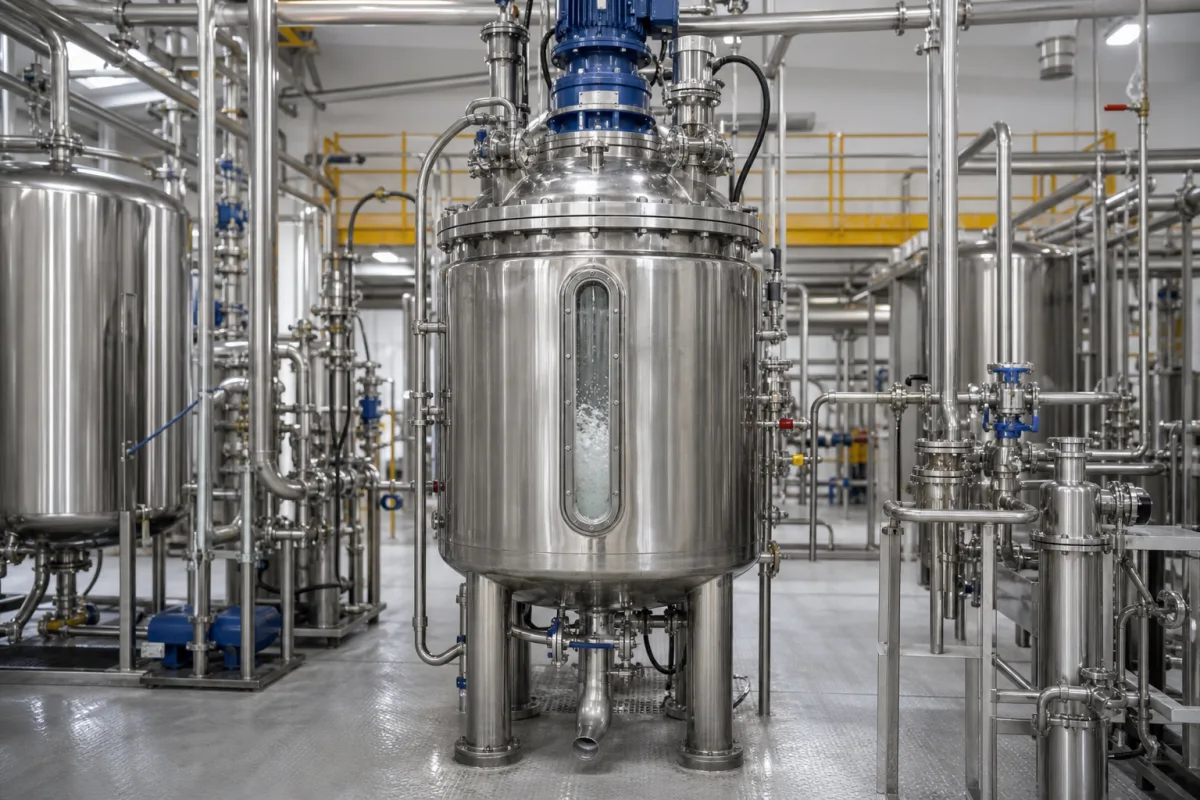
Sugar vacuum pan (boiling crystallization vessel): calandria geometry, circulation and massecuite head in batch and continuous pans
The sugar vacuum pan: a crystallization vessel that boils massecuite under vacuum through a tube calandria, where heating surface per cubic metre, tube diameter, circulation ratio and massecuite head decide how fast crystals grow
In a cane or beet sugar factory the crystallization vessel is the vacuum pan. Syrup or molasses is boiled under vacuum so that water evaporates at low temperature and sucrose crystallizes on seed grains, building up a dense mixture of crystals and mother liquor called massecuite. Heat comes from steam or vapour in a calandria of vertical tubes; the massecuite rises through the tubes as it boils and returns down a central downtake. How well it circulates — which depends on the vessel's geometry — governs evaporation, crystal growth and the purity drop achieved.
Vacuum pans for sugar boiling — batch pans with natural or mechanical circulation and multi-chamber continuous pans: calandria heating surface per volume, tube diameter and length, circulation ratio, graining volume, massecuite head and boiling temperature, and batch versus continuous performance. Continuous forced-circulation, draft-tube-baffle and OSLO crystallizers for chemicals are covered on the Industrial chemical crystallization unit page; jacketed stirred batch cooling crystallizers and their seeding and cooling recipes on the Automated batch cooling crystallizer page; jacketed stirred-tank reactors on the Chemical reactor (jacketed stirred tank) page.
CNFX editorial research · Sources checked October 12, 2026 · 3 sources
Calandria geometry: 5.8 m² of heating surface per m³, tube diameter and the circulation ratio
Rouillard's 1987 design study for the South African Sugar Technologists' Association names the factors that affect circulation: depth of massecuite above the tubes, tube length, tube diameter, the ratio of tube cross-section to downtake cross-section (the circulation ratio) and the ratio of heating surface to massecuite volume. It assumes a heating surface/volume ratio of 5.8 m⁻¹, the mean of South African batch pans at the time, and a graining volume of 35% for high-grade pans. [1] For those conditions it lists the tube length and the massecuite head above the upper tube plate:
Evaporation and circulation both improved with tube diameter, levelling off so that there was little to gain beyond 0.124 m tubes. Against the South African average — 0.098 m tubes and a circulation ratio of 2.8 — 0.124 m tubes at a ratio of 3.0 gave about 2% more evaporation and 20% more circulation. Evaporation fell as the circulation ratio rose from 2.0 to 4.0, while circulation peaked at a ratio of 3.5. [1]
For low-grade, high-viscosity strikes the study advises designing for a graining volume of about 40%, accepting that more cuttings are needed. [1] Sugarprocesstech's pan design notes give different working figures: a heating surface/volume ratio of 6.5–6.8 m²/m³ for batch pans and 9.5–10.5 m²/m³ for continuous pans when bled vapour is the heating medium; a circulation ratio ideally below 2.5; a downtake diameter not less than 0.4 times the pan diameter unless a stirrer is fitted; and stainless AISI 304 tubes of 100 mm diameter, 700–1,500 mm long. [3] Note the difference on circulation ratio: Rouillard cites about 2.0 as ideal but finds circulation peaking at 3.5 in his calculations. [1] Editorial note: graining volume, heating surface per volume and circulation ratio are fixed when the pan is built; state them in the enquiry together with the massecuite grade the pan will boil.
Specify strike volume, graining volume, heating surface and its ratio to volume, tube diameter and length, downtake area or circulation ratio, heating medium and pressure, and vacuum.
02
Massecuite head and temperature: 1.94 m above the tube plate, 108 °C boiling at the tube bottom
The head of massecuite above the calandria raises the boiling point lower down. For the recommended pan above, Rouillard calculates 1.94 m of massecuite above the upper tube plate; a low-head design with an expanded belt above the calandria would cut that to 1.63 m, lower the boiling temperature by 2.3 °C and add about 2% evaporation without changing circulation. [1]
In that pan the massecuite throughout the pan would be close to 60.7 °C, while the boiling point at the bottom of the tubes would be 108 °C and at the top 86 °C; only fluid next to the tube wall reaches boiling, and measurements cited in the paper found the temperature near the wall at the tube outlet up to 30 °C higher than at the centre. [1] Editorial calculation: 108 °C at the tube bottom is about 47 K above the 60.7 °C in the body of the pan, which is why the paper, citing earlier authors, stresses limiting boiling height to avoid overheating massecuite near the bottom of the tubes. Sugarprocesstech's design notes put the highest massecuite level above the top tube plate at around 1,000–1,200 mm in batch pans and 300–500 mm in continuous pans without a mechanical circulator, 200–300 mm higher with one, and note that circulation slows as the level reaches 1,000 mm. [3]
03
Batch pan or continuous VKT for C massecuite: the Providencia mill comparison
CENICAÑA and the Providencia mill in Colombia compared a BMA VKT continuous pan, installed in March 1998, with the mill's batch pans for C massecuite. [2]
The authors report seven additional points of apparent purity drop and 1.2 kg more sucrose recovered per tonne of cane, and an overall energy use 30% lower for the continuous pan including stirrer motors, which let it boil on vapour at 600 mbar from the second evaporator effect; the batch pan gave the narrower crystal size distribution. [2]
Editorial calculation: 1,460 m² over 183 m³ is about 8.0 m² per m³ for the VKT; assuming the 215 m² pan is the 34 m³ one and the 346 m² pan the 51 m³ one (the paper lists them in that order), the batch pans have about 6.3 and 6.8 m² per m³, against the 5.8 m⁻¹ South African batch-pan mean used by Rouillard [1] and the 6.5–6.8 m²/m³ batch and 9.5–10.5 m²/m³ continuous ranges in Sugarprocesstech's notes. [3] The steam ratios 1.10 and 1.57 differ by 30%, matching the energy saving the authors give.
For a continuous pan ask for chamber count and volume, stirrer speed range, residence time at rated output, heating surface per chamber and the vapour pressure it is designed for; for a batch pan, cycle time and graining volume.
04
What to send for a sugar vacuum pan
Paste it into your enquiry below or into an email to a maker, then replace every bracket.
Duty: [A, B or C massecuite; t/h or strikes per day; refinery or raw house]
Type: [batch natural circulation / batch with mechanical circulator / continuous multi-chamber]
Volume: [strike or working volume; graining volume]
Calandria: [heating surface; m²/m³; tube diameter and length; circulation ratio]
Heating: [steam or vapour; pressure; vacuum]
Head: [massecuite height above tube plate; low-head design]
Controls: [Brix or conductivity control; seed and feed system]
Explore company information and manufacturing capabilities, then discuss the scope of your project with a relevant supplier.
Share this page
Compiled and source-reviewed by the CNFX editorial team.
Each manufacturer above links to the page on that company's own website where the product is listed, with the date we checked it. How we source and review
· Page last updated 13 October 2026
Buyer questions
What heating surface does a batch vacuum pan have?
Rouillard's SASTA study used 5.8 m² per m³, the South African batch-pan mean; Providencia's VKT continuous pan works out at about 8 m² per m³ (editorial calculation from its data). [1][2]
Which tube diameter and circulation ratio?
In the study, 0.124 m tubes at a circulation ratio of 3.0 gave about 20% more circulation and 2% more evaporation than 0.098 m tubes at 2.8; little was gained above 0.124 m. [1]
Why limit massecuite head?
Head raises the boiling point at the tube bottom: 108 °C there against about 60.7 °C in the body of the pan studied; a low-head design cut head from 1.94 to 1.63 m. [1]
Is a continuous pan more efficient than batch pans?
At Providencia the BMA VKT used 30% less energy on C massecuite and gave 32% exit molasses purity against 41% in the batch pan, with a wider crystal size spread. [2]
Sources and what still needs a direct check
Sources checked 2026-10-12. Pan geometry, circulation, head and temperature figures come from Rouillard's 1987 SASTA paper on batch and continuous pan design; current design ranges for heating surface, massecuite level, downtake and tubes from Sugarprocesstech's vacuum pan design notes; the batch-versus-continuous comparison from CENICAÑA and the Providencia mill's evaluation of a BMA VKT.