Industry-Verified Manufacturing Data (2026)

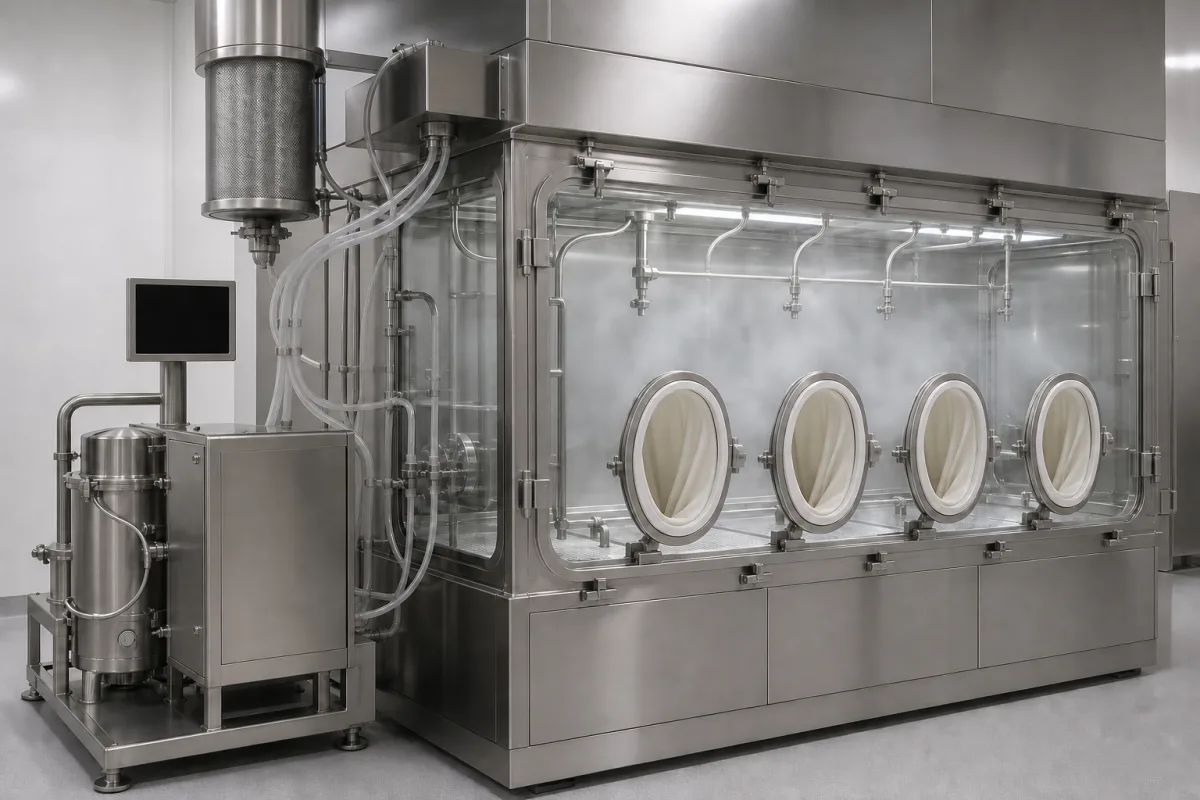
Decontamination System (Isolator)

Based on aggregated insights from multiple verified factory profiles within the CNFX directory, the standard Decontamination System (Isolator) used in the Chemical Manufacturing sector typically supports operational capacities ranging from standard industrial configurations to heavy-duty production requirements.

Technical Definition & Core Assembly

A canonical Decontamination System (Isolator) is characterized by the integration of Vaporizer/Generator and Distribution System (Nozzles/Ducts). In industrial production environments, manufacturers listed on CNFX commonly emphasize Stainless Steel (316L) construction to support stable, high-cycle operation across diverse manufacturing scenarios.

A specialized system integrated within an isolator or RABS to eliminate or reduce microbial contamination from surfaces, equipment, or the internal environment.
Product Specifications

Technical details and manufacturing context for Decontamination System (Isolator)

Definition
The Decontamination System (Isolator) is a critical component of an Aseptic Barrier (Isolator/RABS) designed to achieve and maintain a sterile or aseptic internal environment. Its primary role is to decontaminate the isolator's interior, including all internal surfaces, tools, and materials, before and during aseptic processing operations. It functions as the core sterilization or sanitization mechanism that enables the isolator to act as a physical barrier, protecting the product from external contaminants and the operator from hazardous substances.
Working Principle
The system typically operates by generating and circulating a decontaminating agent (e.g., vaporized hydrogen peroxide - VHP, peracetic acid, or chlorine dioxide) throughout the sealed isolator chamber. A controlled cycle involves phases of conditioning (preparing the environment), gassing (introducing and maintaining the agent at a specified concentration), and aeration (removing the agent to safe levels). The process is automated and validated to ensure a defined log reduction of biological indicators.
Common Materials
Stainless Steel (316L), PTFE (Seals/Gaskets), Quartz (for UV-C systems), High-grade Plastics (for specific components)
Technical Parameters
  • Biological efficacy, typically a 6-log reduction of Geobacillus stearothermophilus spores. (log reduction) Standard Spec
Components / BOM
  • Vaporizer/Generator
    Converts the liquid decontaminant (e.g., hydrogen peroxide solution) into a vapor or aerosol for distribution.
    Material: Stainless Steel, PTFE
  • Distribution System (Nozzles/Ducts)
    Ensures even distribution and circulation of the decontaminating agent throughout the entire isolator chamber.
    Material: Stainless Steel
  • Concentration Sensor
    Monitors and controls the real-time concentration of the decontaminating agent during the cycle.
    Material: Stainless Steel, Sensor-specific materials
  • Aeration Unit (Blower/Filter)
    Provides high-efficiency particulate air (HEPA) filtered air exchange to remove the decontaminant after the gassing phase.
    Material: Stainless Steel, HEPA filter media
Engineering Reasoning
0.5-2.0 bar differential pressure, 20-80°C temperature, 70-95% relative humidity
3.5 bar differential pressure causing isolator seal rupture, 120°C thermal degradation of HEPA filters, <60% RH compromising decontamination efficacy
Design Rationale: Seal failure due to elastomer yield strength exceeding 3.5 MPa, HEPA filter media thermal degradation above 120°C, insufficient vapor phase hydrogen peroxide concentration below 60% RH
Risk Mitigation (FMEA)
Trigger Vaporized hydrogen peroxide concentration exceeding 1500 ppm
Mode: Catalytic converter saturation and bypass valve failure
Strategy: Dual-concentration sensors with 1000 ppm cutoff interlock and redundant catalytic converters
Trigger HEPA filter differential pressure exceeding 250 Pa
Mode: Filter media rupture and particulate breakthrough
Strategy: Pressure transducers with 200 Pa alarm threshold and automated filter integrity testing

Industry Taxonomies & Aliases

Commonly used trade names and technical identifiers for Decontamination System (Isolator).

Applied To / Applications

This component is essential for the following industrial systems and equipment:

Industrial Ecosystem & Supply Chain DNA

Complementary Systems
Downstream Applications
Specialized Tooling

Application Fit & Sizing Matrix

Operational Limits
pressure: Up to 2.5 bar (typical), with pressure differential control ±0.05 bar
flow rate: 10-100 m³/h (adjustable based on chamber volume)
cycle time: 30-120 minutes (including dwell and aeration phases)
temperature: Ambient to 80°C (operational), up to 121°C for sterilization cycles
slurry concentration: Not applicable (typically uses vaporized or aerosolized agents)
Media Compatibility
✓ Vaporized Hydrogen Peroxide (VHP) ✓ Peracetic Acid Mist ✓ Chlorine Dioxide Gas
Unsuitable: High particulate load environments (e.g., powder handling without pre-filtration)
Sizing Data Required
  • Isolator/RABS internal volume (m³)
  • Required log reduction (e.g., 6-log spore reduction)
  • Available utility connections (steam, compressed air, electrical)

Reliability & Engineering Risk Analysis

Failure Mode & Root Cause
Seal Degradation
Cause: Chemical attack from aggressive cleaning agents or process residues, leading to loss of containment integrity.
Filter Clogging
Cause: Accumulation of particulate matter or microbial growth, reducing airflow and compromising decontamination efficiency.
Maintenance Indicators
  • Unusual noise from blowers or fans indicating bearing wear or imbalance
  • Visible leaks or moisture around seals and gaskets
Engineering Tips
  • Implement routine integrity testing (e.g., pressure decay tests) to detect seal failures early before catastrophic breakdown.
  • Establish a preventive maintenance schedule for filter replacement based on differential pressure readings, not just time intervals.

Compliance & Manufacturing Standards

Reference Standards
ISO 14644-1: Cleanrooms and associated controlled environments ANSI/AAMI ST79: Comprehensive guide to steam sterilization and sterility assurance in health care facilities DIN EN 12469: Biotechnology - Performance criteria for microbiological safety cabinets
Manufacturing Precision
  • Leakage rate: ≤ 0.25% of volume per hour at 500 Pa test pressure
  • HEPA filter efficiency: ≥ 99.99% for particles ≥ 0.3 μm
Quality Inspection
  • HEPA Filter Integrity Test (DOP/PAO challenge)
  • Pressure Decay Leak Test

Factories Producing Decontamination System (Isolator)

Verified manufacturers with capability to produce this product in China

✓ 93% Supplier Capability Match Found

T Technical Director from Germany Feb 07, 2026
★★★★★
"The technical documentation for this Decontamination System (Isolator) is very thorough, especially regarding technical reliability."
Technical Specifications Verified
P Project Engineer from Brazil Feb 04, 2026
★★★★☆
"Reliable performance in harsh Chemical Manufacturing environments. No issues with the Decontamination System (Isolator) so far. (Delivery took slightly longer than expected, but technical support was excellent.)"
Technical Specifications Verified
S Sourcing Manager from Canada Feb 01, 2026
★★★★★
"Testing the Decontamination System (Isolator) now; the technical reliability results are within 1% of the laboratory datasheet."
Technical Specifications Verified
Verification Protocol

“Feedback is collected from verified sourcing managers during RFQ (Request for Quote) and factory evaluation processes on CNFX. These reports represent historical performance data and technical audit summaries from our B2B manufacturing network.”

16 sourcing managers are analyzing this specification now. Last inquiry for Decontamination System (Isolator) from Germany (1h ago).

Supply Chain Compatible Machinery & Devices

Modular Distillation Column System

Pre-engineered modular system for continuous separation of chemical mixtures via distillation.

Explore Specs →
Automated Batch Crystallization System

Automated system for controlled crystallization of chemical compounds in batch processes.

Explore Specs →
Automated pH Monitoring and Dosing System

Automated system for continuous pH monitoring and chemical dosing in process streams.

Explore Specs →
Automated Powder Dispensing and Blending System

Automated system for precise dispensing and homogeneous blending of powdered chemicals.

Explore Specs →

Frequently Asked Questions

What types of decontamination agents does this system work with?

This decontamination system is compatible with common vapor-phase agents like hydrogen peroxide (VHP) and chlorine dioxide, which are effective for microbial reduction in chemical manufacturing environments.

How does the concentration sensor ensure effective decontamination?

The integrated concentration sensor continuously monitors agent levels during the cycle, ensuring optimal distribution and contact time to achieve validated log reduction of microbial contaminants.

What maintenance is required for the stainless steel components?

The 316L stainless steel construction requires minimal maintenance - regular visual inspections and cleaning with compatible agents to prevent corrosion and maintain surface integrity.

Can I contact factories directly on CNFX?

CNFX is an open directory, not a transaction platform. Each factory profile provides direct contact information and production details to help you initiate direct inquiries with Chinese suppliers.

Get Quote for Decontamination System (Isolator)

Request technical pricing, lead times, or customized specifications for Decontamination System (Isolator) directly from verified manufacturing units.

Your business information is encrypted and only shared with verified Decontamination System (Isolator) suppliers.

Thank you! Your message has been sent. We'll respond within 1–3 business days.

Need to Manufacture Decontamination System (Isolator)?

Connect with verified factories specializing in this product category

Add Your Factory Contact Us
Previous Product
Crystallization Vessel
Next Product
Demister