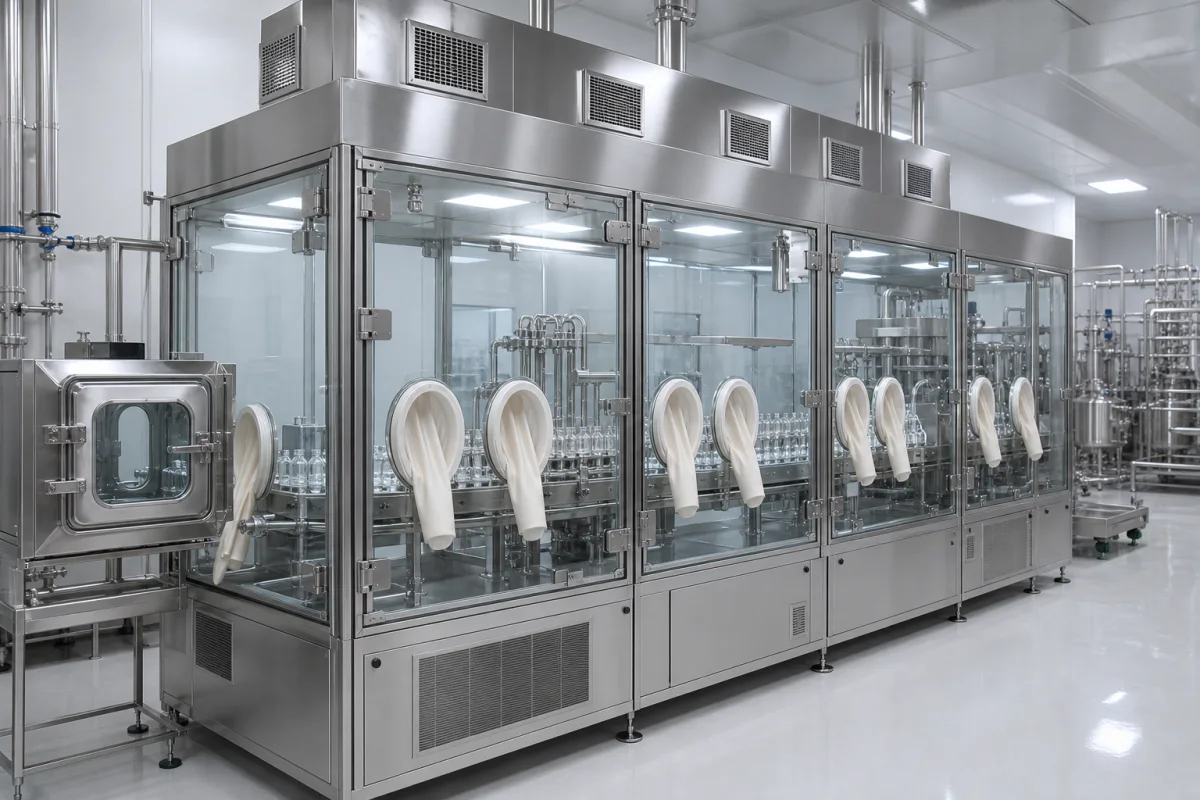
Barrier systems for aseptic filling · Isolators (open and closed) versus restricted access barrier systems (RABS), airflow and pressure, background cleanroom grades, gloves and glove testing, transfer ports and mouseholes, and decontamination
An aseptic barrier separates the operators and the surrounding room from the sterile product during aseptic filling. An isolator is a sealed or nearly sealed enclosure kept at overpressure and decontaminated before use; a restricted access barrier system (RABS) is a rigid barrier with glove ports around a line in a cleanroom, with sterile air flowing out from the critical zone. Ask three things first: whether your process needs an isolator or a RABS, what airflow, pressure and background room grade the design assumes, and how gloves, transfers and decontamination are controlled and tested.
Isolators (open, closed, positive and negative pressure) and restricted access barrier systems for aseptic processing of sterile medicinal products, including glove systems, transfer ports and bio-decontamination equipment, supplied alone or around filling machines. Filling machines themselves (see aseptic filling machine), biosafety cabinets, laboratory glove boxes and cleanroom construction are outside this page except where compared.
CNFX editorial research · Sources checked October 12, 2026 · 4 sources
Choose isolator or RABS and set airflow and background
FDA's guidance Sterile Drug Products Produced by Aseptic Processing (2004) says isolation systems separate the external cleanroom from the aseptic line and minimise personnel exposure; a well-designed positive pressure isolator offers fewer opportunities for contamination than traditional processing. Isolators are open or closed: closed isolators connect to auxiliary equipment for transfers, while open isolators have openings engineered to keep the inside separate by overpressure. Turbulent flow can be acceptable in compact closed isolators that do not house processing lines; others use unidirectional airflow that sweeps over and away from exposed sterile materials. Positive pressure differentials have ranged from about 17.5 to 50 Pa (0.07–0.20 in water gauge); the interior should meet Class 100 (ISO 5), and FDA cites a Class 100,000 (ISO 8) background; an isolator should not be in an unclassified room. FDA describes rigid stainless steel and glass construction. [1]
EU GMP Annex 1 (2022) states that RABS and isolators reduce contamination from direct human intervention in the critical zone and that alternatives must be justified. Isolators and RABS are different technologies, both designed to separate the grade A environment from the room. Open isolators and RABS need grade A with first air protection and unidirectional airflow over exposed product; closed isolators need grade A protection but may not have fully unidirectional flow for simple operations; negative pressure isolators only where containment is essential. The background should be at least grade C for open isolators, grade D for closed isolators and grade B for RABS, with airflow pattern studies showing no air ingress. [2]
Editorial note: tell the supplier which regulatory framework applies, the products and process, and the background room grade you can provide, since these decide whether an isolator or RABS fits.
Give the supplier the product and process (filling, stoppering, lyophilisation loading), the filling machine it surrounds, isolator or RABS and open or closed design, airflow and pressure set points, background cleanroom grade, number and positions of glove ports, glove material and integrity test method, transfer devices (rapid transfer ports, mouseholes), bio-decontamination method and cycle, environmental monitoring, cleaning, and the qualification documents required.
02
Control gloves, transfers and decontamination
FDA says no isolator forms an absolute seal, and a leak in some components can breach integrity; gloves, half-suits and seams need daily attention and a preventive maintenance programme with written replacement frequencies, and gloves should be visually checked with every use and physically tested at set intervals. Rapid transfer ports are an effective transfer mechanism, but some ports have marginal decontamination (for example ultraviolet) or let room air in and need local HEPA unidirectional airflow; a mousehole or other exit port needs continuously monitored overpressure. Decontamination must expose all isolator surfaces to the agent. [1]
Annex 1 requires glove system materials for both isolators and RABS to have appropriate mechanical and chemical resistance, with replacement frequency defined in the contamination control strategy; for isolators, glove leak testing at defined intervals, at least at the beginning and end of each batch or campaign, plus visual inspection with each use. [2]
Editorial calculation: the FDA range of 17.5–50 Pa is 0.0175–0.05 kPa; ask the supplier to show the alarm and interlock settings that keep the isolator above your chosen minimum during door, port and mousehole events. [1]
One maker's isolator description shows how these requirements turn into hardware. Esco Lifesciences describes its OxAP isolator as a positive-pressure unit with Grade A (ISO 5) unidirectional airflow inside the main chamber, a 3.0 mm SS316L fully welded work chamber with rounded corners, a four-glove main chamber with a non-gloved transfer chamber, H14 HEPA filtration on supply and exhaust, inflatable door seals, and a bag-out port with SART and RTP integration. Decontamination is by nebulized hydrogen peroxide, which Esco says achieves a 6-log reduction, with catalytic converters on every chamber exhaust and on the recirculation loop. Pressure integrity testing is automated and performed in accordance with ISO 14644-7, with a Class 3 rating per ISO 10648-2; temperature and humidity sensors are standard, a wireless glove leak tester is optional, and a 15-inch HMI/PLC handles control and data logging. [4]
Editorial note: when comparing quotes, ask each supplier for the leak-tightness class it guarantees under ISO 10648-2 and the test method, the log reduction its decontamination cycle achieves on biological indicators and the cycle time, and whether glove leak testing is built in, since Annex 1 asks for glove tests at least at the beginning and end of each batch or campaign. [4][2]
03
Set background grade and monitoring limits from WHO GMP
WHO's Good manufacturing practices for sterile pharmaceutical products (Technical Report Series No. 961, Annex 6, 2011) states that isolator technology can significantly decrease the risk of microbial contamination from the environment, that transfer of materials in and out is one of the greatest potential sources of contamination, and that the background environment for an isolator used in aseptic processing should be at least Grade D. It asks for validation covering air quality inside and outside the isolator, sanitisation, transfer and integrity, and for monitoring that includes frequent leak testing of the isolator and glove/sleeve system. [3]
The annex also states that HEPA filters should be leak-tested to ISO 14644-3 at a recommended interval of every 6 months and not exceeding 12 months, and that unidirectional airflow and lower velocities may be used in closed isolators and glove boxes. [3] Compare with the FDA and EU Annex 1 requirements above when the product is supplied to more than one market. [1][2]
Editorial calculation: the Grade D at-rest limit of 3,520,000 particles ≥0.5 µm per m³ is 1,000 times the Grade A limit of 3,520.
WHO Annex 6 limit
Grade A
Grade B
Grade C
Grade D
Particles ≥0.5 µm per m³, at rest
3,520
3,520
352,000
3,520,000
Particles ≥0.5 µm per m³, in operation
3,520
352,000
3,520,000
Not defined
Particles ≥5.0 µm per m³, at rest
20
29
2,900
29,000
Air sample, CFU/m³
< 1
10
100
200
Glove print, 5 fingers, CFU/glove
< 1
5
—
—
State the background grade of the room, the markets the product is supplied to, and ask for the isolator's leak-test method, glove testing frequency, HEPA leak-test access and transfer-port design.
04
Enclosure, air handling, gloves, ports and decontamination
The mousehole row matters wherever product leaves the isolator through an open port: FDA asks for continuously monitored overpressure at that exit.
Barrier type, overpressure and glove testing to pin down before a quote
Background grade appears twice because Annex 1 (C for open isolators, D for closed, B for RABS) and WHO Annex 6 (at least Grade D for isolators) state it separately; name the market the product is supplied to.
Explore company information and manufacturing capabilities, then discuss the scope of your project with a relevant supplier.
Share this page
Compiled and source-reviewed by the CNFX editorial team.
Each manufacturer above links to the page on that company's own website where the product is listed, with the date we checked it. How we source and review
· Page last updated 13 October 2026
Buyer questions
What is the difference between an isolator and a RABS?
Both separate grade A from the room; Annex 1 treats them as different technologies with RABS needing a grade B background versus C or D for isolators. [2]
What pressure do aseptic isolators run at?
FDA's 2004 guidance says positive differentials have ranged from about 17.5 to 50 Pa. [1]
How often are isolator gloves tested?
Annex 1 says at least at the beginning and end of each batch or campaign, with visual checks at each use. [2]
What room grade must surround an aseptic isolator under WHO GMP?
WHO TRS 961 Annex 6 says the background environment for an isolator used in aseptic processing should be at least Grade D. [3]
What log reduction should an isolator's hydrogen peroxide cycle reach?
Ask the supplier for the validated value; Esco states that its OxAP isolator's nebulized hydrogen peroxide system achieves a 6-log reduction. [4]
Sources and what still needs a direct check
Sources checked 2026-10-12. FDA's guidance (2004) contains non-binding recommendations for US manufacturers; EU GMP Annex 1 (2022) is the EU's GMP guideline for sterile products. Esco Lifesciences' OxAP description is one isolator maker's statement of its own design.