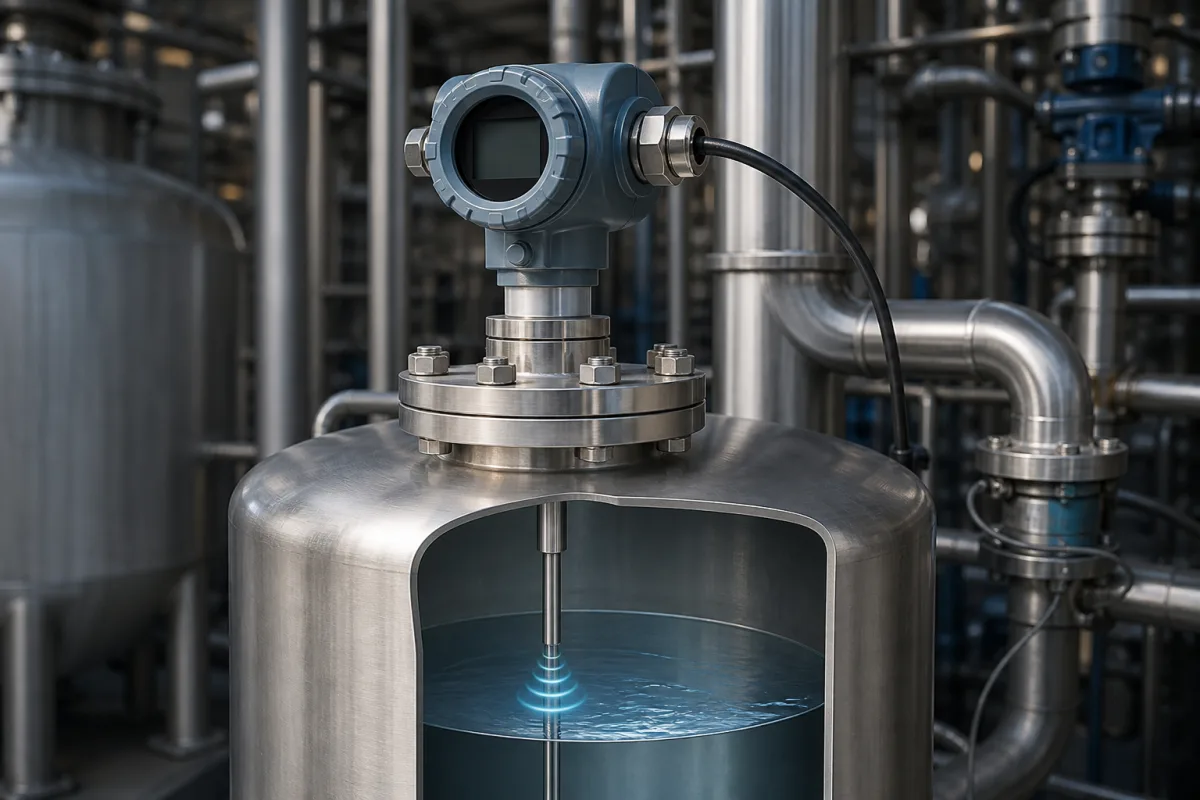
Process instruments · Technology, liquid properties and tank conditions
Every level technology measures something other than level: radar times a reflection, hydrostatic measures pressure, capacitance measures a dielectric. Choose the one whose assumptions your liquid and tank do not break, then specify range, output and wetted materials.
Continuous level transmitters for liquids in tanks and vessels: non-contact and guided wave radar, ultrasonic, capacitance, hydrostatic (pressure) and displacer or magnetostrictive types. Point level switches and sight gauges are outside this page.
CNFX editorial research · Sources checked October 12, 2026 · 5 sources
Endress+Hauser's comparison of continuous level technologies lists, for each, what limits it: non-contact and guided radar cannot measure liquids with a dielectric constant (DC) below 1.4; capacitance needs DC above 2.0 and is affected by conductivity changes; hydrostatic measurement is affected by changing density and by dynamic pressure from agitators or vortices. [1]
The same sheet gives accuracy (typ.) of ±2 mm for 26 GHz and ±1 mm for 80 GHz non-contact radar, ±2 mm for guided radar under 15 m and ±10 mm beyond, ±1% of range for capacitance and ±0.05% of set span for hydrostatic. These are best-case instrument figures; installation and process conditions decide what you actually get. [1]
Editorial calculation (ρgh): a hydrostatic transmitter reads pressure, so the same 1 m of liquid gives about 9.8 kPa for water and about 11.8 kPa for a liquid of density 1,200 kg/m³. If density changes and the transmitter is not compensated, the level reading changes with it.
Give the supplier the liquid, its dielectric constant if known, density and how much it varies, conductivity, temperature and pressure. These decide the technology before range and output do.
02
Check foam, vapour, build-up and agitators
Endress+Hauser lists foam, extreme turbulence and build-up on the antenna as affecting non-contact radar, with wall effects and interfering reflections affecting accuracy; guided radar is affected by extreme build-up and limited by strong mechanical stress from agitators. [1]
In Control Global, Béla Lipták explains that guided wave radar sends pulses down a probe and times the reflection; a rising dielectric constant in a hot vapour space slows the pulse so the level reads low, which a reference target on the probe can correct. Thick, high-dielectric coating along the probe is the worst error source, and readings may be non-linear within about 18 in of the probe ends. [2]
He adds that agitators, thick foam, condensation or splashing cause problems for non-contact pulse radar. [2]
03
Check temperature, pressure and range limits
Endress+Hauser gives guided radar a process range of −196 to +450 °C and −1 to +400 bar, capacitance −80 to +200 °C and −1 to +100 bar, and hydrostatic −70 to +400 °C from vacuum to +420 bar, with hydrostatic unsuitable for vacuum combined with temperatures above +200 °C. [1]
These are limits across a manufacturer's whole range. A given model, seal or antenna will have narrower limits; ask for the limits of the exact model and process connection you are buying.
04
Radar, submersible and buoyancy types on supplier sites
BCST lists non-contact, guided wave and coaxial guided wave radar; Shengke lists 80 GHz radar and non-invasive ultrasonic level sensors; Sentec lists hydrostatic, ultrasonic, radar, magnetostrictive and capacitive transmitters; Lefoo and Rika list submersible level transmitters; HollySys lists buoyancy level transmitters and magnetic level gauges. Ask each for the model's dielectric, temperature and pressure limits. [3][4][5]
05
From antenna or diaphragm to the output electronics
Only the sensing element changes with the technology: an antenna, a probe, a diaphragm or a float. The connection, seal and housing rows are where tank and site details go.
Part
Role
Fix in the order
Sensing element
Antenna, probe, diaphragm or float; meets the process. [1][2]
Type, length, material.
Process connection
Thread or flange on the tank.
Size, rating, nozzle height.
Seal or diaphragm
Isolates electronics from the process.
Material for chemistry and temperature.
Electronics and housing
Converts the measurement to an output.
Output, approvals, enclosure.
Reference or compensation
Vapour-space target or density compensation. [2][1]
Whether needed for your process.
06
Range, accuracy, output and wetted-material entries
Accuracy, process temperature and pressure all depend on the technology chosen above, so settle that first and then fill these rows for the exact model.
Field
What it means and published values
Ask the supplier for
Measuring range (m)
Tank height to measure; blocking distance at the top.
Paste it into your enquiry below or into an email to a maker, then replace every bracket.
Liquid: [name; dielectric constant; density and variation; conductivity; viscosity; coating tendency]
Process: [temperature; pressure or vacuum; foam; vapour or condensation; agitator]
Vessel: [height; material (metal or plastic); nozzle size and height; internals; stilling well]
Measurement: [range; accuracy; level or interface]
Signal: [4–20 mA, HART or other; supply; display]
Approvals: [hazardous area; SIL if required; IP rating]
Documents: [datasheet; dielectric and temperature limits; calibration certificate]
Level instrument makers and the types each one lists
Radar appears on the BCST, Shengke, Wepower, Rika and Aether pages; Lefoo and Rika list submersible transmitters; HollySys lists buoyancy transmitters and magnetic gauges.
Explore company information and manufacturing capabilities, then discuss the scope of your project with a relevant supplier.
Share this page
Compiled and source-reviewed by the CNFX editorial team.
Each manufacturer above links to the page on that company's own website where the product is listed, with the date we checked it. How we source and review
· Page last updated 13 October 2026
Buyer questions
When does radar level measurement not work?
Endress+Hauser lists dielectric constant below 1.4 as a limit for both non-contact and guided radar; foam, turbulence and build-up also affect non-contact radar. [1]
Why does a hydrostatic level transmitter read wrong?
It measures pressure, so changing liquid density changes the reading; agitators and vortices add dynamic pressure. [1]
Does steam or vapour affect guided wave radar?
Lipták explains that a hotter, denser vapour space slows the pulse so level reads low; a reference target on the probe corrects it. [2]
Sources and what still needs a direct check
Sources checked 2026-10-12. Endress+Hauser is an instrument manufacturer; its sheet compares continuous level technologies. Béla Lipták, editor of the Instrument and Automation Engineers' Handbook, answers on radar in Control Global. Supplier pages describe their own offers.