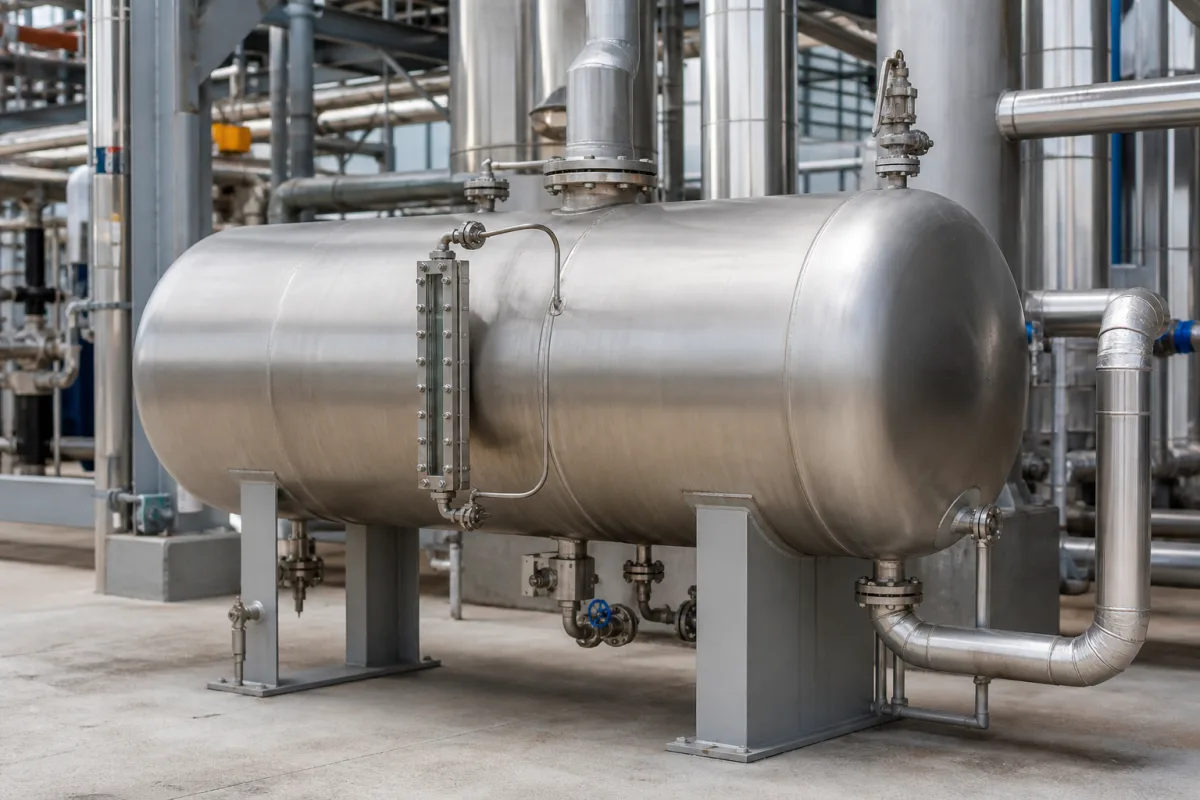
Reflux drum (overhead accumulator): the horizontal vessel after the condenser, its water boot and reflux standpipe, and what goes wrong at closure and relief
Distillation overhead accumulator · horizontal pressure vessel, water-removal boot and reflux standpipe, heads and code, relief discharge and vessel closure
Vapour leaving the top of a distillation column is condensed and runs into a reflux drum, also called the overhead accumulator. From there liquid is pumped partly back to the top tray as reflux and partly away as distillate, while non-condensed gas leaves through a vent and, where the overhead carries water, free water is drawn off from a boot under the drum. The drum is a pressure vessel in its own right, and the details that decide whether it works are small: where the boot sits relative to the reflux draw, how high the draw stands above the bottom, what the relief system discharges into, and whether the vessel was left clean when it was closed.
Reflux drums (overhead accumulators, overhead receivers) of distillation and stripping columns: orientation, pressure-vessel code and heads, nozzles, the water-removal boot and reflux standpipe, level and interface control, relief discharge and vessel closure after maintenance. The column shell, trays and packing are covered on the Distillation column page; atmospheric crude towers on the Crude oil fractionating column page; packaged skid distillation plants, which include their own drums, on the Skid-mounted chemical distillation system page.
CNFX editorial research · Sources checked October 13, 2026 · 3 sources
A horizontal ASME Section VIII drum, not a tank: orientation, pressure and heads
Ford, Bacon & Davis, in a presentation on drums published on an AIChE community site, separates pressure vessels from tanks at 15 psig: vessels for 15 psig and above are built to ASME Section VIII and protected by a relief valve or rupture disc, while tanks below 15 psig follow API 650 (up to 2.5 psig) or API 620 (up to 15 psig), preferably at no more than 200 °F. Its orientation table lists the overhead accumulator (reflux drum) as a horizontal vessel, grouped with hydrocarbon–water separators for liquid–liquid separation, while knockout drums for droplet removal from vapour are vertical. [1]
The same deck lists the connections a drum carries (inlet, outlet, vent, drain, manway, and pressure, temperature and level connections) and gives residence time and disengagement length as the sizing methods for horizontal drums, against Stokes and Souders–Brown velocity methods for vertical ones. [1] Editorial calculation: for a 1,500 mm diameter drum, a 2:1 elliptical head is 375 mm deep (1,500 ÷ 4) and a torispherical head with Rd = 1,500 mm needs a knuckle radius of at least 90 mm (0.06 × 1,500).
Crown radius Rd no more than D; knuckle radius Rc at least 0.06 × Rd [1]
Give the vessel maker the condensed liquid and water flows, the vapour vent flow, design pressure and temperature, the holdup you need between level alarms, and the code of construction.
02
Water boot at the far end, upstream of the reflux draw, with a 6 in standpipe
Henry Kister of Fluor and Norman Lieberman of Process Improvement Engineering, writing in PTQ, describe the correct arrangement: condensate enters at one end of the drum, the water-removal boot sits at the opposite end, and the reflux and product draw is downstream of the boot. Their figure shows the draw standpipe rising 6 in above the bottom of the drum, more where sludge builds up, to keep water out of the reflux line. [2]
They give three failures. In a chemical tower the boot had been placed downstream of the reflux draw, picked up little water, and its draw line plugged with corrosion products because the valve was opened only now and then; with the boot removed, the water was refluxed, accumulated in the overhead loop and corroded the exchangers. Their remedy was to put the boot back upstream of the draw and feed water on flow control to the boot outlet so the valve stays open. In an atmospheric crude tower every rule was followed except the standpipe, and water in the 165 °F reflux built up in the overhead loop, dissolved chlorides and caused corrosion, salting out and flooding. [2]
In a reformer debutaniser the boot was a separate vessel joined to the drum by a line only 1 to 1.5 in in diameter, through which water had to move into the boot and displaced hydrocarbon back to the drum; at high tower rates the line became restrictive, water accumulated in the tower and overhead system, and the overhead product went off specification. Their sketch of the correct arrangement shows an interface level controller on the boot and a level controller on the drum, with the vent on pressure control. [2]
Ask for the nozzle layout to show the inlet, boot and reflux draw in that order along the drum, the standpipe height above the bottom, and the size of any line between drum and a separate boot.
03
Closing the drum after entry and what the relief system discharges into: the 2023 Dow reflux drum explosion
The US Chemical Safety Board's final report on the 14 July 2023 explosions at Dow's Glycol II unit in Plaquemine, Louisiana, found that ethylene oxide entered air-filled pressure relief piping through a rupture disc punctured by metal debris. The mixture ignited, the flame ran through about 50 feet of piping to a relief valve, and when the valve lifted it entered the vapour space of a reflux drum holding liquid and vapour EtO; the vapour decomposed, pressure rose until the drum failed, and more than 31,000 pounds of EtO were released. [3]
The debris came from portable work lights left inside a large reflux drum during turnaround work in May 2023, which degraded after restart. The CSB cited vessel closure practices that let the drum be sealed and restarted without positive confirmation that it was clean and free of foreign material, nitrogen that had leaked out of the relief piping unnoticed, and a cooler relief system that discharged back into the reflux drum and let the flame front into its vapour space. It noted that Dow could have removed the need to vent EtO into the drum when it replaced the product cooler in 2010. [3]
The CSB recommended that NFPA and ASSP add guidance on leaving vessels clean and ready for startup after confined space entry; Dow has since adopted a new vessel closure process and a Global Foreign Materials Exclusion Standard. [3]
For a drum in reactive or flammable service, ask what relief and thermal-expansion lines discharge into it, how those lines are inerted and monitored, and include a signed internal inspection before the manway is closed.
04
Process and layout data for a reflux drum enquiry
Paste it into your enquiry below or into an email to a maker, then replace every bracket.
Service: [column; overhead composition; water present or not]
Flows: [condensate; reflux; distillate; vent gas; free water]
Design: [pressure; temperature; code of construction; corrosion allowance]
Vessel: [horizontal; diameter and length; head type; material]
Nozzles: [inlet; vent; reflux and product draw with standpipe height; boot; manway]
Boot: [integral or separate; interface control; water draw]
Relief: [relief device; lines discharging into the drum]
Explore company information and manufacturing capabilities, then discuss the scope of your project with a relevant supplier.
Share this page
Compiled and source-reviewed by the CNFX editorial team.
Each manufacturer above links to the page on that company's own website where the product is listed, with the date we checked it. How we source and review
· Page last updated 13 October 2026
Buyer questions
Why is a reflux drum horizontal?
Ford, Bacon & Davis list the overhead accumulator as a horizontal vessel, grouped with hydrocarbon–water separators for liquid–liquid separation. [1]
Where should the water boot go?
Kister and Lieberman place it at the end opposite the inlet, upstream of the reflux draw, with the draw standpipe 6 in above the drum bottom. [2]
Is a reflux drum a pressure vessel?
Ford, Bacon & Davis treat drums at 15 psig and above as ASME Section VIII pressure vessels protected by a relief device. [1]
What happened in the Dow reflux drum explosion?
The CSB found a flame entered the drum's vapour space through a relief system that discharged into it; work lights left inside during maintenance had produced the debris that started the chain. [3]
Sources and what still needs a direct check
Sources checked 2026-10-13. Ford, Bacon & Davis's drum design presentation for AIChE, Kister and Lieberman's PTQ article on water–hydrocarbon separation in distillation overhead systems, and the CSB's February 2026 release on its Dow Plaquemine investigation.