Industry-Verified Manufacturing Data (2026)

Mixing Element

Based on aggregated insights from multiple verified factory profiles within the CNFX directory, the standard Mixing Element used in the Chemical Manufacturing sector typically supports operational capacities ranging from standard industrial configurations to heavy-duty production requirements.

Technical Definition & Core Assembly

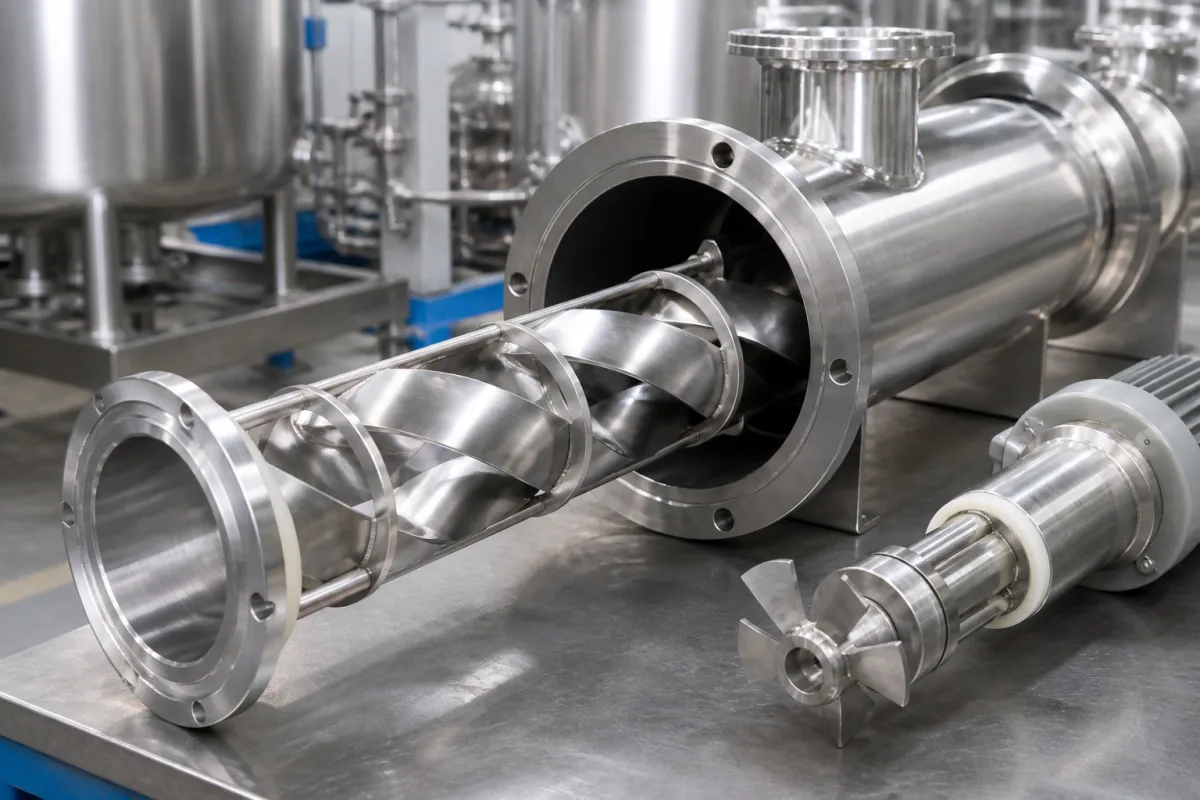
A canonical Mixing Element is characterized by the integration of Shaft Connection and Mixing Blades/Vanes. In industrial production environments, manufacturers listed on CNFX commonly emphasize Stainless Steel (e.g., 316L) construction to support stable, high-cycle operation across diverse manufacturing scenarios.

A component within a Reaction Module designed to facilitate the thorough blending of reactants, catalysts, or other substances to ensure uniform composition and optimal reaction conditions.
Product Specifications

Technical details and manufacturing context for Mixing Element

Definition
The Mixing Element is a critical part of the Reaction Module that ensures homogeneous mixing of chemical reactants, catalysts, solvents, or other process fluids. It enhances mass and heat transfer within the reaction vessel, promoting consistent reaction rates, preventing localized concentration gradients, and improving overall process efficiency and product quality in chemical manufacturing applications.
Working Principle
The Mixing Element operates by creating turbulence, shear forces, or specific flow patterns within the reaction medium. This is typically achieved through mechanical agitation (using impellers, blades, or static mixers), fluid dynamics (via designed geometries that induce mixing), or a combination of both, ensuring reactants are uniformly distributed and in constant contact.
Common Materials
Stainless Steel (e.g., 316L), Hastelloy, PTFE (Polytetrafluoroethylene), Ceramic
Technical Parameters
  • Diameter or characteristic dimension of the mixing element, critical for fitting within the reaction vessel and determining mixing efficiency. (mm) Standard Spec
Components / BOM
  • Shaft Connection
    Provides mechanical linkage to the drive system (motor/gearbox) for transmitting torque to the mixing element.
    Material: Stainless Steel
  • Mixing Blades/Vanes
    Primary surfaces that contact the fluid, generating flow, shear, and turbulence to blend materials.
    Material: Stainless Steel or PTFE-coated Steel
  • Hub/Body
    Central structure that supports and positions the blades/vanes, and may house bearings or seals.
    Material: Stainless Steel
Engineering Reasoning
0.1-15.0 bar
18.5 bar differential pressure across element
Design Rationale: Material yield strength exceeded at 250 MPa von Mises stress, causing permanent deformation and loss of mixing efficiency
Risk Mitigation (FMEA)
Trigger Cavitation at NPSH below 2.3 m
Mode: Surface pitting and erosion reducing mixing efficiency by >40%
Strategy: Install NPSH monitoring with automatic flow reduction below 2.5 m
Trigger Bearing lubrication failure at temperatures above 120°C
Mode: Seizure causing shaft fracture at 1800 RPM
Strategy: Integrate PT100 temperature sensors with automatic shutdown at 115°C

Industry Taxonomies & Aliases

Commonly used trade names and technical identifiers for Mixing Element.

Applied To / Applications

This component is essential for the following industrial systems and equipment:

Industrial Ecosystem & Supply Chain DNA

Complementary Systems
Downstream Applications
Specialized Tooling

Application Fit & Sizing Matrix

Operational Limits
pressure: Up to 10 bar
flow rate: 0.5 to 50 m³/h
temperature: -20°C to 200°C
slurry concentration: Up to 40% solids by weight
Media Compatibility
✓ Aqueous solutions ✓ Organic solvents ✓ Polymer melts
Unsuitable: Highly corrosive acids (e.g., concentrated sulfuric acid)
Sizing Data Required
  • Viscosity of media
  • Required mixing intensity (Reynolds number)
  • Reactor volume

Reliability & Engineering Risk Analysis

Failure Mode & Root Cause
Fatigue cracking
Cause: Cyclic stress from turbulent flow and pressure variations, often exacerbated by material defects or improper heat treatment
Corrosion pitting
Cause: Chemical attack from process fluids, especially in acidic or chloride-rich environments, combined with erosion from suspended solids
Maintenance Indicators
  • Unusual vibration patterns or audible knocking during operation
  • Visible material loss, pitting, or surface discoloration on the element
Engineering Tips
  • Implement regular ultrasonic thickness testing and vibration analysis to detect early degradation
  • Optimize process parameters (flow rate, temperature) to minimize cavitation and turbulent stress on the element

Compliance & Manufacturing Standards

Reference Standards
ISO 9001:2015 - Quality Management Systems ASTM A276/A276M-17 - Standard Specification for Stainless Steel Bars and Shapes CE Marking - Directive 2006/42/EC on Machinery
Manufacturing Precision
  • Bore Diameter: +/-0.02mm
  • Surface Flatness: 0.1mm per 100mm
Quality Inspection
  • Dye Penetrant Test for Surface Defects
  • Spectrographic Analysis for Material Composition

Factories Producing Mixing Element

Verified manufacturers with capability to produce this product in China

✓ 98% Supplier Capability Match Found

T Technical Director from Singapore Jan 26, 2026
★★★★★
"Great transparency on the Mixing Element components. Essential for our Chemical Manufacturing supply chain."
Technical Specifications Verified
P Project Engineer from Germany Jan 23, 2026
★★★★☆
"The Mixing Element we sourced perfectly fits our Chemical Manufacturing production line requirements. (Delivery took slightly longer than expected, but technical support was excellent.)"
Technical Specifications Verified
S Sourcing Manager from Brazil Jan 20, 2026
★★★★★
"Found 24+ suppliers for Mixing Element on CNFX, but this spec remains the most cost-effective."
Technical Specifications Verified
Verification Protocol

“Feedback is collected from verified sourcing managers during RFQ (Request for Quote) and factory evaluation processes on CNFX. These reports represent historical performance data and technical audit summaries from our B2B manufacturing network.”

12 sourcing managers are analyzing this specification now. Last inquiry for Mixing Element from India (1h ago).

Supply Chain Compatible Machinery & Devices

Modular Distillation Column System

Pre-engineered modular system for continuous separation of chemical mixtures via distillation.

Explore Specs →
Automated Batch Crystallization System

Automated system for controlled crystallization of chemical compounds in batch processes.

Explore Specs →
Automated pH Monitoring and Dosing System

Automated system for continuous pH monitoring and chemical dosing in process streams.

Explore Specs →
Automated Powder Dispensing and Blending System

Automated system for precise dispensing and homogeneous blending of powdered chemicals.

Explore Specs →

Frequently Asked Questions

What materials are best for corrosive chemical mixing applications?

For highly corrosive environments, Hastelloy or PTFE mixing elements offer superior chemical resistance compared to standard stainless steel, ensuring longer service life and preventing contamination.

How does the mixing element design affect reaction efficiency?

The blade/vanes geometry and placement on the hub are engineered to create optimal flow patterns, ensuring thorough blending of reactants and catalysts for uniform composition and consistent reaction rates.

Can mixing elements be customized for specific reactor configurations?

Yes, mixing elements can be tailored in size, material, and blade design to fit various shaft connections and reactor dimensions, accommodating different viscosity fluids and process requirements.

Can I contact factories directly on CNFX?

CNFX is an open directory, not a transaction platform. Each factory profile provides direct contact information and production details to help you initiate direct inquiries with Chinese suppliers.

Get Quote for Mixing Element

Request technical pricing, lead times, or customized specifications for Mixing Element directly from verified manufacturing units.

Your business information is encrypted and only shared with verified Mixing Element suppliers.

Thank you! Your message has been sent. We'll respond within 1–3 business days.

Need to Manufacture Mixing Element?

Connect with verified factories specializing in this product category

Add Your Factory Contact Us
Previous Product
Mixing Chamber
Next Product
Mixing Reactor Vessel