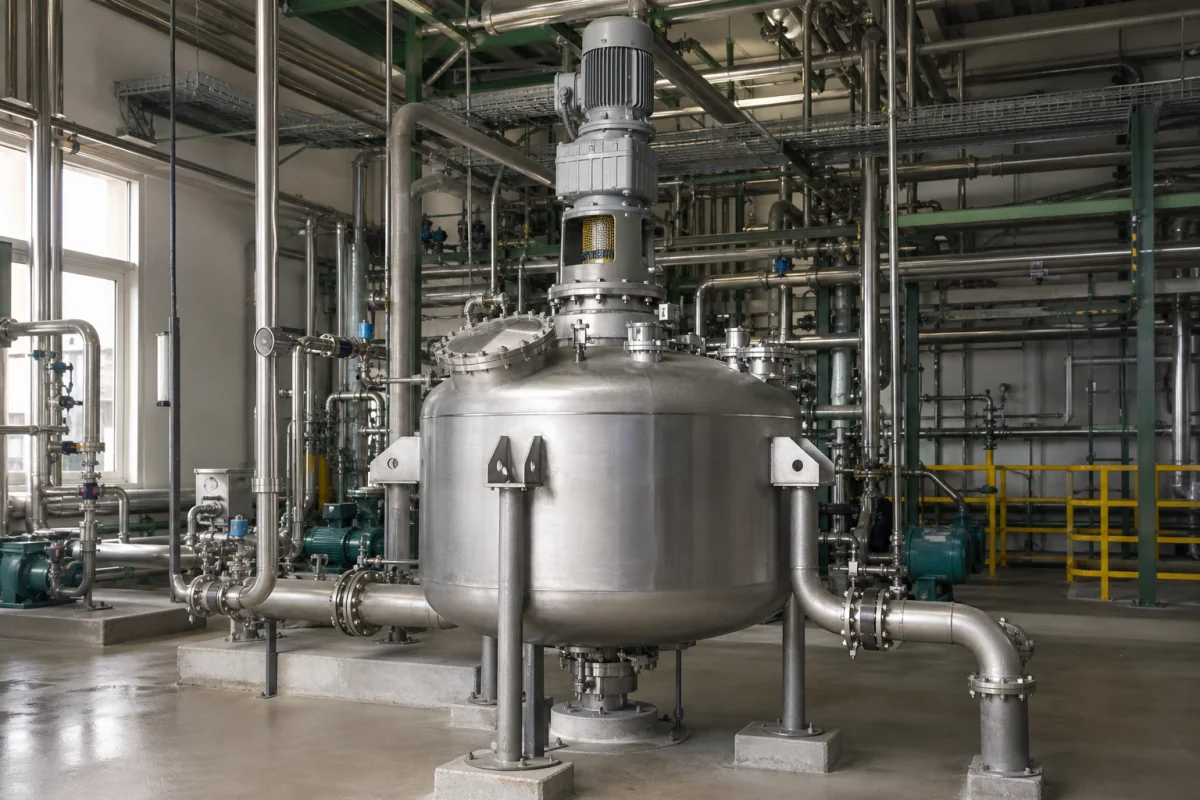
Batching tank for pharmaceutical oral solutions and suspensions: final quantity by weight on load cells, heated dissolution of preservatives, and an outlet with no dead leg
The agitated stainless batching tank in which an oral solution or suspension is compounded, brought to final quantity by weight on load cells, and held before filling
Oral solutions and suspensions are compounded in an agitated stainless tank: purified water is charged, preservatives and the drug substance are dissolved or dispersed, and the batch is brought to final quantity (Q.S.) before it is held and pumped to filling. The tank itself is plain equipment, but three details of it decide whether the batch is right. The final quantity is set by weight, so the tank sits on load cells and its piping must not carry weight away from them. Some ingredients dissolve only with heat, so the tank's heating and its temperature record are part of the process. And a suspension can separate in any dead space, so the bottom outlet and the agitation during filling matter as much as the mixing itself. This page treats the batching tank through those three points.
Agitated batching (compounding) tanks for pharmaceutical oral solutions, syrups and suspensions: weighing on load cells for the final Q.S., piping arrangements that keep the weight reading true, heating for preservative dissolution, nitrogen protection for oxygen-sensitive drugs, and outlets and agitation that keep suspensions uniform up to filling. Tumbling and convective blenders for pharmaceutical powders are covered on the Automated pharmaceutical powder blender page; the valve itself on the Flush-bottom discharge valve for reactors and process tanks page; impeller choice and power number for liquid mixing on the Mixing vessel (agitated mixing tank) for liquids page; hygienic construction of beverage mixing tanks on the Sanitary mixing vessel construction page; food-tank agitators on the Top-entry hygienic agitator for food mixing tanks page; load cell mounting and corner trimming for hoppers and vessels of any service on the Hopper and vessel weighing installation page.
CNFX editorial research · Sources checked October 13, 2026 · 4 sources
Final Q.S. by weight: load cells under the legs and pipe runs that leave the tank free to move
FDA's Guide to Inspections of Oral Solutions and Suspensions (1994) states that these products are formulated on a weight basis with the batching tank on load cells so the final Q.S. can be made by weight, and that volumetric means such as a dip stick or a line on the tank have been found inaccurate. It records far greater variability in batches made by volume, with one manufacturer having to adjust approximately 8 % of its batches after final Q.S. to meet potency. [1]
Alfa Laval's load cell installation guide explains why these lengths matter: the error from process piping equals the force needed to deflect the piping 0.2 mm, the deflection of the load cells at rated capacity; its capacitive cells deflect about 0.10 mm at full capacity. It recommends flexible connections balanced around the vessel, no rigid cabling to mixers and agitators, agitators balanced and centred where possible, process connections tightened before calibration, and names contact between the tank and other structures as the number one cause of inaccuracy. [2]
The same guide gives about 1–2 % accuracy for gravimetric level measurement with load cells under only some of the legs, and the highest accuracy with load cells under all legs. [2] Editorial calculation: on a 1,000 kg batch, 1–2 % is 10–20 kg, so a tank used to make the final Q.S. by weight is the case for cells under every leg.
Pipe to the weighed tank (Alfa Laval)
Free horizontal length recommended
Bends
Up to 16 mm / 1 mm wall
More than 500 + 500 mm (or 400 + 600 mm and so on) [2]
Give the batch weight range, the number of legs, every pipe and hose connected to the tank with its size, and the weighing resolution needed at final Q.S.
02
Heating to dissolve the parabens: 2.5 g/L methylparaben and 0.5 g/L propylparaben in water at 25 °C
FDA notes that some additives, such as the parabens, are difficult to dissolve and require heat, and that the control and assurance of their dissolution during compounding should be reviewed; it also notes that some manufacturers rely on heat during compounding to control microbiological levels, and that storage of product at high temperature can raise degradant levels. [1]
Editorial calculation from the 25 °C values: dissolving 1 kg of methylparaben needs at least 400 L of water and 1 kg of propylparaben at least 2,000 L, before any other solute competes. [3][4] Where temperature is a critical part of the operation, FDA expects the firm's documentation of temperature, such as control charts, to be reviewed. [1]
For oxygen-sensitive drugs FDA names the phenothiazine class, such as perphenazine and chlorpromazine, as products whose manufacture might require removal of oxygen by nitrogen purging and storage in sealed tanks rather than tanks with loose lids. [1]
Preservative
Water solubility listed by PubChem
Methylparaben
2,500 mg/L at 25 °C; 0.25 % w/w at 20 °C and 0.30 % w/w at 25 °C [3]
Propylparaben
500 mg/L at 25 °C; 463 mg/L at 20 °C; soluble in 2,000 parts water [4]
State the heating medium and the temperature the batch is held at for dissolution, how long, the cooling before final Q.S., and whether the tank must be sealed and nitrogen-blanketed.
03
A suspension in the tank and on its way to the filler: a flush bottom valve and agitation that does not stop
FDA describes bottom discharge valves, including ball valves, found inches to as much as a foot below the tank bottom, with drug or preservative not completely dissolved lying in the dead leg and the first samples found subpotent; for suspensions, it states that valves should be flush. [1]
Editorial calculation, assuming a 2 in (50.8 mm) bore: a one-foot (305 mm) dead leg below the tank holds π/4 × 0.0508² × 0.305 m³ ≈ 0.62 L of undissolved or settled material, the kind of dead leg in which FDA found undissolved material and subpotent first samples. [1]
FDA adds that suspensions, depending on viscosity, require continuous or periodic agitation during filling, that segregation may occur in delivery lines between the bulk tank and the filler if the product is not viscous, and that viscosity testing may be more important than an assay of a bulk-tank sample for in-process control. It also warns against flexible transfer hoses left on the floor and against manifolds or shared connections on water, premix or raw-material tanks as sources of contamination. [1]
Specify a flush-mounted bottom valve, the agitator speed that will run during filling, the transfer route to the filler, and how hoses, if any, are stored and drained.
04
What to send for an oral liquid batching tank
Paste it into your enquiry below or into an email to a maker, then replace every bracket.
Product: [solution, syrup or suspension; viscosity; batch size kg]
Weighing: [load cells under all legs; resolution at final Q.S.]
Heating: [jacket medium; dissolution temperature and hold time]
Atmosphere: [open lid, sealed, nitrogen blanket]
Outlet: [flush bottom valve type and size]
Agitation: [type; speed range; running during filling]
Connections: [all pipes and hoses to the tank, with sizes]
Explore company information and manufacturing capabilities, then discuss the scope of your project with a relevant supplier.
Share this page
Compiled and source-reviewed by the CNFX editorial team.
Each manufacturer above links to the page on that company's own website where the product is listed, with the date we checked it. How we source and review
· Page last updated 13 October 2026
Buyer questions
Why are oral liquid batching tanks on load cells?
FDA's inspection guide says the final Q.S. should be made by weight; dip sticks and tank lines were found inaccurate, and one maker adjusted about 8 % of batches made by volume after Q.S. [1]
How much water does methylparaben need to dissolve?
PubChem lists 2,500 mg/L at 25 °C, so 1 kg needs at least 400 L of water at that temperature; FDA notes parabens require heat to dissolve. [3][1]
What pipe length keeps a weighed tank accurate?
Alfa Laval recommends over 500 + 500 mm of free horizontal pipe with one 90° bend for pipes up to 16 mm, rising to 1,000 + 1,000 + 1,000 mm with two bends for pipes up to 50 mm. [2]
Sources and what still needs a direct check
Sources checked 2026-10-13. Four sources: FDA's Guide to Inspections of Oral Solutions and Suspensions (1994), Alfa Laval's load cell installation guide, and the PubChem solubility records for methylparaben and propylparaben (US National Library of Medicine).