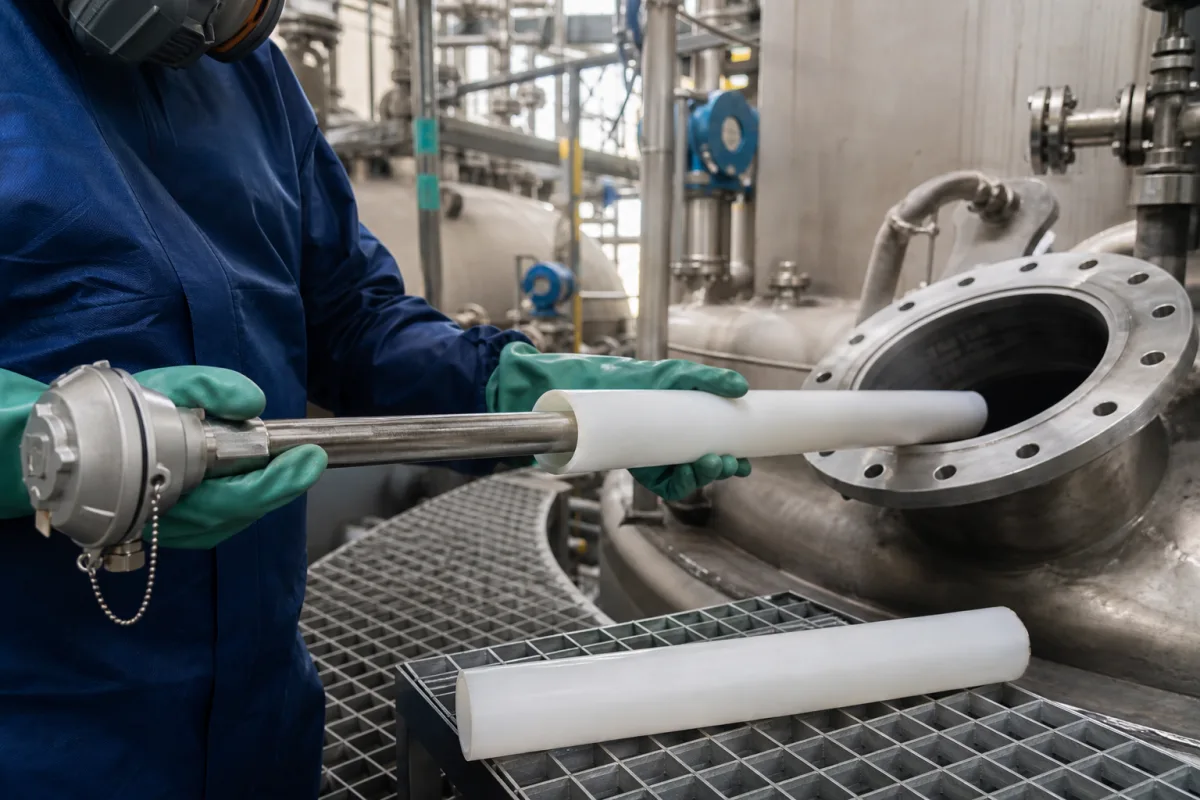
Fluoropolymer protection sheath (PTFE, PFA, FEP) for temperature probes in corrosive chemical reactors
PTFE, PFA and FEP sheaths that keep acids away from a reactor temperature probe · where the plastic's temperature limit sits (200 to 288 °C depending on the source), why a thick jacket slows the reading, and the tantalum-tip and fused-in-glass alternatives
In a reactor full of hot hydrochloric acid, chlorine chemistry or mixed solvents, a stainless-steel thermowell may not last, and a glass-lined vessel cannot take an ordinary metal probe through its nozzle. The answer is a plastic barrier: a sheath of solid PTFE, a thick PTFE jacket over a metal tube, or a PFA or FEP coating, with the sensor inside. What matters is how hot the plastic can run, how much it slows the reading, and whether a metal or glass tip is needed where the temperature is actually measured.
Protection sheaths, jackets and coatings in PTFE, PFA and FEP for thermocouples and resistance thermometers inserted into corrosive chemical and pharmaceutical reactors, vessels and pipes, including solid PTFE wells, PTFE-jacketed metal wells with tantalum or thin PTFE tips, and fluoropolymer-coated probes. Machined and fabricated metal thermowells with their wake-frequency checks are covered on the Thermowell (process temperature sensor well) page; ceramic and metal protection tubes for furnaces on the High-temperature thermocouple assemblies page; the sensors themselves on the Industrial temperature probe (RTD and thermocouple assemblies) page.
CNFX editorial research · Sources checked October 12, 2026 · 5 sources
How hot the plastic can run: PTFE, PFA and FEP limits from four sources
The sheath material, not the sensor, sets the maximum temperature. The published limits differ even for the same plastic, so the lowest figure that applies to the actual product should govern.
The two Micromold patents, by the same inventor a year apart, give different maximum allowable temperatures for PTFE: 288 °C in the first and 260 °C in the second. [3][4] Editorial note: the gap is 28 °C; ask the sheath maker which limit it designs to and whether it is a continuous-service figure, and keep the process maximum below the lowest of the figures above unless the maker's own data says otherwise.
TC Direct's PTFE thermowells are 12 mm OD for 6 mm stainless-sheathed thermocouples or Pt100s, with a 1/2 in BSP taper process thread and 1/4 in BSP parallel sensor thread, in insertion lengths of 80, 230, 430 and 930 mm for 150, 300, 500 and 1,000 mm sensors. [1] Editorial calculation: in each pairing the sensor is 70 mm longer than the insertion length, which is the length left outside the process for the fitting and head.
State the maximum process temperature and the temperature during cleaning or sterilisation, the chemicals, and whether the sheath is solid plastic, a jacket over metal or a coating.
02
Corrosion protection against response time: thick jackets, thin tantalum tips and sensors fused into glass
Every millimetre of plastic between the process and the sensor slows the reading. Micromold's patents describe the problem in highly aggressive service: PTFE jackets much thicker than coatings are used, but such wells may have length limits, may not be strong enough for agitated fluids, or lose sensitivity if built to overcome those limits. [3]
Micromold's answer is a PTFE-jacketed metal well with a small, thin-walled conductive cup at the measuring point, tantalum in one patent, tantalum or thin PTFE in the other, around a copper centring guide that takes sensors as small as 1/16 in diameter. The copper also reinforces the thin tip so the well can be used at higher pressures, and Micromold mentions diameters up to 100 mm or more for long wells that must resist rapid or turbulent flow. [3][4] Both patents cite the 1995 thermowell failure at Japan's Monju reactor, where flow-induced vibration led to a sodium leak, as the reason a well must be tunable against vibration. [3]
GMM Pfaudler, a glass-lined reactor maker, compares its probes. In the traditional TMI probe up to three Pt100 sensors sit in a flange-mounted thermowell; Pfaudler lists long response times from the metal mass, drift from corrosive vapour or condensate in the well and breakage from vibration, and recommends it only for monitoring, not for controlling the process. Its TW probe fuses the Pt100 into the glass layer of a baffle or thermometer tube, with response time roughly divided by five and no recalibration; the T probe does the same with a thermocouple and allows up to six measuring points on one carrier. [5]
Ask for the response time of the sheathed probe, not of the bare sensor, and for the tip construction: solid plastic, thin plastic, tantalum cup or sensor fused into glass.
03
Fitting the sheath to the reactor: nozzle, length and the sensor inside
Chemglass' detachable process-reactor thermocouples show the coated-probe end of the range: PFA-coated stainless thermocouples of 1/8 in diameter in lengths matched to reactor size, and 1/2 in diameter probes with a clear FEP coating that transition to PTFE leads. [2]
At the other end, Micromold describes wells built from standard pipe or tube so that large diameters, heavy walls or high-strength metals can be used under the PTFE jacket, in short lengths for elbows and tees and long lengths that reach far into large vessels through a flanged opening. [3] Pfaudler's T probe can be combined on valve shafts with other sensors such as corrosion monitoring, and a ring version mounted between flanges measures temperature in glass-lined or PTFE pipelines. [5]
Editorial note: on a glass-lined reactor the nozzle, gasket and flange are part of the sheath's sealing; specify the nozzle size and flange standard, the insertion depth below the liquid level at minimum batch volume, and clearance from the agitator.
04
What to state when ordering a fluoropolymer protection sheath
Paste it into your enquiry below or into an email to a maker, then replace every bracket.
Process: [chemicals; concentration; max temperature incl. cleaning; pressure; agitation]
Sheath: [solid PTFE / PTFE jacket over metal / PFA or FEP coating]
Tip: [plastic; thin PTFE; tantalum cup]
Geometry: [OD; insertion length; nozzle and flange; threads]
Sensor: [thermocouple or Pt100; diameter; spring loading]
Performance: [response time of the sheathed probe; vibration check]
Explore company information and manufacturing capabilities, then discuss the scope of your project with a relevant supplier.
Share this page
Compiled and source-reviewed by the CNFX editorial team.
Each manufacturer above links to the page on that company's own website where the product is listed, with the date we checked it. How we source and review
· Page last updated 13 October 2026
Buyer questions
What temperature can a PTFE protection sheath take?
Published limits vary: TC Direct lists -75 to 250 °C for solid PTFE thermowells, while Micromold's patents quote 288 °C and 260 °C for PTFE. [1][3][4]
Is PFA or FEP coating better for heat?
Chemglass limits its FEP-coated reactor probes to 200 °C and its PFA-coated probes to 250 °C. [2]
Why do PTFE-sheathed probes respond slowly?
The plastic between process and sensor insulates it; Micromold adds a thin tantalum or PTFE tip with a copper insert to improve sensitivity. [3][4]
How do glass-lined reactors measure temperature without a metal well?
Pfaudler fuses Pt100 sensors or thermocouples into the glass of baffles or thermometer tubes, cutting response time by about five times. [5]
Sources and what still needs a direct check
Sources checked 2026-10-12. Temperature limits come from TC Direct's and Chemglass' product pages and from two Micromold Products patents; response-time trade-offs from those patents and from GMM Pfaudler's description of its glass-lined temperature probes.