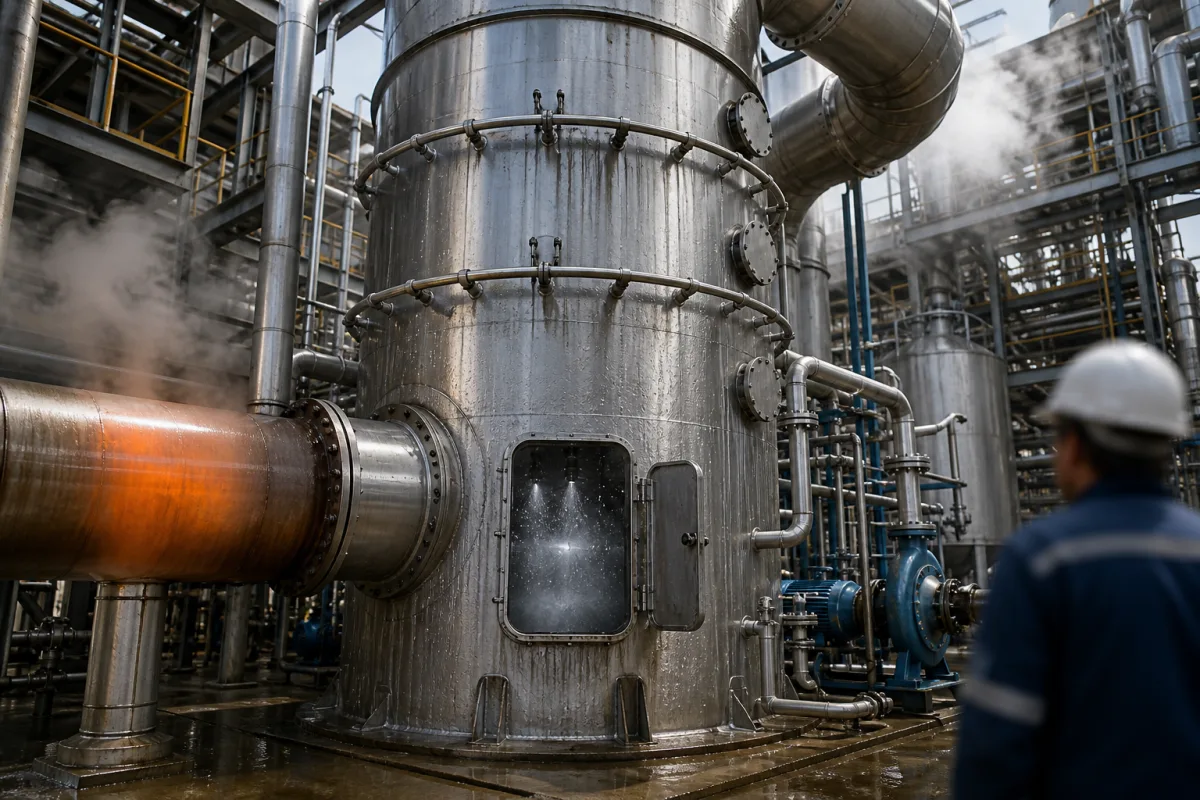
Quench towers and quenchers for hot off-gas · Cooling hot flue gas to adiabatic saturation by water evaporation, spray nozzle versus venturi quench designs, nozzle pressure drop, plugging and corrosion, and sizing ahead of scrubbers
A quench tower cools hot process or combustion off-gas quickly by spraying or contacting it with water, which evaporates and takes heat out until the gas is near saturation. It protects downstream scrubbers, absorbers and fans from high temperature and removes some coarse dust. Ask three things first: what gas flow, temperature and contaminants enter it, what outlet temperature and saturation the next equipment needs, and how water is supplied, recycled and kept from plugging and corroding the quencher.
Quench towers, quench chambers and venturi quenchers that cool hot off-gas by direct water contact ahead of wet scrubbers, absorbers or other gas cleaning. Evaporative cooling towers for cooling water, heat exchangers and boilers that recover heat, and the scrubbers themselves (see venturi scrubber) are outside this page except where compared.
CNFX editorial research · Sources checked October 11, 2026 · 4 sources
US patent 6,149,137 (Method and apparatus for quenching hot flue gases) explains that hot flue gases from thermal oxidation processes "frequently require cooling to their adiabatic saturation temperature" before further processing in a packed absorber or venturi scrubber. It gives hot flue gas temperatures "typically in the range of 1400 to 2000 degrees F"; adiabatic saturation temperature, the minimum reachable by water evaporation with no other heat loss, varies with pressure and moisture but "is largely a function of the temperature of the incoming hot flue gases", about 150–195°F for that inlet range. [1]
EPA's Air Pollution Control Cost Manual (Section 6, wet scrubbers for particulate matter) notes that when hot gas passes through a wet scrubber, water evaporates, humidifying and cooling the gas; outlet conditions are taken as saturated for design and evaporation is modelled as adiabatic saturation, with the dry air mass flow constant. It says "for PM applications, wet scrubbers are generally limited to a temperature range of (50°F to 700°F) due to evaporation", high-temperature gas reduces droplet formation in a venturi, so the gas must be cooled first with a quencher spraying water into it, and quenchers increase capital and operating costs only marginally. [2]
Editorial calculation: 1400–2000°F is about 760–1093°C and 150–195°F about 66–91°C, so the quench takes the gas down by roughly 694–1002 °C (Editorial calculation); ask the supplier for the water evaporated per hour at your flow and the outlet temperature guarantee. [1]
Give the supplier the gas source, flow and composition, inlet temperature and pressure, dust and acid gas loading, required outlet temperature or saturation, downstream equipment, water source, recycle and blowdown, allowable nozzle or venturi pressure drop, materials and lining for corrosive condensate, emergency water supply on loss of quench water, instrumentation, and space and height limits.
02
Choose spray nozzle or venturi quench
US 6,149,137 says conventional quench systems use spray nozzles in a duct or spray contactor vessel ("typically, numerous nozzles are connected to the water source"), the nozzles taking a pressure drop of about 80–100 psi to make fine drops for rapid cooling; their drawbacks are substantial valving and piping, nozzles that corrode, erode and plug with solids in the "hot and usually corrosive recycled spray water", and the need for a high-pressure pump. Its system mounts a venturi in a quench vessel and raises the water level to submerge the downcomer when the venturi pressure drop alone does not cool the gas to adiabatic saturation. [1]
Editorial note: ask the supplier which quench principle it proposes for your dirty, corrosive gas, how nozzles or venturi are kept from plugging, and what happens on loss of quench water, since downstream equipment may not survive inlet temperature.
03
Check the gas temperature the US incinerator rule ties to dioxin limits
Where a quench cools gas from a hazardous waste incinerator in the United States, the federal emission rule links the dioxin and furan limit to gas temperature. Under US EPA's 40 CFR 63.1219, an existing incinerator equipped with a waste heat boiler or dry air pollution control system must not emit dioxins and furans in excess of 0.20 ng TEQ/dscm, corrected to 7 percent oxygen, or alternatively 0.40 ng TEQ/dscm provided the combustion gas temperature at the inlet to the initial particulate matter control device is 400 °F or lower, based on the average of the test run average temperatures. [3] The rule states that operation of a wet particulate matter control device is presumed to meet the 400 °F or lower requirement. [3] Editorial calculation: 400 °F is about 204 °C ((400 − 32) ÷ 1.8).
For existing incinerators with neither a waste heat boiler nor a dry air pollution control system, the rule sets 0.40 ng TEQ/dscm. For new sources it sets 0.11 ng TEQ/dscm with a waste heat boiler or dry air pollution control system, and 0.20 ng TEQ/dscm without either, all corrected to 7 percent oxygen. [3] The rule counts a dry system followed by a wet system as a dry system, and a wet system followed by a dry system as not a dry system. [3]
Editorial note: if the quench feeds a fabric filter or electrostatic precipitator rather than a wet scrubber, write the gas temperature the quench must hold at that device inlet into the order, and ask the supplier how it is held at minimum and maximum gas flow.
04
Ask how the nozzle layout was checked for outlet temperature and wall wetting
In a 2024 article by Zumao Chen, the engineering firm Becht describes using computational fluid dynamics (CFD) modelling to set the number, layout and orientation of spray nozzles. In a quench section with an internal diameter of 1 m, three rows of six independently operated nozzles gave an average exit gas temperature of 547 K against a design requirement of 573 K, a local maximum of 650 K at the exit, and a maximum wall temperature of 639 K against a 1000 K limit. [4]
In a second project, nozzles in the third pass of an incinerator quench cooled flue gas from 2000°F to 1000°F ahead of a spray dryer absorber. Moving the nozzles away from the sidewalls and placing one row on the rear wall cut the water striking the wall tubes from 14.2% to 4.4% of the spray; the two designs had different targets (820°F initial, 1000°F final), so their water flows are not directly comparable. [4]
Editorial note: ask the supplier how its nozzle layout was checked for an even outlet temperature and for spray reaching the walls.
Becht CFD case
Total water flow (lb/hr)
Droplet impingement (lb/hr; %)
Initial design
36,726
5,214; 14.2%
Final design
15,789
689; 4.4%
05
Trace the quench system
This is a functional reference built from the sources cited; it is not one maker's design.
Fill the specification fields with values for your gas
A quench tower quotation needs values for your gas and plant. The table explains each field, gives published values where a reviewed source states them, and says what to obtain from the supplier.
Explore company information and manufacturing capabilities, then discuss the scope of your project with a relevant supplier.
Share this page
Compiled and source-reviewed by the CNFX editorial team.
Published product pages show what a company offers, not tested performance. Confirm the legal seller, factory and scope for your order. How we source and review
· Page last updated 13 October 2026
Buyer questions
How cool can a quench tower get hot flue gas?
Down to its adiabatic saturation temperature; about 150–195°F for oxidiser gas at 1400–2000°F (US 6,149,137). [1]
Why quench before a wet scrubber?
EPA says wet scrubbers for PM are limited to about 50–700°F and hot gas evaporates scrubbing liquid, so a quencher cools it first. [2]
What are the drawbacks of spray nozzle quenchers?
They need 80–100 psi nozzle drop, high-pressure pumps and much piping, and nozzles corrode, erode and plug (US 6,149,137). [1]
Does quench outlet temperature affect US dioxin limits for hazardous waste incinerators?
Yes. US EPA's rule 40 CFR 63.1219 lets an existing incinerator with a waste heat boiler or dry control system meet 0.40 ng TEQ/dscm instead of 0.20 ng TEQ/dscm if gas at the inlet to the initial particulate matter control device is 400 °F or lower. [3]
How can a buyer check that quench sprays will not wet the duct walls?
Ask for a CFD check of the nozzle layout. Becht reports that in one incinerator quench, moving nozzles away from the sidewalls cut droplet impingement on the wall tubes from 14.2% to 4.4% of the spray water. [4]
Sources and what still needs a direct check
Sources checked 2026-10-11. The US patent describes quench systems in its own terms; EPA's Air Pollution Control Cost Manual is US government guidance for estimating control equipment.