Industry-Verified Manufacturing Data (2026)

Reaction Chamber

Based on aggregated insights from multiple verified factory profiles within the CNFX directory, the standard Reaction Chamber used in the Chemical Manufacturing sector typically supports operational capacities ranging from standard industrial configurations to heavy-duty production requirements.

Technical Definition & Core Assembly

A canonical Reaction Chamber is characterized by the integration of Heating Jacket and Thermocouple Port. In industrial production environments, manufacturers listed on CNFX commonly emphasize Stainless Steel 316L construction to support stable, high-cycle operation across diverse manufacturing scenarios.

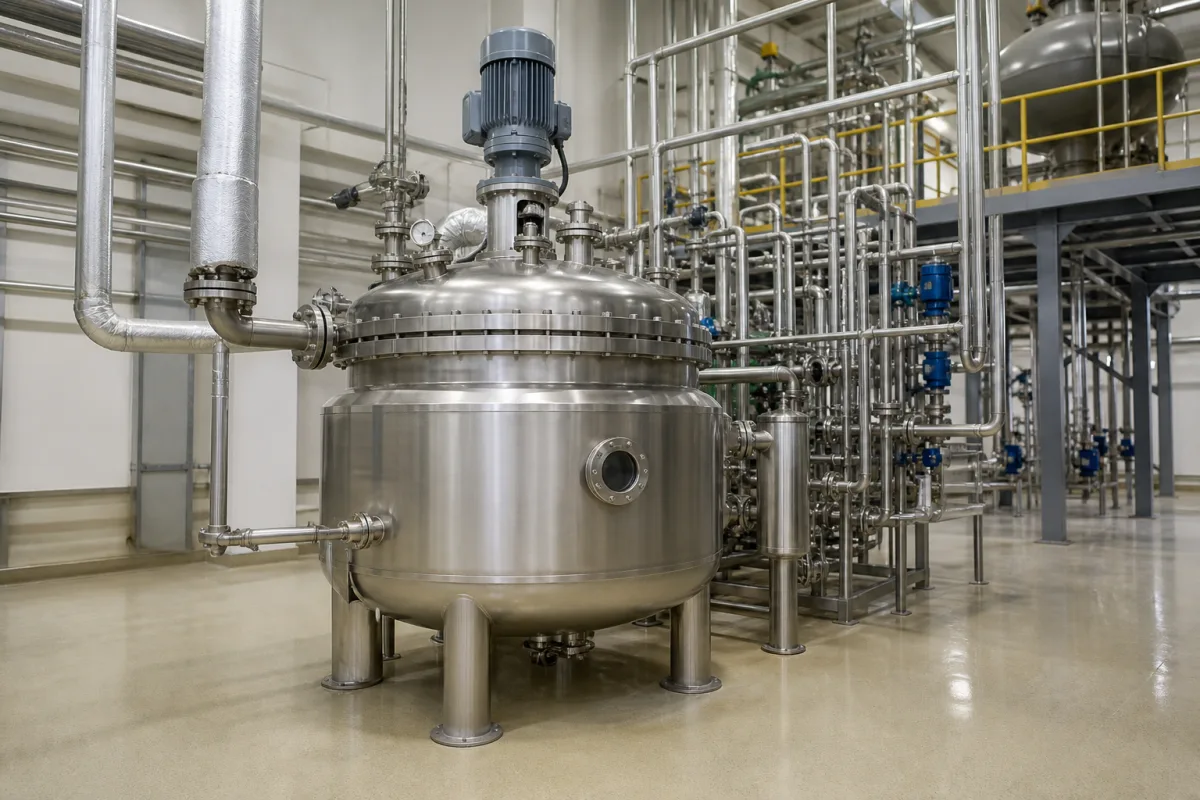
A specialized vessel within the Regeneration Section where controlled chemical reactions occur to regenerate or transform materials.
Product Specifications

Technical details and manufacturing context for Reaction Chamber

Definition
The Reaction Chamber is a critical component of the Regeneration Section, designed to facilitate specific chemical or physical reactions under controlled conditions of temperature, pressure, and atmosphere. It serves as the core processing unit where raw or spent materials are converted into regenerated products or intermediate compounds, enabling the recovery and reuse of valuable substances within an industrial system.
Working Principle
Materials are introduced into the sealed chamber, where controlled environmental conditions (e.g., heat, catalysts, specific gas atmospheres) are applied to drive a desired chemical reaction, such as decomposition, synthesis, or catalytic regeneration, transforming the input materials.
Common Materials
Stainless Steel 316L, Hastelloy, Quartz
Technical Parameters
  • Internal volume capacity of the chamber. (L) Customizable
Components / BOM
  • Heating Jacket
    Provides uniform heating to the chamber walls to maintain the required reaction temperature.
    Material: Stainless Steel
  • Thermocouple Port
    Allows insertion of temperature sensors for precise monitoring and control of the internal environment.
    Material: Stainless Steel
  • Viewport
    A sealed window for visual inspection of the reaction process inside the chamber.
    Material: Quartz or Borosilicate Glass
Engineering Reasoning
0.1-15.0 MPa, 300-800 K
Yield strength of 316L stainless steel at 800 K: 145 MPa, Creep rupture limit at 800 K for 1000 hours: 120 MPa
Design Rationale: Thermal fatigue from cyclic heating/cooling (ΔT=500 K) causing crack initiation at stress concentrations exceeding 145 MPa, coupled with creep deformation at sustained 800 K temperatures reducing load-bearing capacity below 120 MPa
Risk Mitigation (FMEA)
Trigger Catalyst bed channeling from uneven flow distribution (Reynolds number < 2000)
Mode: Localized hot spot formation exceeding 900 K
Strategy: Perforated distributor plate with 5 mm diameter holes at 10 mm pitch ensuring uniform velocity profile (CV<0.05)
Trigger Corrosion from chloride ion concentration exceeding 25 ppm at pH<4
Mode: Pitting corrosion penetration rate >0.5 mm/year
Strategy: Duplex stainless steel UNS S32205 cladding with PREN>40 and cathodic protection at -850 mV vs Ag/AgCl

Industry Taxonomies & Aliases

Commonly used trade names and technical identifiers for Reaction Chamber.

Applied To / Applications

This component is essential for the following industrial systems and equipment:

Industrial Ecosystem & Supply Chain DNA

Complementary Systems
Downstream Applications
Specialized Tooling

Application Fit & Sizing Matrix

Operational Limits
pressure: 0-10 bar (0-145 psi)
flow rate: Up to 100 m³/h (440 GPM)
temperature: 50-300°C (122-572°F)
slurry concentration: Up to 40% solids by weight
Media Compatibility
✓ Catalyst regeneration in petrochemical processes ✓ Mineral acid regeneration in hydrometallurgy ✓ Chemical solvent recovery in gas treatment
Unsuitable: High-chloride environments (>1000 ppm) due to stress corrosion cracking risk
Sizing Data Required
  • Required reaction volume (m³) based on residence time
  • Maximum heat transfer requirement (kW) for temperature control
  • Material throughput capacity (kg/h) for production scaling

Reliability & Engineering Risk Analysis

Failure Mode & Root Cause
Corrosion-induced pitting
Cause: Chemical attack from aggressive reactants or byproducts, especially at high temperatures and pressures, leading to localized material degradation and potential leaks.
Thermal fatigue cracking
Cause: Repeated heating and cooling cycles during batch processes causing stress concentrations at welds, nozzles, or other geometric discontinuities, eventually leading to crack initiation and propagation.
Maintenance Indicators
  • Unusual hissing or whistling sounds indicating gas or vapor leaks through compromised seals or cracks
  • Visible discoloration, bulging, or localized hot spots on the chamber exterior during operation, suggesting internal degradation or insulation failure
Engineering Tips
  • Implement a rigorous chemical compatibility analysis and material selection process, considering not just primary reactants but also trace contaminants and reaction byproducts, possibly upgrading to corrosion-resistant alloys or applying protective linings.
  • Establish controlled heating and cooling ramps in operational procedures to minimize thermal shock, and incorporate regular non-destructive testing (e.g., ultrasonic testing, thermography) at high-stress areas to detect early-stage cracks before catastrophic failure.

Compliance & Manufacturing Standards

Reference Standards
ISO 9001:2015 - Quality management systems ASME BPVC Section VIII - Rules for construction of pressure vessels CE Marking - Pressure Equipment Directive 2014/68/EU
Manufacturing Precision
  • Bore diameter: +/-0.05mm
  • Surface flatness: 0.1mm per 300mm
Quality Inspection
  • Hydrostatic pressure test
  • Helium leak detection test

Factories Producing Reaction Chamber

Verified manufacturers with capability to produce this product in China

✓ 97% Supplier Capability Match Found

P Procurement Specialist from Canada Jan 27, 2026
★★★★★
"The Reaction Chamber we sourced perfectly fits our Chemical Manufacturing production line requirements."
Technical Specifications Verified
T Technical Director from United States Jan 24, 2026
★★★★★
"Found 53+ suppliers for Reaction Chamber on CNFX, but this spec remains the most cost-effective."
Technical Specifications Verified
P Project Engineer from United Arab Emirates Jan 21, 2026
★★★★★
"The technical documentation for this Reaction Chamber is very thorough, especially regarding technical reliability."
Technical Specifications Verified
Verification Protocol

“Feedback is collected from verified sourcing managers during RFQ (Request for Quote) and factory evaluation processes on CNFX. These reports represent historical performance data and technical audit summaries from our B2B manufacturing network.”

11 sourcing managers are analyzing this specification now. Last inquiry for Reaction Chamber from UAE (1h ago).

Supply Chain Compatible Machinery & Devices

Continuous Flow Reactor System

Automated chemical synthesis system for continuous production.

Explore Specs →
Modular Distillation Column System

Pre-engineered modular system for continuous separation of chemical mixtures via distillation.

Explore Specs →
Automated Batch Crystallization System

Automated system for controlled crystallization of chemical compounds in batch processes.

Explore Specs →
Automated pH Monitoring and Dosing System

Automated system for continuous pH monitoring and chemical dosing in process streams.

Explore Specs →

Frequently Asked Questions

What materials are best for a reaction chamber in corrosive chemical environments?

Stainless Steel 316L offers excellent corrosion resistance for most applications, while Hastelloy provides superior performance in highly corrosive environments, and quartz is ideal for high-purity or high-temperature processes.

How does the heating jacket in a reaction chamber work?

The heating jacket surrounds the reaction chamber vessel, circulating thermal fluids or using electric elements to maintain precise temperature control for optimal chemical reaction kinetics and regeneration efficiency.

What maintenance is required for industrial reaction chambers?

Regular inspection of seals and gaskets, cleaning of viewports and thermocouple ports, monitoring for corrosion or material degradation, and calibration of temperature control systems are essential for safe and efficient operation.

Can I contact factories directly on CNFX?

CNFX is an open directory, not a transaction platform. Each factory profile provides direct contact information and production details to help you initiate direct inquiries with Chinese suppliers.

Get Quote for Reaction Chamber

Request technical pricing, lead times, or customized specifications for Reaction Chamber directly from verified manufacturing units.

Your business information is encrypted and only shared with verified Reaction Chamber suppliers.

Thank you! Your message has been sent. We'll respond within 1–3 business days.

Need to Manufacture Reaction Chamber?

Connect with verified factories specializing in this product category

Add Your Factory Contact Us
Previous Product
Rapid Transfer Port (RTP)
Next Product
Reaction Module