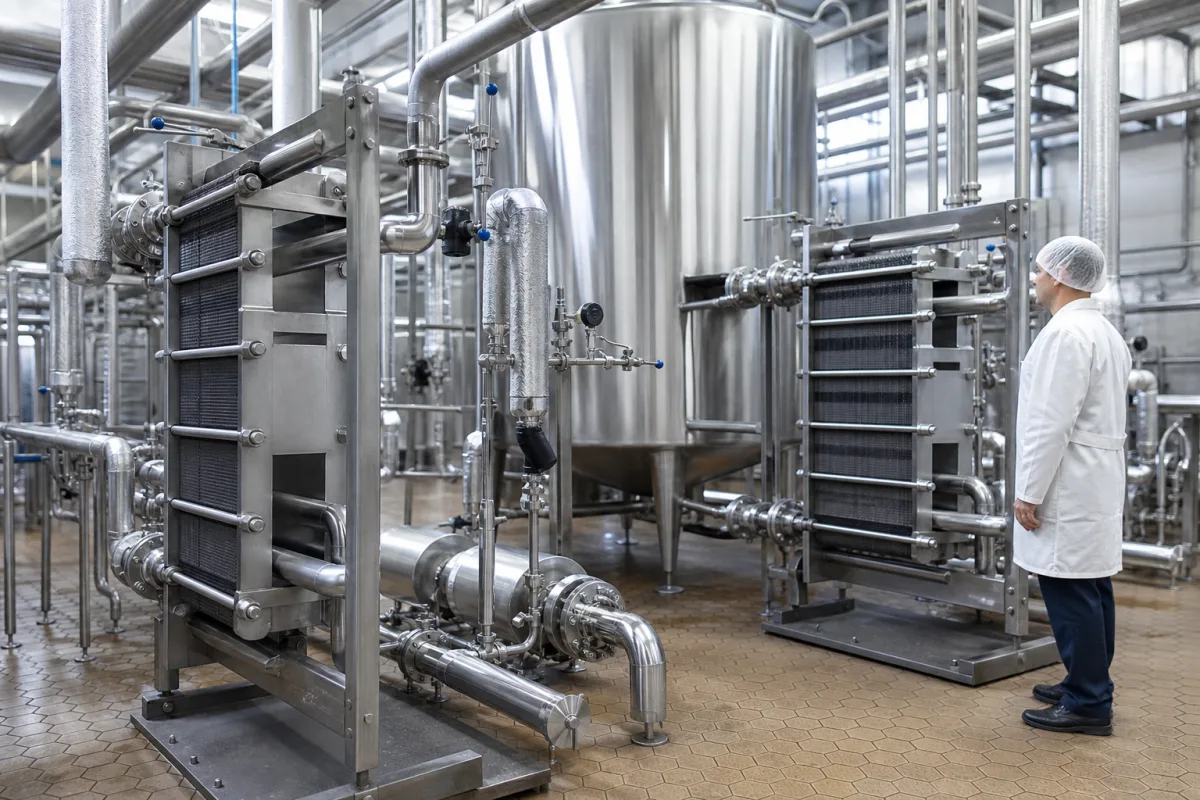
Regeneration section of a plate pasteuriser: holding the pasteurised side above raw-side pressure and finding plate leaks before they contaminate product
Product-to-product heat recovery plates in an HTST pasteuriser · pasteurised side at least 6.9 kPa (1 psi) above raw, 30.5 cm elevation rule, booster pump interlock, leak tests on the assembled pack
In the regeneration section, hot product leaving the holding tube gives up its heat through stainless steel plates to the cold raw product coming in. The two streams are separated only by a plate and its gaskets, so a fatigue crack, corrosion pinhole or failed gasket lets raw product reach product that has already been pasteurised. Design and testing of this section therefore revolve around one question: which side is at the higher pressure at every moment, including start-up, shutdown and diversion, and how will a leak be found if it opens?
Regenerator (heat recovery) sections of plate-type continuous-flow pasteurisers for milk, dairy products and similar liquid foods: milk-to-milk and milk-to-water-to-milk arrangements, the pressure relationships and booster pump interlocks that protect them, their differential pressure controllers, and leak testing of the assembled plates. Complete HTST and HHST pasteurisers with their holding tube, timing pump, controls, flow-diversion device and heat-recovery percentage are covered on the Continuous-flow (HTST) pasteurisation system page; tubular units on the Tubular heat exchanger for food and dairy processing page; general heat exchangers on the Heat exchanger page.
CNFX editorial research · Sources checked October 12, 2026 · 3 sources
Raw side under suction, pasteurised side above atmosphere: the 12-inch rise and the 1 psi booster pump interlock
The US Grade "A" Pasteurized Milk Ordinance (PMO, 2025 revision) gives the reason for its regenerator rules directly: raw product must always be under less pressure than pasteurised product or the heat-transfer medium, so that flaws in the metal or the gasketed joints cannot contaminate pasteurised product. [1]
For milk-to-milk regenerators with both sides closed to the atmosphere, Item 16p(C) requires that pasteurised product, between the regenerator outlet and the nearest point open to the atmosphere, rise to a vertical elevation of 30.5 cm (12 inches) above the highest raw product level downstream of the constant-level tank; that the overflow rim of the constant-level tank stays below the lowest product level in the regenerator; that no pump or flow-promoting device sits between the pasteurised outlet and that open point; and that the raw regenerator drains freely back to the constant-level tank or to the floor when the raw pumps stop. [1]
The PMO's appendix explains how this works: while the timing pump runs, raw product is drawn through the regenerator at sub-atmospheric pressure while pasteurised product is above atmospheric. A flow-diversion device cannot be relied on to stop backflow when the pump stops, because for the first few minutes the product is still hot enough to hold it in forward flow; the elevation and constant-level tank rules are what keep the pressure relationship. [1]
A raw booster pump may be fitted only if it can run when the timing pump is running, the flow-diversion device is in forward flow, and pasteurised product pressure exceeds the booster pump's maximum pressure by at least 6.9 kPa (1 psi), with pressure gauges at the raw inlet and the pasteurised outlet checked by the regulatory agency on installation, quarterly and after repair. [1]
Editorial calculation: the 30.5 cm rise is a small head. With an assumed product density of 1,030 kg/m³, 1,030 × 9.81 × 0.305 ≈ 3.1 kPa, about 0.45 psi, less than half of the 6.9 kPa (1 psi) margin demanded once a booster pump pushes raw product into the section. [1]
Ask the builder for a piping elevation drawing showing the pasteurised outlet rise against the highest raw level, the constant-level tank rim against the lowest regenerator level, and every pump between the constant-level tank and the open point downstream.
02
Milk-to-water-to-milk regenerators and the differential pressure controller test every three months
Instead of raw and pasteurised product meeting across one plate, a regenerator can carry heat through a water circuit. Under the PMO's Option I, the heat-transfer water side in the raw section must always be at higher pressure than raw product: the water must be safe water in a covered tank open to the atmosphere at least 30.5 cm (12 inches) above any raw product level downstream of the constant-level tank, the circuit must be full at start and any loss replenished automatically while raw product is present. [1]
If a raw booster pump is used with such a regenerator, it must be wired so that it cannot run unless the heat-transfer water pump is running and the water pressure exceeds raw product pressure in the regenerator by at least 6.9 kPa (1 psi), measured by a differential pressure controller at the raw inlet and the water outlet. Under Option II, with the flow-diversion device downstream of the regenerator or cooler, the controller compares the pasteurised product outlet with the heat-transfer medium inlet and diverts flow whenever the lowest pasteurised pressure fails to exceed the highest medium pressure by 1 psi. [1]
PMO Appendix I Test 9.2 applies to these controllers on installation, at least once every three months, after adjustment or repair, and whenever the regulatory seal is broken. With the sensing elements drained, both readings must be within 3.5 kPa (0.5 psi) of zero; mounted together on a testing tee under booster pump pressure, their separation must stay within 6.9 kPa (1 psi) of the unpressurised reading. In the booster pump interwiring test, the air supply is adjusted until the pasteurised element reads less than 14 kPa (2 psi) above the raw element, and the booster pump must stop while the flow-diversion device stays in forward flow and the timing pump keeps running. [1]
Agree with the regulator which option applies to your regenerator, where each sensing element sits, and the switch setting the controller will be sealed at.
03
Finding pinholes without stripping the pack: a 15 g/l salt tracer at 3 bar and a hydrogen test gas at 4 bar
The conventional check, as Somerset Technical Laboratories describes it in a 1990s patent, is to shut the plant down, dismantle the pasteuriser, examine and test the plates one by one, clean, reassemble with new seals and pressure-test again, which costs production time and new seals and risks introducing new leaks during rebuilding. [2]
Its alternative circulates a salt solution as the donor fluid in one path and clean water in the other, watching the water's conductivity rise. In its example, 0.05 g/l of sodium chloride gives 100 µS/cm and 0.25 g/l gives 500 µS/cm, the donor is circulated at about 45 psi, and salt at 15 g/l with a 45 psi (3 bar) differential can be detected leaking into soft water through a hole as small as 70 microns. [2]
APV North America's later patent aims to detect smaller faults in an assembled pack than earlier methods, naming fatigue cracks and corrosion pinholes in the plates, and notes that even the very small cross-flow they allow means the product must be thrown away. Its method seals a test section, evacuates both sides to about 0.1 bar or less, charges one side with a test gas such as 5% hydrogen in nitrogen to about 4 bar, and samples the gas drawn from the other side for hydrogen; in its example the vacuum is held for about 10 minutes before charging and the test gas is left about 15 minutes before sampling. [3]
Editorial calculation: evacuating the receiving side to 0.1 bar and charging the donor side to 4 bar gives a differential of about 3.9 bar, slightly above the 3 bar of the salt-tracer example; the two patents give their figures as examples, not as a required test pressure. [2][3]
Ask the supplier which leak test it uses on the regeneration section, the test pressure each side sees against the plate and gasket rating, the smallest hole the method is stated to detect, and how often it recommends testing.
04
Regeneration section data to send with an enquiry
Paste it into your enquiry below or into an email to a maker, then replace every bracket.
Product: [milk, dairy product or other liquid; viscosity; solids]
Flow rate: [l/h]
Temperatures: [raw in; pasteurised in; target out of each side]
Arrangement: [milk-to-milk or milk-to-water-to-milk]
Pumps: [timing pump; raw booster pump; position of separator or vacuum equipment]
Pressure protection: [elevation drawing; differential pressure controller; sensing points; set point]
Plates: [material; gasket material; pressure rating]
Leak testing: [method; test pressure; detection limit; interval]
Regulation: [PMO or other authority for your market]
Explore company information and manufacturing capabilities, then discuss the scope of your project with a relevant supplier.
Share this page
Compiled and source-reviewed by the CNFX editorial team.
Each manufacturer above links to the page on that company's own website where the product is listed, with the date we checked it. How we source and review
· Page last updated 13 October 2026
Buyer questions
Why must the pasteurised side of a regenerator be at higher pressure?
The PMO requires raw product to be at lower pressure than pasteurised product or the heat-transfer medium so that a flaw in the plates or gaskets cannot let raw product contaminate pasteurised product. [1]
What pressure differential does the PMO require when a booster pump is used?
At least 6.9 kPa (1 psi) between pasteurised product (or heat-transfer water) and raw product, with the booster pump wired so it cannot run otherwise. [1]
How often is the regenerator differential pressure controller tested?
Under PMO Test 9.2, on installation, at least once every three months, after adjustment or repair, and whenever the regulatory seal is broken. [1]
Can a plate pasteuriser be leak-tested without dismantling it?
Patents describe circulating a salt tracer and watching conductivity (holes down to 70 microns in one example) or evacuating the pack and charging one side with hydrogen test gas at about 4 bar. [2][3]
Sources and what still needs a direct check
Sources checked 2026-10-12. Pressure rules and controller tests come from the 2025 Pasteurized Milk Ordinance published by the US FDA with the National Conference on Interstate Milk Shipments; leak-test figures come from patents by Somerset Technical Laboratories and APV North America.