Industry-Verified Manufacturing Data (2026)

Reactor Shell/Vessel

Based on aggregated insights from multiple verified factory profiles within the CNFX directory, the standard Reactor Shell/Vessel used in the Chemical Manufacturing sector typically supports operational capacities ranging from standard industrial configurations to heavy-duty production requirements.

Technical Definition & Core Assembly

A canonical Reactor Shell/Vessel is characterized by the integration of Cylindrical Shell and Dished Ends. In industrial production environments, manufacturers listed on CNFX commonly emphasize Stainless Steel 304/316L construction to support stable, high-cycle operation across diverse manufacturing scenarios.

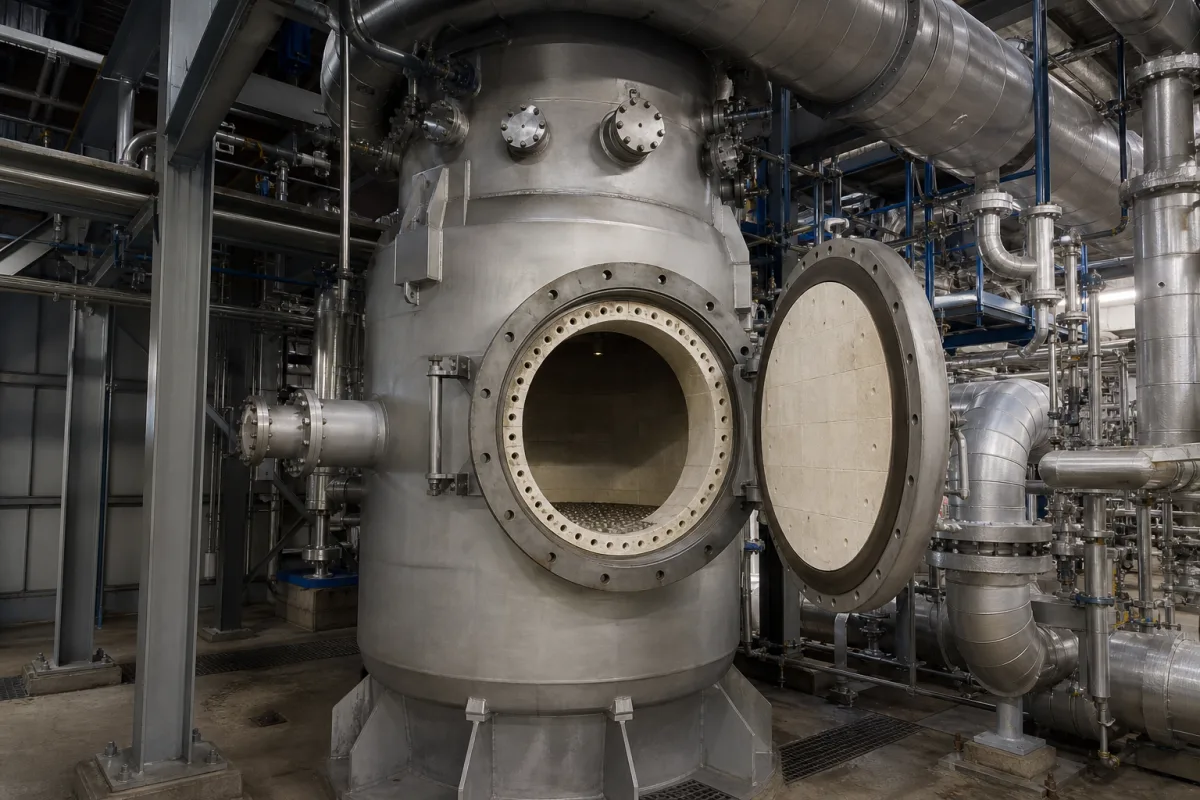
The primary pressure-containing structure of an ammonia oxidation reactor that houses the catalyst bed and reaction zone.
Product Specifications

Technical details and manufacturing context for Reactor Shell/Vessel

Definition
The reactor shell/vessel is the main structural component of an ammonia oxidation reactor, designed to withstand high temperatures and pressures while containing the exothermic oxidation reaction. It provides a sealed environment for the catalytic conversion of ammonia and oxygen to nitric oxide, typically operating at 800-950°C and 1-10 bar pressure. The vessel must maintain structural integrity under thermal cycling and corrosive conditions while supporting internal components like catalyst beds, heat exchangers, and distribution systems.
Working Principle
The shell/vessel contains the reaction environment where preheated ammonia-air mixture contacts platinum-rhodium catalyst gauzes. It withstands the exothermic heat of reaction (ΔH = -904 kJ/mol NH₃) and maintains pressure to optimize reaction kinetics and product yield. The vessel's design ensures proper gas distribution, temperature control, and safety containment during the oxidation process.
Common Materials
Stainless Steel 304/316L, Inconel 600/601, Hastelloy C-276
Technical Parameters
  • Shell diameter and thickness designed for pressure containment and thermal expansion (mm) Standard Spec
Components / BOM
  • Cylindrical Shell
    Primary pressure-containing section housing the reaction zone
    Material: Stainless steel or high-temperature alloy
  • Dished Ends
    Hemispherical or elliptical closures for pressure distribution
    Material: Same as shell material
  • Flanges
    Connection points for nozzles, manways, and instrument ports
    Material: Forged steel with matching material grade
  • Support Skirt
    Structural support transferring vessel weight to foundation
    Material: Carbon steel or low-alloy steel
  • Insulation Cladding
    Thermal insulation system to reduce heat loss
    Material: Stainless steel jacket with mineral wool
Engineering Reasoning
15-25 bar at 850-950°C
Yield strength threshold of 310 MPa at 950°C for Inconel 617, corresponding to 32.5 bar internal pressure
Design Rationale: Creep rupture due to sustained operation above 0.5Tm (melting point) of nickel-chromium alloy, with stress exceeding 0.8σ_y at operating temperature
Risk Mitigation (FMEA)
Trigger Catalyst bed channeling causing localized exothermic reaction at 1100°C
Mode: Thermal stress-induced circumferential cracking at weld HAZ
Strategy: Distributed thermocouple array with PID-controlled quench gas injection
Trigger Nitric acid condensation below 180°C dew point during shutdown
Mode: Intergranular corrosion at 0.5 mm/year in 304L stainless steel sections
Strategy: Positive-pressure nitrogen blanket system maintaining 2 bar during cooldown

Industry Taxonomies & Aliases

Commonly used trade names and technical identifiers for Reactor Shell/Vessel.

Applied To / Applications

This component is essential for the following industrial systems and equipment:

Industrial Ecosystem & Supply Chain DNA

Complementary Systems
Downstream Applications
Specialized Tooling

Application Fit & Sizing Matrix

Operational Limits
pressure: Up to 15 bar (design pressure with safety factor)
flow rate: Variable based on ammonia feed rate and catalyst bed design
temperature: 400-950°C (typical ammonia oxidation operating range)
slurry concentration: Not applicable (gas-phase reaction vessel)
Media Compatibility
✓ Ammonia-air mixtures ✓ Nitrogen oxides (NOx) process streams ✓ High-temperature steam
Unsuitable: Chloride-containing environments (risk of stress corrosion cracking)
Sizing Data Required
  • Ammonia feed rate (kg/hr)
  • Required conversion efficiency (%)
  • Catalyst bed volume/dimensions (m³)

Reliability & Engineering Risk Analysis

Failure Mode & Root Cause
Stress corrosion cracking
Cause: Combination of tensile stress (from pressure, thermal gradients, or residual welding stresses) and corrosive environment (e.g., chlorides, sulfides, or caustic agents) leading to crack initiation and propagation, often exacerbated by material sensitization in stainless steels or alloy degradation.
Localized corrosion/pitting
Cause: Breakdown of protective oxide layer due to chemical attack (e.g., from chlorides, acids, or oxidizing agents), stagnant conditions, or microbiologically influenced corrosion (MIC), resulting in localized metal loss that can penetrate the shell thickness and cause leaks or structural weakness.
Maintenance Indicators
  • Visible external corrosion, bulging, or distortion on the shell surface, especially near welds, nozzles, or support skirts, indicating potential loss of structural integrity or internal damage.
  • Audible or detected leaks (hissing, dripping) or sudden changes in pressure/temperature readings without operational cause, suggesting crack formation, gasket failure, or corrosion penetration.
Engineering Tips
  • Implement a rigorous corrosion monitoring program using non-destructive testing (NDT) methods such as ultrasonic thickness gauging, radiography, or acoustic emission testing at regular intervals, focusing on high-risk areas like welds, nozzles, and bottom sections where residues accumulate.
  • Optimize process controls to minimize thermal cycling and pressure fluctuations, ensure proper chemical dosing to maintain non-corrosive environments, and apply protective coatings or cathodic protection where applicable, coupled with thorough post-weld heat treatment (PWHT) to relieve residual stresses.

Compliance & Manufacturing Standards

Reference Standards
ISO 9001:2015 - Quality Management Systems ASME Boiler and Pressure Vessel Code Section VIII Division 1 PED 2014/68/EU - Pressure Equipment Directive
Manufacturing Precision
  • Wall Thickness: +/- 2.5% of nominal thickness
  • Circumferential Weld Misalignment: ≤ 1.5mm
Quality Inspection
  • Hydrostatic Pressure Test at 1.5x Design Pressure
  • Ultrasonic Testing of All Welds

Factories Producing Reactor Shell/Vessel

Verified manufacturers with capability to produce this product in China

✓ 95% Supplier Capability Match Found

P Procurement Specialist from Brazil Jan 11, 2026
★★★★★
"Great transparency on the Reactor Shell/Vessel components. Essential for our Chemical Manufacturing supply chain."
Technical Specifications Verified
T Technical Director from Canada Jan 08, 2026
★★★★★
"The Reactor Shell/Vessel we sourced perfectly fits our Chemical Manufacturing production line requirements."
Technical Specifications Verified
P Project Engineer from United States Jan 05, 2026
★★★★★
"Found 39+ suppliers for Reactor Shell/Vessel on CNFX, but this spec remains the most cost-effective."
Technical Specifications Verified
Verification Protocol

“Feedback is collected from verified sourcing managers during RFQ (Request for Quote) and factory evaluation processes on CNFX. These reports represent historical performance data and technical audit summaries from our B2B manufacturing network.”

12 sourcing managers are analyzing this specification now. Last inquiry for Reactor Shell/Vessel from Thailand (1h ago).

Supply Chain Compatible Machinery & Devices

Modular Distillation Column System

Pre-engineered modular system for continuous separation of chemical mixtures via distillation.

Explore Specs →
Automated Batch Crystallization System

Automated system for controlled crystallization of chemical compounds in batch processes.

Explore Specs →
Automated pH Monitoring and Dosing System

Automated system for continuous pH monitoring and chemical dosing in process streams.

Explore Specs →
Automated Powder Dispensing and Blending System

Automated system for precise dispensing and homogeneous blending of powdered chemicals.

Explore Specs →

Frequently Asked Questions

What materials are best for ammonia oxidation reactor shells?

Stainless Steel 304/316L, Inconel 600/601, and Hastelloy C-276 are preferred for their corrosion resistance and high-temperature strength in ammonia oxidation environments.

What are the key components in a reactor vessel BOM?

A typical bill of materials includes a cylindrical shell, dished ends, flanges, support skirt, and insulation cladding for structural integrity and thermal management.

How does the reactor shell handle high-pressure conditions?

The cylindrical shell with dished ends is designed to contain pressure, while materials like Inconel and Hastelloy provide durability under the stresses of ammonia oxidation reactions.

Can I contact factories directly on CNFX?

CNFX is an open directory, not a transaction platform. Each factory profile provides direct contact information and production details to help you initiate direct inquiries with Chinese suppliers.

Get Quote for Reactor Shell/Vessel

Request technical pricing, lead times, or customized specifications for Reactor Shell/Vessel directly from verified manufacturing units.

Your business information is encrypted and only shared with verified Reactor Shell/Vessel suppliers.

Thank you! Your message has been sent. We'll respond within 1–3 business days.

Need to Manufacture Reactor Shell/Vessel?

Connect with verified factories specializing in this product category

Add Your Factory Contact Us
Previous Product
Reactor Module
Next Product
Reagent Storage Hopper