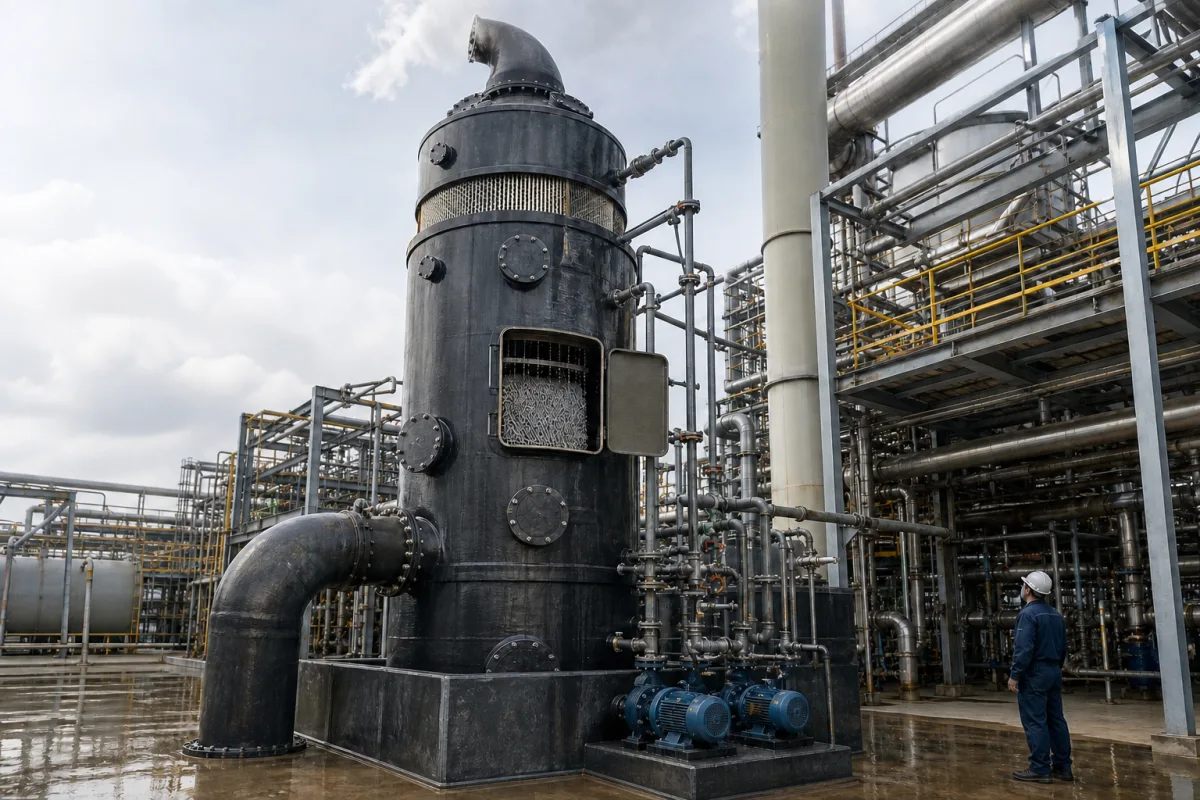
Wet scrubbers (packed-bed towers, spray and tray towers) for acid gases, ammonia, VOC and fine particulate from chemical and industrial exhausts · gas flow, inlet temperature and loading, removal efficiency, packing and liquid distribution, FRP construction, monitoring, cost
A wet scrubber removes pollutants from an exhaust gas by bringing it into close contact with a scrubbing liquid — water, or a solution that reacts with the pollutant — in a tower filled with packing, trays or sprays. Chemical plants and other industries use it for acid gases, ammonia, some organic vapours and fine dust. Ask three things first: which pollutants and concentrations must be removed and to what efficiency; the gas flow, temperature and dust loading; and how the used liquid will be treated or disposed of.
Wet gas scrubbers for industrial exhausts — packed-bed (packed-tower) absorbers, spray towers and tray (impingement-plate) towers, counter-current and cross-flow — with fans, recirculation pumps, chemical dosing and mist eliminators. Venturi scrubbers (see venturi scrubber), dry and semi-dry scrubbers, fabric filters, electrostatic precipitators and marine exhaust-gas scrubbers are outside this page except where compared.
CNFX editorial research · Sources checked October 12, 2026 · 4 sources
The US EPA's fact sheet on packed-bed/packed-tower wet scrubbers (EPA-452/F-03-015) describes them as wet scrubbers — called acid-gas scrubbers when used for inorganic gases — for inorganic fumes, vapours and gases such as chromic acid, hydrogen sulphide, ammonia, chlorides, fluorides and SO₂, for volatile organic compounds and for particulate matter including PM10 and PM2.5. Vendors estimate removal efficiencies of 95–99% for inorganic gases; for VOC, efficiencies range from 70% to over 99% depending on the pollutant and solvent. Typical gas flows are 0.25–35 sm³/s (500–75,000 scfm); inlet temperatures are 4–370 °C where particulate is controlled and 4–38 °C for gas absorption, since higher temperatures lower absorption and evaporate solvent; gaseous concentrations run 250–10,000 ppmv; and particulate is kept below about 0.45 g/sm³ to avoid clogging the bed. In the scrubber, liquid flows down over layers of packing held by mesh retainers, forming a thin film; vertical towers run gas upward against the liquid (counter-current) and some horizontal beds run gas across the packing (cross-flow). Advantages include relatively low pressure drop, FRP construction for highly corrosive atmospheres, and packing that can be changed to improve mass transfer; disadvantages include liquid disposal, wet waste, plugging by particulate, FRP's sensitivity to temperature and relatively high maintenance. [1]
Editorial note: give the supplier a full gas analysis — flow, temperature, moisture, each pollutant's concentration and the dust loading — so it can size packing height, liquid rate and chemistry, and state whether low outlet concentrations for organic vapours need a second control device, which EPA notes may be needed. [1]
Packing choice sets the contact area. Raschig and Jaeger's Mass Transfer Products bulletin 101 (circulated at Distillation & Absorption 2010) lists plastic Pall-Rings of 15, 25 and 90 mm at 350, 220 and 90 m²/m³ of surface with 88%, 91% and 94% free volume, weighing 110, 75 and 50 kg/m³ (268,640, 54,600 and 1,240 pieces per m³). Its plastic Raschig Super-Ring in sizes 0.6 and 2 gives 206 and 100 m²/m³ with 93% and 96% free volume at 62 and 55 kg/m³. The bulletin warns that poor liquid distribution cuts mass-transfer efficiency, that an inadequate support plate can raise pressure drop, and that packing has been damaged or swept away where no hold-down plate was fitted. [3]
Editorial calculation: a tower 1.5 m across with 3 m of 25 mm plastic Pall-Rings holds about 5.3 m³ of packing (π ÷ 4 × 1.5² × 3), about 1,170 m² of surface (5.3 × 220) and about 400 kg of packing (5.3 × 75), before liquid hold-up. The tower size is an assumed example. [3]
Give the supplier the pollutants and inlet concentrations, required outlet limits or removal efficiency, gas flow (normal and maximum), temperature, moisture and dust loading, scrubbing liquid and reagent (water, caustic, acid), construction material (FRP, PP, stainless), packing type, mist eliminator, fan and pump duties, effluent handling, instruments (pressure differential, liquid flow, pH/ORP), site layout, and applicable emission permits.
02
Plan monitoring, problems and cost
EPA's monitoring guidance for wet scrubbers used for gaseous control explains that the liquid absorbs the pollutant across large surface areas created by packing, mesh, grids, trays or sprays; that absorbers remove more than 90% depending on the pollutant; and that the primary performance indicators are pressure differential, liquid flow rate and outlet liquid concentration, with gas flow, neutralising-chemical feed and outlet gas temperature as secondary indicators. It lists operating problems including low gas or liquid flow, aerosol condensation, poor liquid distribution, liquid with high pollutant concentration, tray or plate collapse, air in-leakage, re-entrainment, freezing or plugged lines and scaling. [2] The fact sheet's 2002-dollar cost ranges for conventional packed-bed scrubbers on hydrochloric acid with caustic soda are USD 23,000–117,000 per sm³/s capital, USD 32,000–104,000 per sm³/s per year operating and maintenance, and USD 110–550 per tonne of pollutant controlled. [1]
Editorial calculation: at those 2002 capital rates, a 10 sm³/s (about 21,000 scfm) scrubber would have cost roughly USD 230,000–1,170,000 to purchase and install, before price changes since 2002 and before effluent treatment. Use current quotations for budgeting. [1]
03
Compare what suppliers offer
The companies in the manufacturer list below show this product on their own websites. Confirm the legal seller, factory and scope for your order.
When requesting quotations, ask each supplier for guaranteed outlet concentrations, pressure drop, liquid and reagent consumption, materials of construction, instrumentation and references on similar gases.
04
Size the mist eliminator by droplet size, velocity and liquid load
ACS Industries' engineering manual The Engineered Mist Eliminator (2004) gives design data for mist eliminators, which remove entrained liquid droplets from a gas stream. An engineered wire-mesh pad may remove 99.9% of droplets of 2 µm and larger, properly designed vane (chevron) units 99% of droplets down to 10 µm, and co-knit mesh suits droplets of 2–8 µm. Wire mesh accommodates liquid loads up to about one US gallon per square foot, vanes about twice as much. [4]
The manual sizes the face area from the Souders-Brown velocity, Vd = k × ((ρL − ρG) ÷ ρG)^½, with the k values in the table. Ideal air–water velocities are about 10 ft/s for plain wire mesh, 8.5 ft/s for co-knits and 14 ft/s for its vane units; acceptable velocities run from 25% to 125% of the ideal. Pressure drop across a properly sized pad or vane is never more than a few inches of water. [4]
Editorial calculation: 10 sm³/s through a mesh pad at 10 ft/s (3.05 m/s) needs about 3.3 m² of pad (10 ÷ 3.05), about 2.04 m across at actual conditions; the flow is an assumed example inside EPA's 0.25–35 sm³/s range. [4][1]
Fill the specification fields with values for your project
A wet scrubber quotation needs values for your project. The table explains each field, gives published values where a reviewed source states them, and says what to obtain from the supplier.
Explore company information and manufacturing capabilities, then discuss the scope of your project with a relevant supplier.
Share this page
Compiled and source-reviewed by the CNFX editorial team.
Published product pages show what a company offers, not tested performance. Confirm the legal seller, factory and scope for your order. How we source and review
· Page last updated 13 October 2026
Buyer questions
How efficient are packed-bed wet scrubbers?
EPA cites vendor estimates of 95–99% removal for inorganic gases; VOC removal ranges from 70% to over 99% depending on pollutant and solvent. [1]
What gas flows do packed-bed scrubbers handle?
EPA gives a range of 0.25–35 sm³/s (500–75,000 scfm). [1]
What should be monitored on a wet scrubber?
Pressure differential, liquid flow rate and outlet liquid concentration are the primary indicators. [2]
How much surface does scrubber packing give?
Raschig/Jaeger list plastic Pall-Rings at 350 m²/m³ (15 mm), 220 m²/m³ (25 mm) and 90 m²/m³ (90 mm), with 88–94% free volume. [3]
How fine a mist can a scrubber's mist eliminator remove?
ACS Industries' (AMACS) mist-eliminator manual says engineered wire mesh may remove 99.9% of droplets of 2 µm and larger, and properly designed vanes 99% of droplets down to 10 µm. [4]
Sources and what still needs a direct check
Sources checked 2026-10-12. Both sources are US EPA documents; the fact sheet's costs are in 2002 dollars.