Industry-Verified Manufacturing Data (2026)

Off-gas Cleaning System

Based on aggregated insights from multiple verified factory profiles within the CNFX directory, the standard Off-gas Cleaning System used in the Basic Metal Manufacturing sector typically supports operational capacities ranging from standard industrial configurations to heavy-duty production requirements.

Technical Definition & Core Assembly

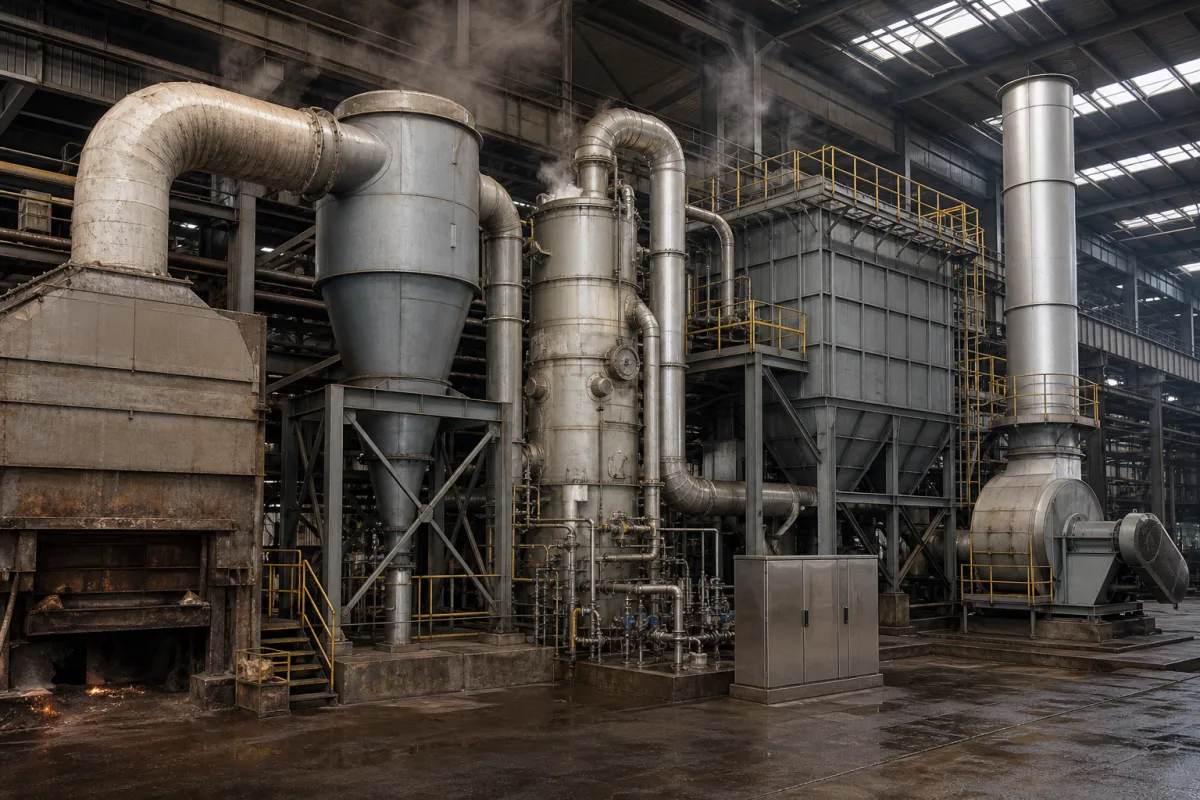
A canonical Off-gas Cleaning System is characterized by the integration of Quench Tower and Bag Filter House. In industrial production environments, manufacturers listed on CNFX commonly emphasize Carbon Steel construction to support stable, high-cycle operation across diverse manufacturing scenarios.

A system designed to remove pollutants and particulate matter from exhaust gases generated during steelmaking processes.

Product Specifications

Technical details and manufacturing context for Off-gas Cleaning System

Definition
An essential environmental control component within the Integrated Direct Reduction Iron and Electric Arc Furnace Steelmaking System, responsible for treating and cleaning the hot, dust-laden, and potentially toxic off-gases produced during the direct reduction of iron ore and subsequent melting in the electric arc furnace. Its primary role is to meet environmental regulations, recover process heat, and protect downstream equipment by removing particulate matter (dust), sulfur compounds, nitrogen oxides, and other contaminants before the cleaned gas is released into the atmosphere or recirculated.
Working Principle
The system typically operates by first cooling the high-temperature off-gas, often through water quenching or heat exchangers. The cooled gas then passes through a series of cleaning stages, which may include cyclones for coarse particle removal, bag filters or electrostatic precipitators for fine particulate collection, and scrubbers (wet or dry) for acid gas removal (e.g., SOx, HCl). The collected particulates (dust) are handled for disposal or recycling, while the cleaned gas is exhausted via a stack.
Common Materials
Carbon Steel, Stainless Steel (for corrosive sections), Refractory Linings, Filter Fabrics (e.g., PTFE, fiberglass)
Technical Parameters
  • Design gas flow rate capacity (Nm³/h) Per Request
Components / BOM
  • Quench Tower
    Rapidly cools the high-temperature off-gas by direct water injection to prevent damage to downstream filters and reduce gas volume.
    Material: Carbon Steel with refractory lining
  • Bag Filter House
    Removes fine particulate matter from the gas stream by passing it through fabric filter bags that capture dust on their surface.
    Material: Carbon Steel, PTFE/Glass Fiber Filter Bags
  • ID Fan
    Induced draft fan that provides the necessary pressure to move the gas through the entire cleaning system and out the stack.
    Material: Carbon Steel / Stainless Steel
  • Dust Handling System
    Collects, conveys, and stores the particulate matter removed from the gas, typically including hoppers, screw conveyors, and storage silos.
    Material: Carbon Steel
  • Scrubber
    Removes acid gases (SOx, HCl) and additional fine particulates through contact with a scrubbing liquid (water or reagent solution).
    Material: FRP (Fiber Reinforced Plastic) / Stainless Steel
Engineering Reasoning
0.5-2.0 bar differential pressure across filter media, 150-250°C gas inlet temperature, 10-30 m/s gas velocity in ductwork
Filter media rupture at 2.5 bar differential pressure, baghouse fabric degradation above 280°C, ductwork erosion at 35 m/s gas velocity
Design Rationale: Filter media tensile failure due to excessive pressure differential, polymer degradation via Arrhenius kinetics at elevated temperatures, abrasive wear following Finnie's erosion model at critical particle impact velocity
Risk Mitigation (FMEA)
Trigger Condensation formation due to gas temperature dropping below acid dew point (150°C for sulfuric acid)
Mode: Corrosive attack on carbon steel ductwork following Arrhenius corrosion kinetics
Strategy: Insulated ductwork with temperature monitoring and automatic bypass to maintain gas temperature above 180°C
Trigger Pulse-jet cleaning system solenoid valve coil failure due to 24VDC supply voltage drop below 18V
Mode: Filter bag blinding and pressure drop exceeding 2.5 bar across filter media
Strategy: Redundant power supply with automatic transfer switch and voltage monitoring at 20V threshold

Industry Taxonomies & Aliases

Commonly used trade names and technical identifiers for Off-gas Cleaning System.

Industrial Ecosystem & Supply Chain DNA

Complementary Systems
Downstream Applications
Specialized Tooling

Application Fit & Sizing Matrix

Operational Limits
pressure: Up to 1.5 bar (g) maximum system pressure
flow rate: 10,000-500,000 Nm³/h (standard design range)
temperature: 50-400°C (typical operating range)
slurry concentration: 5-15% solids by weight (optimal range)
Media Compatibility
✓ Wet scrubbing with alkaline slurry (e.g., lime/limestone) ✓ Venturi scrubber configuration for high-efficiency particulate removal ✓ Fabric filter baghouse for dry particulate collection
Unsuitable: High-chloride environments (>1000 ppm) due to corrosion risks
Sizing Data Required
  • Exhaust gas volumetric flow rate (Nm³/h)
  • Inlet particulate loading (g/Nm³)
  • Required outlet emission concentration (mg/Nm³)

Reliability & Engineering Risk Analysis

Failure Mode & Root Cause
Corrosion-induced perforation
Cause: Exposure to acidic gases (e.g., SOx, NOx) and chlorides forming corrosive condensates, accelerated by temperature cycling and material incompatibility.
Filter media blinding/plugging
Cause: Accumulation of particulate matter (e.g., fly ash, unburned carbon) beyond design capacity, often due to improper upstream process control or inadequate cleaning cycle optimization.
Maintenance Indicators
  • Visible particulate emissions or opacity increase at stack outlet indicating filter breach or seal failure.
  • Abnormally high system pressure drop accompanied by audible straining or whistling from blowers/fans, signaling flow restriction.
Engineering Tips
  • Implement real-time corrosion monitoring with ultrasonic thickness testing at critical zones (e.g., duct transitions, quench sections) and upgrade to corrosion-resistant alloys or linings based on gas analysis.
  • Optimize pulse-jet cleaning cycles using differential pressure trend analysis and install pre-filtration (e.g., cyclone separators) to reduce particulate loading on final filter stages.

Compliance & Manufacturing Standards

Reference Standards
ISO 8573-1:2010 (Compressed air purity classes and contaminants) ANSI/ASME B31.3:2022 (Process piping design and construction) DIN EN 1092-1:2018 (Flanges and their joints for piping systems)
Manufacturing Precision
  • Pipe wall thickness: +/-0.5mm for corrosion allowance
  • Flange bolt hole alignment: +/-1.0mm for assembly
Quality Inspection
  • Leakage test (pressure decay method per ISO 20486)
  • Material verification test (X-ray fluorescence analysis for alloy composition)

Factories Producing Off-gas Cleaning System

Verified manufacturers with capability to produce this product in China

✓ 97% Supplier Capability Match Found

P Procurement Specialist from Canada Jan 19, 2026
★★★★★
"Standard OEM quality for Basic Metal Manufacturing applications. The Off-gas Cleaning System arrived with full certification."
Technical Specifications Verified
T Technical Director from United States Jan 16, 2026
★★★★★
"Great transparency on the Off-gas Cleaning System components. Essential for our Basic Metal Manufacturing supply chain."
Technical Specifications Verified
P Project Engineer from United Arab Emirates Jan 13, 2026
★★★★★
"The Off-gas Cleaning System we sourced perfectly fits our Basic Metal Manufacturing production line requirements."
Technical Specifications Verified
Verification Protocol

“Feedback is collected from verified sourcing managers during RFQ (Request for Quote) and factory evaluation processes on CNFX. These reports represent historical performance data and technical audit summaries from our B2B manufacturing network.”

19 sourcing managers are analyzing this specification now. Last inquiry for Off-gas Cleaning System from USA (1h ago).

Supply Chain Compatible Machinery & Devices

Vacuum Induction Melting Furnace

Industrial furnace for melting metals under vacuum using electromagnetic induction

Explore Specs →
Electroslag Remelting Furnace

Secondary refining furnace for high-quality metal ingots

Explore Specs →
Molten Metal Flow Control Valve

Precision valve for regulating molten metal flow in casting and pouring operations.

Explore Specs →
Molten Metal Temperature Measurement System

Automated system for continuous temperature monitoring of molten metals during processing.

Explore Specs →

Frequently Asked Questions

What pollutants does this off-gas cleaning system remove from steelmaking exhaust?

Our system effectively removes particulate matter, sulfur oxides, nitrogen oxides, and other pollutants generated during steelmaking processes using a combination of bag filtration and scrubbing technologies.

Why are different materials like carbon steel and stainless steel used in the construction?

Carbon steel provides structural strength for most components, while stainless steel is used in corrosive sections to withstand acidic gases. Refractory linings protect against high temperatures, and PTFE/fiberglass filter fabrics handle particulate filtration.

How does the system handle varying gas volumes and temperatures from steelmaking operations?

The system includes a quench tower for rapid gas cooling, adjustable ID fans for volume control, and temperature-resistant components that maintain efficiency across the operational range of steelmaking exhaust conditions.

Can I contact factories directly on CNFX?

CNFX is an open directory, not a transaction platform. Each factory profile provides direct contact information and production details to help you initiate direct inquiries with Chinese suppliers.

Get Quote for Off-gas Cleaning System

Request technical pricing, lead times, or customized specifications for Off-gas Cleaning System directly from verified manufacturing units.

Your business information is encrypted and only shared with verified Off-gas Cleaning System suppliers.

Thank you! Your message has been sent. We'll respond within 1–3 business days.

Need to Manufacture Off-gas Cleaning System?

Connect with verified factories specializing in this product category

Add Your Factory Contact Us
Previous Product
Nozzle Body
Next Product
Oscillation Actuator