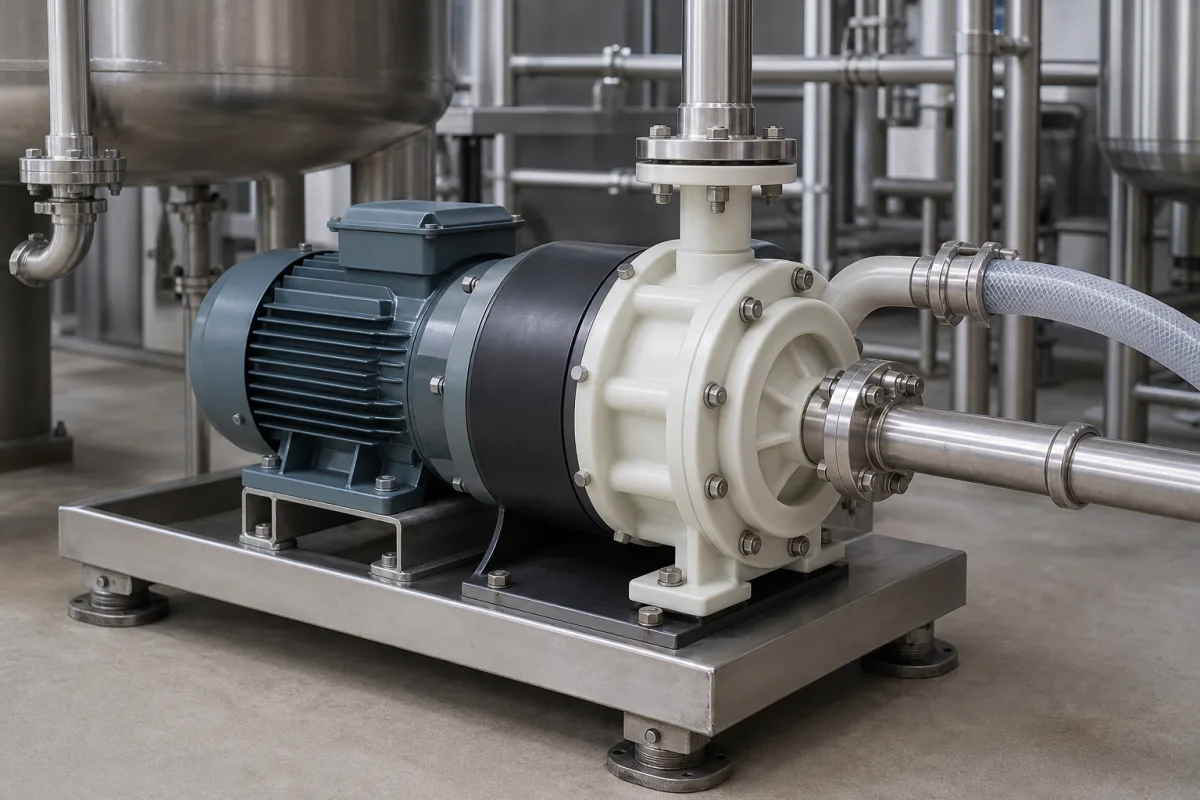
Solution pump in polypropylene or PVDF: centrifugal transfer of acids, caustics and plating solutions
Thermoplastic centrifugal pumps for acids, caustics and plating solutions · polypropylene versus PVDF wetted ends, temperature and pH limits, and motor power for dense solutions
Plating, printed-circuit-board, chemical processing and cleaning lines move acid, caustic and plating solutions between tanks. A solution pump for this duty is a centrifugal pump whose casing, impeller and wetted parts are moulded from polypropylene or PVDF. Buying one means matching the plastic to the solution's temperature and pH, choosing elastomers, bushings and shaft materials for the same chemistry, and sizing the motor for the solution's density rather than for water.
Centrifugal pumps with moulded polypropylene or PVDF wetted parts, sealed or magnetically driven, for transferring and circulating acids, caustics, plating and etching solutions. Industrial pumps across all pumping principles are covered on the Industrial pumps page; metal ISO 2858 / ISO 5199 chemical process pumps, glycol coolant pumps, cooling-water pumps, dosing skids and precision metering pumps have their own pages. Peristaltic, diaphragm and metal magnetic-drive pumps are outside this page.
CNFX editorial research · Sources checked October 12, 2026 · 6 sources
Polypropylene or PVDF wetted ends: temperature ceilings and pH limits
Finish Thompson lists the same maximum temperatures for its sealless DB series and its mechanically sealed GP series: 180 °F (82 °C) in polypropylene and 220 °F (104 °C) in PVDF. [1][3] Arkema, the maker of Kynar PVDF, gives as a guideline at ambient temperature a resistance limit of pH 12 for its PVDF homopolymers and pH 13.5 for its Kynar Flex copolymers, and names hot-acid applications among the uses of the resin. [5]
Arkema lists factors that change chemical resistance: exposure time, concentration, extreme temperature and pressure, temperature and pressure cycling, abrasive particles and the type of mechanical stress, and warns that certain combinations of chemical exposure and mechanical load can induce stress cracking. It recommends trial installations under actual service conditions, noting that immersion tests in individual chemicals do not predict behaviour when chemicals react exothermically together. [5]
The plastic body is only part of the wetted path. On Finish Thompson's DB11 the buyer also chooses O-rings in FKM, EPDM, Simriz or Kalrez, bushings in carbon, PTFE, ceramic or SiC, and shafts in ceramic or Hastelloy; its GP series offers bellows, multi-spring or double seals mounted externally. [2][3] Editorial note: a strong caustic near or above pH 12 is the case to ask whether the PVDF offered is a homopolymer or a copolymer grade, and to check every elastomer against the same solution and temperature.
Give the supplier each solution's chemical names, concentrations, pH, temperature range and any solids, and ask for a compatibility statement covering the casing plastic, O-rings, bushings, shaft and seal faces.
02
Dense solutions: specific gravity, motor power and working pressure
The Department of Energy and Hydraulic Institute sourcebook Improving Pumping System Performance gives fluid power in horsepower as head (ft) × flow (gpm) × specific gravity ÷ 3,960, and notes that specific gravity affects the energy required to lift and move the fluid and must be considered when determining pump power requirements. [6]
Finish Thompson states the DB11's power range as 0.28 to 1.74 hp and 0.37 to 1.38 kW, both based on a specific gravity of 1.0; the two figures are listed against 3,450 and 2,900 rpm columns and do not convert into each other, so confirm which applies to your supply frequency. [2] For the GP series it lists maximum suction pressure of 15 psi (1 bar) with a bellows seal and 65 psi (4.5 bar) with a multi-spring seal. [3]
Editorial calculation with the DOE formula: 50 gpm against 50 ft of head needs 50 × 50 × 1.0 ÷ 3,960 = 0.63 hp of fluid power for water, and 1.14 hp for a solution of specific gravity 1.8 at the same flow and head. Applied to the DB11's 1.74 hp upper figure at specific gravity 1.0, the same head and flow at 1.8 would need about 3.1 hp, before efficiency changes. [6][2]
State the solution's specific gravity and viscosity at operating temperature with flow and head, so the supplier sizes the motor and, for magnetic-drive pumps, the magnet coupling for the actual density.
03
Send the solution chemistry, the duty point and the density
Paste it into your enquiry below or into an email to a maker, then replace every bracket.
Solution: [chemicals; concentration; pH; solids]
Temperature: [minimum; maximum; cleaning]
Duty point: [flow; head; suction conditions]
Density: [specific gravity; viscosity at temperature]
Design: [sealed or magnetic drive; dry-running protection]
Materials: [PP or PVDF; O-rings; bushings; shaft; seal]
Motor: [voltage; frequency; enclosure]
Explore company information and manufacturing capabilities, then discuss the scope of your project with a relevant supplier.
Share this page
Compiled and source-reviewed by the CNFX editorial team.
Each manufacturer above links to the page on that company's own website where the product is listed, with the date we checked it. How we source and review
· Page last updated 13 October 2026
Buyer questions
How hot can a plastic solution pump run?
Finish Thompson rates its polypropylene DB and GP pumps to 82 °C (180 °F) and its PVDF versions to 104 °C (220 °F). [1][3]
Can PVDF pumps handle caustic solutions?
Arkema gives pH 12 as the limit for its PVDF homopolymers and pH 13.5 for its Kynar Flex copolymers at ambient temperature, as a general guideline. [5]
Why does a dense solution need a bigger motor?
Fluid power equals head × flow × specific gravity ÷ 3,960 (in hp, ft and gpm), so at the same flow and head a solution of specific gravity 1.8 needs 1.8 times the power of water. [6]
What else in the pump touches the solution?
On Finish Thompson's DB11, the O-rings (FKM, EPDM, Simriz or Kalrez), bushings (carbon, PTFE, ceramic or SiC) and shaft (ceramic or Hastelloy). [2]
Sources and what still needs a direct check
Sources checked 2026-10-12. Finish Thompson pages give published limits for two plastic centrifugal pump series; Arkema's Kynar PVDF brochure states the resin's chemical-resistance limits; the DOE and Hydraulic Institute sourcebook gives the fluid-power relationship with specific gravity.