Industry-Verified Manufacturing Data (2026)

Signal Cable

Based on aggregated insights from multiple verified factory profiles within the CNFX directory, the standard Signal Cable used in the Chemical Manufacturing sector typically supports operational capacities ranging from standard industrial configurations to heavy-duty production requirements.

Technical Definition & Core Assembly

A canonical Signal Cable is characterized by the integration of Conductor and Insulation Layer. In industrial production environments, manufacturers listed on CNFX commonly emphasize Copper conductor construction to support stable, high-cycle operation across diverse manufacturing scenarios.

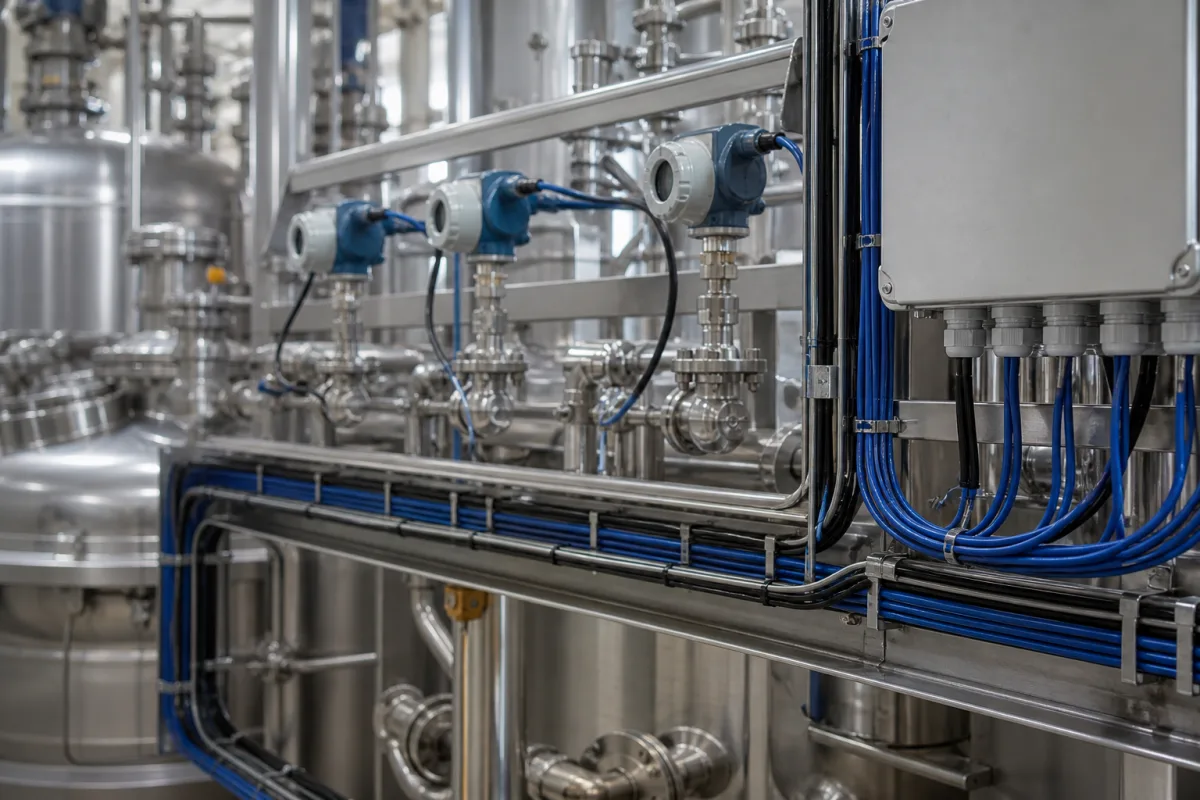
Electrical cable designed to transmit temperature measurement signals from a sensor probe to monitoring equipment.
Product Specifications

Technical details and manufacturing context for Signal Cable

Definition
A specialized cable that serves as the transmission medium for electrical signals generated by temperature sensors within chemical reactor temperature sensor probes. It carries analog or digital temperature data from the sensing element to data acquisition systems, controllers, or display units, ensuring accurate signal integrity in industrial environments.
Working Principle
The signal cable transmits electrical signals (typically low-voltage analog signals like 4-20mA, or digital signals) generated by temperature sensing elements (thermocouples, RTDs, or thermistors) through conductive wires. It maintains signal integrity by providing proper insulation, shielding against electromagnetic interference (EMI), and protection from environmental factors like heat, chemicals, and mechanical stress.
Common Materials
Copper conductor, PTFE/Teflon insulation, Stainless steel braided shield, Silicone/PVC outer jacket
Technical Parameters
  • Cable diameter typically ranges from 3-10mm depending on conductor count and insulation requirements (mm) Customizable
Components / BOM
  • Conductor
    Carries electrical signals from the temperature sensor
  • Insulation Layer
    Prevents electrical short circuits and protects conductors
  • Shielding
    Protects signal integrity from electromagnetic interference
  • Outer Jacket
    Provides mechanical protection and chemical resistance
  • Connector Termination
    Interface for connecting to sensor probe and monitoring equipment
Engineering Reasoning
-200°C to +260°C with 24 AWG copper conductors carrying 0-10 VDC signals at 4-20 mA current loop
Insulation breakdown at 300°C for PTFE materials, conductor fatigue failure at 10^7 bending cycles with 25 mm radius, signal attenuation exceeding -3 dB at 100 kHz frequency
Design Rationale: Thermal degradation of polymer insulation exceeding glass transition temperature, work hardening of copper conductors from cyclic mechanical stress, skin effect and dielectric losses at high frequencies
Risk Mitigation (FMEA)
Trigger Electromagnetic interference from adjacent 480 VAC power cables at 60 Hz
Mode: Signal-to-noise ratio degradation below 20 dB causing temperature measurement errors exceeding ±2°C
Strategy: Twisted pair configuration with 32 twists per meter and aluminum foil shielding with 90% coverage
Trigger Moisture ingress through compromised cable jacket at 85% relative humidity
Mode: Insulation resistance drop below 100 MΩ·km causing signal leakage current above 1 μA
Strategy: Radial water-blocking gel filling with 0.3 mm thickness and hermetic connector sealing rated IP68

Industry Taxonomies & Aliases

Commonly used trade names and technical identifiers for Signal Cable.

Applied To / Applications

This component is essential for the following industrial systems and equipment:

Industrial Ecosystem & Supply Chain DNA

Complementary Systems
Downstream Applications
Specialized Tooling

Application Fit & Sizing Matrix

Operational Limits
pressure: Atmospheric to 10 bar (typical), up to 20 bar with reinforced jacket
other spec: Bending radius: ≥10x cable diameter, Signal integrity: ≤0.1% error at 100m length
temperature: -40°C to 200°C (continuous), up to 250°C (short-term)
Media Compatibility
✓ Industrial process fluids (water, oils, chemicals) ✓ Food-grade environments (FDA-approved jacket materials) ✓ Corrosive atmospheres (with PTFE/FEP insulation)
Unsuitable: Direct immersion in strong acids/bases without specialized chemical-resistant jacketing
Sizing Data Required
  • Signal type (mV, mA, RTD, thermocouple type)
  • Required cable length and voltage drop tolerance
  • Environmental exposure (temperature extremes, chemical contact, mechanical stress)

Reliability & Engineering Risk Analysis

Failure Mode & Root Cause
Insulation breakdown
Cause: Exposure to moisture, chemicals, or excessive heat leading to dielectric failure and short circuits
Conductor fatigue/fracture
Cause: Repeated bending, vibration, or mechanical stress causing wire breakage and signal loss
Maintenance Indicators
  • Intermittent signal transmission or complete signal loss
  • Visible damage to cable jacket (cracks, cuts, abrasion) or exposed conductors
Engineering Tips
  • Install cables with proper bend radius protection and strain relief at termination points
  • Use appropriate cable routing and shielding to protect from environmental hazards and electromagnetic interference

Compliance & Manufacturing Standards

Reference Standards
ISO 11801: Information technology - Generic cabling for customer premises ANSI/TIA-568.2-D: Balanced Twisted-Pair Telecommunications Cabling and Components Standards CE Marking: Compliance with EU directives for electromagnetic compatibility (EMC) and low voltage (LVD)
Manufacturing Precision
  • Conductor diameter: +/-0.02mm
  • Insulation thickness: +/-0.1mm
Quality Inspection
  • Continuity and Resistance Test
  • High Voltage Dielectric Strength Test

Factories Producing Signal Cable

Verified manufacturers with capability to produce this product in China

✓ 94% Supplier Capability Match Found

P Project Engineer from United Arab Emirates Feb 14, 2026
★★★★★
"The Signal Cable we sourced perfectly fits our Chemical Manufacturing production line requirements."
Technical Specifications Verified
S Sourcing Manager from Australia Feb 11, 2026
★★★★★
"Found 55+ suppliers for Signal Cable on CNFX, but this spec remains the most cost-effective."
Technical Specifications Verified
P Procurement Specialist from Singapore Feb 08, 2026
★★★★★
"The technical documentation for this Signal Cable is very thorough, especially regarding technical reliability."
Technical Specifications Verified
Verification Protocol

“Feedback is collected from verified sourcing managers during RFQ (Request for Quote) and factory evaluation processes on CNFX. These reports represent historical performance data and technical audit summaries from our B2B manufacturing network.”

8 sourcing managers are analyzing this specification now. Last inquiry for Signal Cable from Brazil (1h ago).

Supply Chain Compatible Machinery & Devices

Continuous Flow Reactor System

Automated chemical synthesis system for continuous production.

Explore Specs →
Modular Distillation Column System

Pre-engineered modular system for continuous separation of chemical mixtures via distillation.

Explore Specs →
Automated Batch Crystallization System

Automated system for controlled crystallization of chemical compounds in batch processes.

Explore Specs →
Automated pH Monitoring and Dosing System

Automated system for continuous pH monitoring and chemical dosing in process streams.

Explore Specs →

Frequently Asked Questions

What makes this signal cable suitable for chemical manufacturing environments?

This cable features PTFE/Teflon insulation resistant to chemicals and high temperatures, stainless steel braided shielding for EMI protection, and durable silicone/PVC outer jacket for harsh industrial conditions.

What temperature range can this signal cable withstand?

With PTFE insulation and appropriate materials, this cable typically operates reliably in temperatures from -60°C to +200°C, making it ideal for chemical process monitoring applications.

How does the shielding protect signal integrity in chemical plants?

The stainless steel braided shield provides electromagnetic interference (EMI) protection, preventing signal distortion from nearby electrical equipment while offering mechanical protection in corrosive environments.

Can I contact factories directly on CNFX?

CNFX is an open directory, not a transaction platform. Each factory profile provides direct contact information and production details to help you initiate direct inquiries with Chinese suppliers.

Get Quote for Signal Cable

Request technical pricing, lead times, or customized specifications for Signal Cable directly from verified manufacturing units.

Your business information is encrypted and only shared with verified Signal Cable suppliers.

Thank you! Your message has been sent. We'll respond within 1–3 business days.

Need to Manufacture Signal Cable?

Connect with verified factories specializing in this product category

Add Your Factory Contact Us
Previous Product
Sight Glass Assembly
Next Product
Solution Pump