Industry-Verified Manufacturing Data (2026)

Temperature Control Jacket

Based on aggregated insights from multiple verified factory profiles within the CNFX directory, the standard Temperature Control Jacket used in the Chemical Manufacturing sector typically supports operational capacities ranging from standard industrial configurations to heavy-duty production requirements.

Technical Definition & Core Assembly

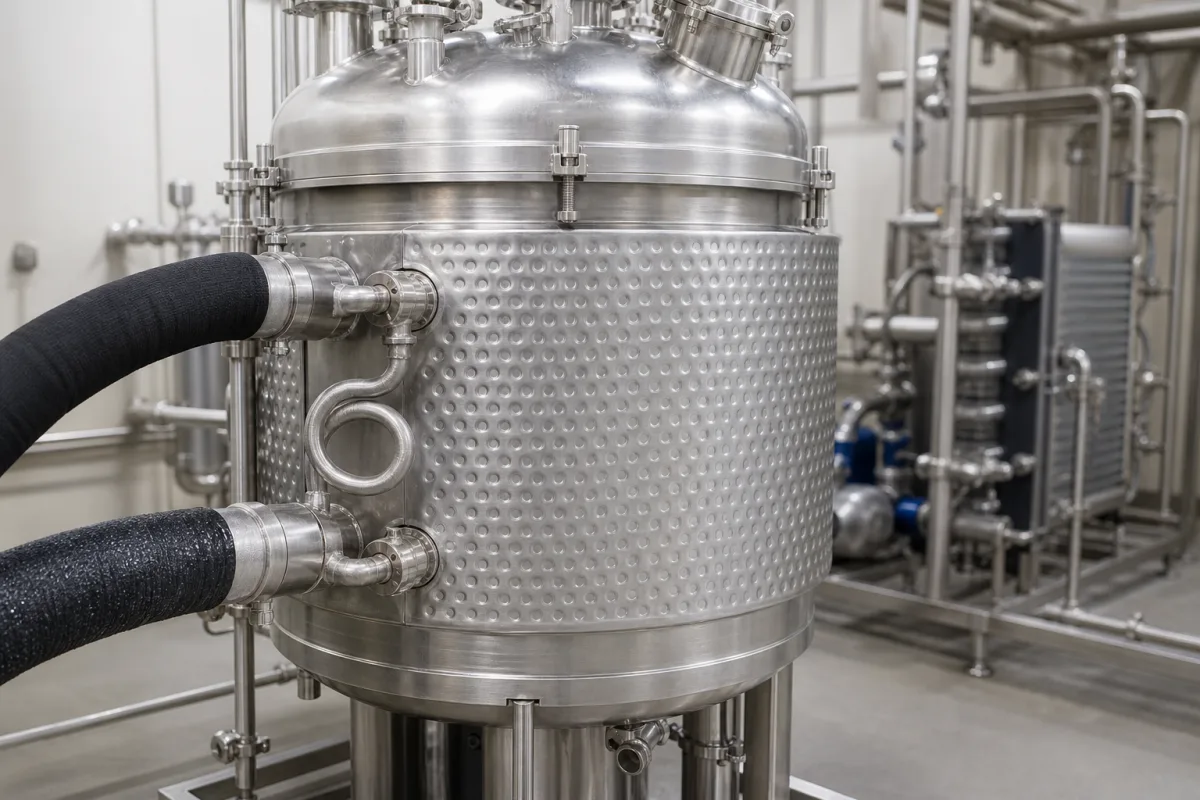
A canonical Temperature Control Jacket is characterized by the integration of Jacket Shell and Inlet/Outlet Nozzles. In industrial production environments, manufacturers listed on CNFX commonly emphasize Stainless Steel (e.g., 316L) construction to support stable, high-cycle operation across diverse manufacturing scenarios.

A thermal management component that surrounds a reaction vessel to precisely control its temperature.
Product Specifications

Technical details and manufacturing context for Temperature Control Jacket

Definition
A temperature control jacket is an essential part of a Reaction Module, designed as an outer shell or sleeve that encloses a reactor vessel. Its primary function is to regulate the temperature of the contents within the reactor by circulating a heating or cooling medium (such as water, oil, or steam) through the jacket's internal channels. This enables precise thermal control for chemical processes, ensuring optimal reaction conditions, safety, and product quality.
Working Principle
The jacket operates by circulating a heat transfer fluid through a sealed space between the inner wall of the jacket and the outer wall of the reactor vessel. A temperature control unit (TCU) heats or cools the fluid, which then transfers thermal energy to or from the reactor wall via conduction, thereby controlling the temperature of the reactor's contents. The flow rate and temperature of the fluid are adjusted to maintain the desired setpoint.
Common Materials
Stainless Steel (e.g., 316L), Carbon Steel, Hastelloy
Technical Parameters
  • Jacket thickness, typically ranging from 3mm to 10mm depending on pressure and thermal requirements. (mm) Customizable
Components / BOM
  • Jacket Shell
    Forms the outer pressure boundary and contains the heat transfer fluid.
    Material: Stainless Steel
  • Inlet/Outlet Nozzles
    Connections for the entry and exit of the heat transfer fluid.
    Material: Stainless Steel
  • Baffles/Channels
    Internal structures to direct fluid flow and enhance heat transfer efficiency.
    Material: Stainless Steel
  • Insulation Cladding
    External layer to minimize heat loss to the environment.
    Material: Mineral Wool or Polyurethane Foam
Engineering Reasoning
-40°C to 200°C with ±0.5°C control accuracy
Thermal stress exceeding 250 MPa at 220°C differential across 5 mm stainless steel wall
Design Rationale: Thermal fatigue from cyclic heating/cooling exceeding material yield strength (ASTM A240 316L: 170 MPa at 200°C)
Risk Mitigation (FMEA)
Trigger Coolant flow interruption for >120 seconds at 180°C setpoint
Mode: Localized boiling causing 15°C hot spots and polymer degradation
Strategy: Redundant pumps with 2-out-of-3 voting logic and 30-second backup battery
Trigger PID controller integral windup during 50°C/min ramp rates
Mode: Overshoot exceeding 8°C beyond setpoint causing exothermic runaway
Strategy: Anti-windup compensation with 0.05-1.0 min⁻¹ reset rate limiting

Industry Taxonomies & Aliases

Commonly used trade names and technical identifiers for Temperature Control Jacket.

Applied To / Applications

This component is essential for the following industrial systems and equipment:

Industrial Ecosystem & Supply Chain DNA

Complementary Systems
Downstream Applications
Specialized Tooling

Application Fit & Sizing Matrix

Operational Limits
pressure: Up to 10 bar
flow rate: 5-50 L/min
temperature: -40°C to 200°C
slurry concentration: Up to 30% solids by weight
Media Compatibility
✓ Water/Glycol Mixtures ✓ Thermal Oils (e.g., Syltherm) ✓ Process Fluids (non-corrosive)
Unsuitable: Highly corrosive acids (e.g., concentrated sulfuric acid)
Sizing Data Required
  • Vessel Outer Diameter and Height
  • Required Heat Transfer Rate (kW)
  • Process Temperature Setpoint and Ambient Conditions

Reliability & Engineering Risk Analysis

Failure Mode & Root Cause
Corrosion and scaling
Cause: Chemical attack from process fluids or cooling media, leading to material degradation and reduced heat transfer efficiency, often exacerbated by improper material selection or water treatment.
Thermal fatigue cracking
Cause: Repeated thermal cycling (heating and cooling) causing stress concentrations at weld joints or material transitions, leading to crack initiation and propagation, often due to rapid temperature changes or poor design.
Maintenance Indicators
  • Visible external leaks or weeping at connections, welds, or seals, indicating potential jacket integrity failure.
  • Audible hissing or gurgling sounds from the jacket, suggesting steam or fluid flow issues, blockages, or internal leaks.
Engineering Tips
  • Implement routine water quality monitoring and treatment (e.g., pH control, anti-scaling agents) to prevent corrosion and scaling, and ensure compatible materials are used for the jacket and process media.
  • Use gradual temperature ramping protocols and avoid sudden thermal shocks to minimize thermal stress; inspect and reinforce critical weld areas during scheduled maintenance.

Compliance & Manufacturing Standards

Reference Standards
ISO 9001:2015 - Quality management systems ASME B31.3 - Process piping design and construction EN 13445 - Pressure vessel design and testing
Manufacturing Precision
  • Jacket bore diameter: +/-0.05mm
  • Surface flatness: 0.15mm per meter
Quality Inspection
  • Hydrostatic pressure test at 1.5x working pressure
  • Dimensional verification with coordinate measuring machine (CMM)

Factories Producing Temperature Control Jacket

Verified manufacturers with capability to produce this product in China

✓ 97% Supplier Capability Match Found

P Procurement Specialist from Canada Jan 27, 2026
★★★★★
"Reliable performance in harsh Chemical Manufacturing environments. No issues with the Temperature Control Jacket so far."
Technical Specifications Verified
T Technical Director from United States Jan 24, 2026
★★★★★
"Testing the Temperature Control Jacket now; the technical reliability results are within 1% of the laboratory datasheet."
Technical Specifications Verified
P Project Engineer from United Arab Emirates Jan 21, 2026
★★★★★
"Impressive build quality. Especially the technical reliability is very stable during long-term operation."
Technical Specifications Verified
Verification Protocol

“Feedback is collected from verified sourcing managers during RFQ (Request for Quote) and factory evaluation processes on CNFX. These reports represent historical performance data and technical audit summaries from our B2B manufacturing network.”

11 sourcing managers are analyzing this specification now. Last inquiry for Temperature Control Jacket from UAE (1h ago).

Supply Chain Compatible Machinery & Devices

Continuous Flow Reactor System

Automated chemical synthesis system for continuous production.

Explore Specs →
Modular Distillation Column System

Pre-engineered modular system for continuous separation of chemical mixtures via distillation.

Explore Specs →
Automated Batch Crystallization System

Automated system for controlled crystallization of chemical compounds in batch processes.

Explore Specs →
Automated pH Monitoring and Dosing System

Automated system for continuous pH monitoring and chemical dosing in process streams.

Explore Specs →

Frequently Asked Questions

What materials are available for temperature control jackets in chemical manufacturing?

Our temperature control jackets are available in 316L stainless steel, carbon steel, and Hastelloy alloys to withstand various chemical processes and corrosion requirements.

How does the jacket maintain precise temperature control for reaction vessels?

The jacket features internal baffles/channels that circulate heating or cooling fluids uniformly around the vessel, while insulation cladding minimizes heat loss for consistent thermal management.

Can temperature control jackets be customized for specific chemical processes?

Yes, we offer customization of nozzle configurations, jacket dimensions, and material selection to match your reactor specifications and process temperature requirements.

Can I contact factories directly on CNFX?

CNFX is an open directory, not a transaction platform. Each factory profile provides direct contact information and production details to help you initiate direct inquiries with Chinese suppliers.

Get Quote for Temperature Control Jacket

Request technical pricing, lead times, or customized specifications for Temperature Control Jacket directly from verified manufacturing units.

Your business information is encrypted and only shared with verified Temperature Control Jacket suppliers.

Thank you! Your message has been sent. We'll respond within 1–3 business days.

Need to Manufacture Temperature Control Jacket?

Connect with verified factories specializing in this product category

Add Your Factory Contact Us
Previous Product
Temperature Control
Next Product
Temperature Control Unit