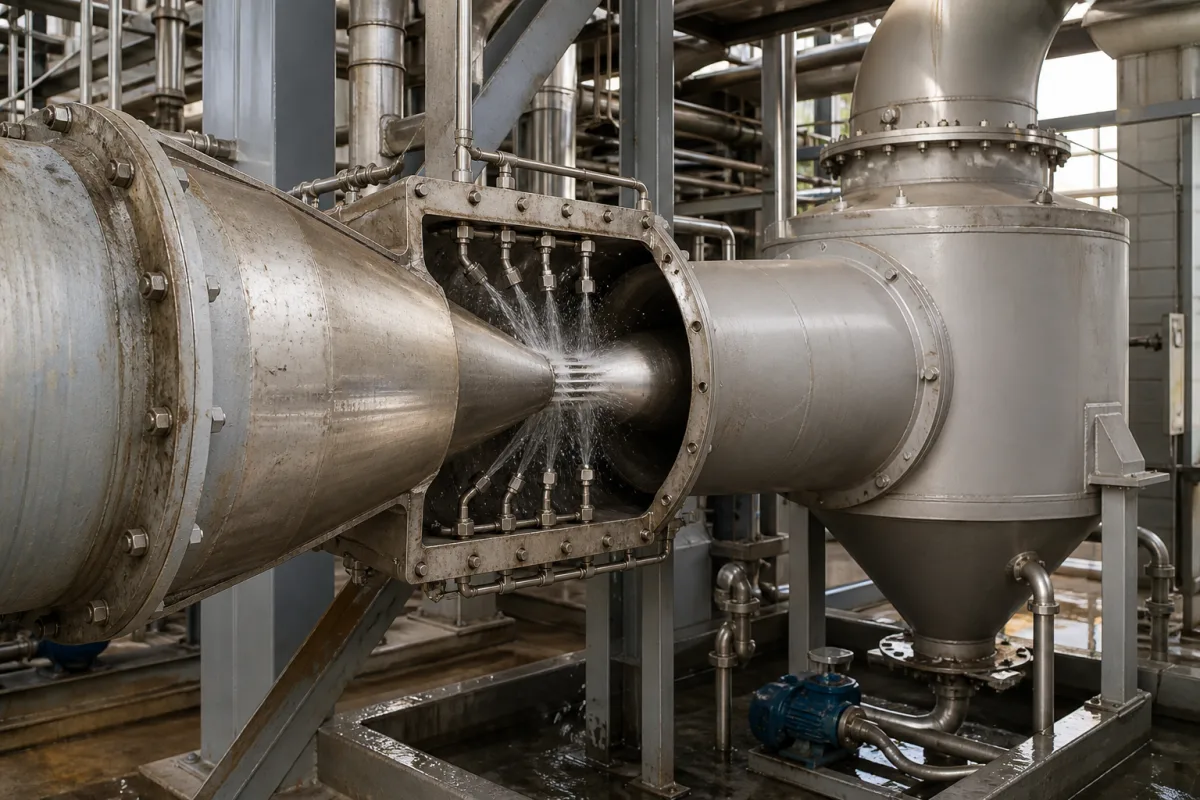
Venturi wet scrubbers · PM collection from 70% to over 99%, throat velocity and pressure drop, liquid-to-gas ratio, fixed and variable throats, flooded elbows and entrainment separators, and the wastewater and sludge they create
A venturi scrubber is a wet scrubber in which the exhaust gas is accelerated through a narrow throat, where scrubbing liquid is atomised into fine droplets that capture particles and soluble gases, before an entrainment separator removes the wetted droplets. Ask three things first: what particle size and removal efficiency the permit requires, what pressure drop and fan power that implies, and how the liquid, slurry and sludge will be handled.
Venturi wet scrubbers (fixed-throat, variable-throat, multiple-throat, ejector-venturi) with their liquid injection and entrainment separators, for particulate and soluble-gas control. Packed-bed gas absorbers, dry scrubbers, fabric filters and electrostatic precipitators are outside this page except where compared.
CNFX editorial research · Sources checked October 12, 2026 · 4 sources
EPA's venturi scrubber fact sheet names particulate matter, including PM10 and PM2.5, and highly soluble gases as what venturi scrubbers control, with collection efficiencies from 70% to over 99% depending on the application, higher for particles of about 0.5–5 µm; increasing efficiency requires more pressure drop and therefore more energy. The fact sheet gives single-throat flows of 500 to 100,000 scfm (typ.), with larger flows using parallel units or multiple throats, and inlet temperatures of 40–750 °F (typ.) and loadings of 0.1–50 gr/scf (typ.). Current designs use vertical downflow with a wetted (flooded-wall) approach, an adjustable throat and a flooded elbow ahead of the entrainment separator to reduce abrasive wear, and the throat may be refractory-lined. [1]
EPA's Air Pollution Control Cost Manual chapter on wet scrubbers for particulate matter gives peak throat gas velocities of 150–500 ft/s (45–150 m/s) and venturi pressure losses of 10–80 in w.c., noting that above about 45 in w.c. efficiency does not rise much for conventional designs; PM10 control needs under 20 in w.c. and PM2.5 control 25 in w.c. or more, and pressure drops above 15 in w.c. require thicker or stiffened construction. [2]
Give the supplier the gas flow (actual and standard), temperature and humidity, particle size distribution and loading, soluble gases, required outlet concentration or efficiency, allowable pressure drop and fan arrangement, scrubbing liquid and make-up water, materials of construction and corrosion, throat type (fixed or variable), separator type, slurry handling and wastewater treatment, freezing protection, plume and reheat needs, and site layout.
02
Size the liquid rate and throat
The cost manual defines the liquid-to-gas (L/G) ratio as the volume of liquid injected per volume of gas: 7–10 gal per 1,000 ft³ gives optimum performance with fairly constant efficiency at a given pressure drop, and more than 10 gal/1,000 ft³ does not improve performance significantly but raises pumping cost; higher particulate loading needs a higher L/G. Fixed throats can be circular or rectangular (rectangular throats limited to about 10 in. wide); variable throats use dampers such as plugs, discs or blades to hold throat velocity, and so efficiency, as gas flow changes. [2]
Editorial calculation: at 20,000 acfm, an L/G of 7–10 gal per 1,000 ft³ means 20 × 7 = 140 to 20 × 10 = 200 gal/min of scrubbing liquid; a throat velocity of 300 ft/s needs a throat area of about 20,000 / 60 / 300 ≈ 1.1 ft². Flow and velocity are assumed examples within the source ranges.
EPA lists advantages including handling flammable and explosive dusts and mists, low maintenance, variable efficiency and gas cooling, and disadvantages including water pollution from effluent, wet waste, corrosion, freezing protection, possible plume reheat and costly sludge disposal. [1]
03
Compare a measured pilot venturi with the EPA ranges
A study by Costa and co-authors at São Paulo State University (UNESP) measured a small rectangular venturi scrubber on sugarcane-bagasse combustion gas from an 8.1 kW burner. The throat was 2.4 × 3.5 cm and 11.7 cm long, with four water injection holes of 2.05 cm, a 9.9 cm convergent and a 28 cm divergent section, followed by a cyclone to separate droplets. Throat gas velocities were 88, 137, 174, 217 and 262 m/s and the liquid-to-gas ratio 0.2–1.4 L/m³, with water at 2.5 to 6.0 L/min. [4]
The authors report average collection efficiencies of 96.6% for PM larger than 2.5 µm, 85.5% for PM 1.0–2.5 µm and 66.9% for PM below 1.0 µm, and identify 262 m/s throat velocity with 2.5 L/min of water (L/G of 0.19 L/m³) as the best condition for their unit. [4]
Editorial calculation: 1 L/m³ equals about 7.48 gal per 1,000 ft³, so the study's 0.2–1.4 L/m³ is about 1.5–10.5 gal/1,000 ft³ and its best point (0.19 L/m³) about 1.4 gal/1,000 ft³, below EPA's 7–10 gal optimum; its 262 m/s throat velocity is about 860 ft/s, above EPA's 150–500 ft/s range. A pilot unit of this size is not a design basis, but the drop in efficiency below 1 µm is consistent with EPA's statement that collection efficiency is higher for particles of about 0.5–5 µm. Ask the supplier for fractional efficiency by particle size at your design throat velocity and L/G. [4][2][1]
Fixed, variable, multiple-throat and ejector venturis
Configurations include fixed-throat venturis (circular or rectangular), variable-throat venturis with adjustable dampers, multiple-throat venturis for large flows, and venturis used as pretreatment ahead of packed-bed scrubbers where both particulate and gases must be removed. [1][2]
Schutte & Koerting, an ejector maker, describes its Fig. 7010 ejector-venturi gas scrubber as using a high-velocity spray of scrubbing liquid both to remove particles by impaction and to absorb gases such as ammonia, chlorine, HCl and SO₂, with no moving parts and no electrical supply. Its example unit has 12 in gas inlet and outlet, a 3 in motive-liquid inlet and titanium (SB-265 Gr. 2) construction, designed for 150 psig and 250 °F. [3]
Editorial note: an ejector-venturi takes its energy from the pumped liquid instead of a fan, so ask for the motive-liquid flow and pressure needed for your gas flow and draft, and compare pump power with fan power for a high-energy venturi. [3][2]
05
Wet approach, throat, flooded elbow and separator
The wetted approach and the flooded elbow are the two parts EPA ties to dry build-up and abrasive wear; name both in the order if the dust is abrasive. [1]
Efficiency guarantee, ΔP, throat velocity and L/G for the exhaust
Pressure drop is the row that sets running cost: EPA's cost manual ties PM2.5 control to 25 in w.c. or more, so agree the guarantee by particle size before the fan is sized. [2]
Explore company information and manufacturing capabilities, then discuss the scope of your project with a relevant supplier.
Share this page
Compiled and source-reviewed by the CNFX editorial team.
Each manufacturer above links to the page on that company's own website where the product is listed, with the date we checked it. How we source and review
· Page last updated 13 October 2026
Buyer questions
How efficient are venturi scrubbers?
EPA gives PM collection efficiencies from 70% to over 99%, higher for particles of about 0.5–5 µm. [1]
What pressure drop does a venturi scrubber need?
EPA's cost manual gives 10–80 in w.c.; PM10 control under 20 and PM2.5 control 25 in w.c. or more. [2]
How much scrubbing liquid is needed?
The cost manual puts optimum L/G at 7–10 gal per 1,000 ft³ of gas; more than 10 adds cost without much gain. [2]
Can a venturi scrubber work without a fan?
Schutte & Koerting's ejector-venturi scrubber uses the motive liquid spray to draw and clean the gas, with no moving parts and no electrical supply, and can provide a draft. [3]
How well does a venturi scrubber catch sub-micron particles?
In a UNESP pilot study on biomass combustion gas, average collection was 96.6% above 2.5 µm, 85.5% for 1.0–2.5 µm and 66.9% below 1.0 µm. [4]
Sources and what still needs a direct check
Sources checked 2026-10-12. Two sources are US Environmental Protection Agency documents (cited from Internet Archive copies of epa.gov files); cost figures in them are dated and not reproduced here. Schutte & Koerting describes its own ejector-venturi scrubber, and a peer-reviewed pilot study from São Paulo State University gives measured efficiencies.