Industry-Verified Manufacturing Data (2026)

Slurry Reservoir/Tank

Based on aggregated insights from multiple verified factory profiles within the CNFX directory, the standard Slurry Reservoir/Tank used in the Machinery and Equipment Manufacturing sector typically supports operational capacities ranging from standard industrial configurations to heavy-duty production requirements.

Technical Definition & Core Assembly

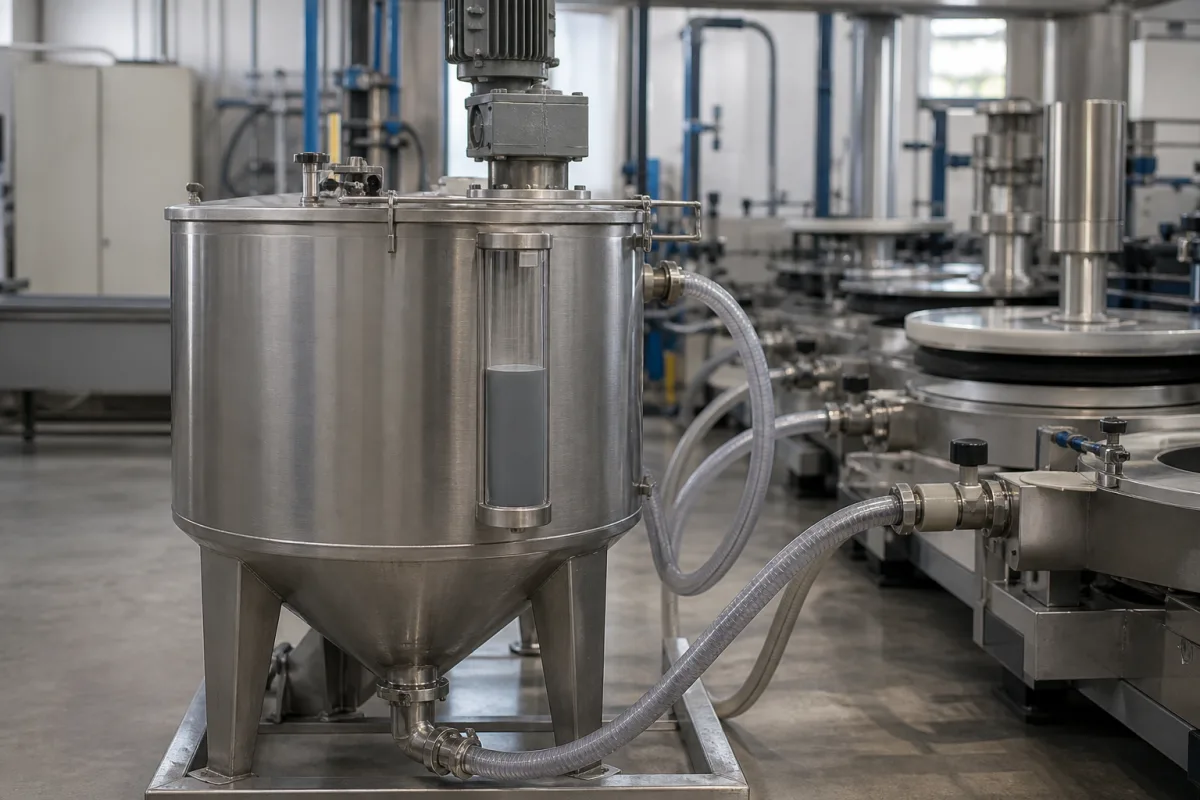
A canonical Slurry Reservoir/Tank is characterized by the integration of Agitator Assembly and Level Sensor. In industrial production environments, manufacturers listed on CNFX commonly emphasize Stainless Steel 316L construction to support stable, high-cycle operation across diverse manufacturing scenarios.

A container designed to store and supply abrasive slurry mixtures for delivery systems.
Product Specifications

Technical details and manufacturing context for Slurry Reservoir/Tank

Definition
A specialized tank or reservoir that holds abrasive slurry mixtures within an Abrasive Slurry Delivery System, serving as the primary storage and supply point for the slurry before it is pumped through the delivery network to processing or application points.
Working Principle
The reservoir maintains a consistent supply of abrasive slurry through gravity feed or pump suction, often incorporating agitation systems to prevent particle settling and ensure homogeneous mixture consistency for reliable delivery.
Common Materials
Stainless Steel 316L, High-Density Polyethylene (HDPE), Fiberglass Reinforced Plastic (FRP)
Technical Parameters
  • Storage capacity of the slurry reservoir (L) Customizable
Components / BOM
  • Agitator Assembly
    Prevents abrasive particles from settling and maintains slurry homogeneity
    Material: Stainless Steel 304
  • Level Sensor
    Monitors slurry volume and provides feedback for automated filling systems
    Material: Polypropylene with Stainless Steel Probe
  • Drain Valve
    Allows complete drainage for maintenance and slurry changeover
    Material: Stainless Steel 316 with PTFE Seals
  • Inlet/Outlet Ports
    Connections for slurry filling and delivery to pump systems
    Material: Stainless Steel 316 Flanges
Engineering Reasoning
0.1-2.0 bar (gauge pressure)
3.5 bar internal pressure or 0.05 bar vacuum
Design Rationale: Yield strength of 316L stainless steel (205 MPa) exceeded at 3.5 bar internal pressure causing plastic deformation; vacuum collapse at 0.05 bar due to Euler buckling instability in cylindrical shell geometry
Risk Mitigation (FMEA)
Trigger Slurry particle sedimentation exceeding 40% volume fraction
Mode: Outlet nozzle erosion rate exceeding 5 mm/year
Strategy: Install bottom-mounted agitator with 0.5 kW/m³ power density maintaining minimum 0.3 m/s slurry velocity
Trigger pH drift below 6.0 or above 9.0 for silica-based slurries
Mode: Corrosion rate exceeding 0.1 mm/year at tank walls
Strategy: Integrate pH sensor with automated dosing system maintaining 7.0-8.5 pH range using 0.1M NaOH/HCl solutions

Industry Taxonomies & Aliases

Commonly used trade names and technical identifiers for Slurry Reservoir/Tank.

Applied To / Applications

This component is essential for the following industrial systems and equipment:

Industrial Ecosystem & Supply Chain DNA

Complementary Systems
Downstream Applications
Specialized Tooling

Application Fit & Sizing Matrix

Operational Limits
pressure: 0 to 2 bar (gauge)
flow rate: 0 to 50 m³/h
temperature: -20°C to 80°C
slurry concentration: Up to 60% solids by weight
Media Compatibility
✓ Ceramic slurry with alumina particles ✓ Chemical-mechanical polishing (CMP) slurry ✓ Coal-water slurry
Unsuitable: Highly acidic or caustic environments (pH <2 or >12)
Sizing Data Required
  • Required slurry volume (m³)
  • Maximum particle size and abrasiveness
  • Required residence/agitation time

Reliability & Engineering Risk Analysis

Failure Mode & Root Cause
Abrasive erosion
Cause: High-velocity slurry particles wearing away tank walls, especially at bends and outlets, due to improper particle size control or excessive flow rates.
Corrosion and pitting
Cause: Chemical attack from acidic or alkaline slurry components, exacerbated by stagnant conditions, poor material selection, or inadequate protective coatings.
Maintenance Indicators
  • Visible thinning or localized wear spots on tank walls, detected via ultrasonic thickness testing or visual inspection during downtime.
  • Unusual vibrations or audible knocking sounds during operation, indicating slurry settlement, agitator imbalance, or structural fatigue.
Engineering Tips
  • Implement routine slurry particle size monitoring and adjust milling processes to maintain optimal size distribution, reducing abrasive wear.
  • Apply wear-resistant linings (e.g., polyurethane or ceramic tiles) in high-impact areas and ensure regular inspection and replacement of compromised sections.

Compliance & Manufacturing Standards

Reference Standards
ISO 14001:2015 Environmental management systems ANSI/ASME B31.3 Process Piping DIN 28018:2010-12 Welded circular tanks for above-ground storage of liquids
Manufacturing Precision
  • Wall thickness: +/-5% of nominal thickness
  • Circularity: +/-0.5% of nominal diameter
Quality Inspection
  • Hydrostatic Pressure Test
  • Visual and Dimensional Inspection

Factories Producing Slurry Reservoir/Tank

Verified manufacturers with capability to produce this product in China

✓ 93% Supplier Capability Match Found

T Technical Director from Germany Feb 23, 2026
★★★★★
"The Slurry Reservoir/Tank we sourced perfectly fits our Machinery and Equipment Manufacturing production line requirements."
Technical Specifications Verified
P Project Engineer from Brazil Feb 20, 2026
★★★★☆
"Found 56+ suppliers for Slurry Reservoir/Tank on CNFX, but this spec remains the most cost-effective. (Delivery took slightly longer than expected, but technical support was excellent.)"
Technical Specifications Verified
S Sourcing Manager from Canada Feb 17, 2026
★★★★★
"The technical documentation for this Slurry Reservoir/Tank is very thorough, especially regarding technical reliability."
Technical Specifications Verified
Verification Protocol

“Feedback is collected from verified sourcing managers during RFQ (Request for Quote) and factory evaluation processes on CNFX. These reports represent historical performance data and technical audit summaries from our B2B manufacturing network.”

14 sourcing managers are analyzing this specification now. Last inquiry for Slurry Reservoir/Tank from Vietnam (1h ago).

Supply Chain Compatible Machinery & Devices

Hydraulic Press

Industrial machine using hydraulic pressure to compress, form, or assemble materials

Explore Specs →
Heavy-Duty CNC Plasma Cutting Machine

Industrial machine for precision metal cutting using plasma arc technology

Explore Specs →
Automated Assembly Line System

Integrated production system for sequential component assembly operations

Explore Specs →
Automated Powder Coating System

Integrated industrial system for applying dry powder coatings to metal substrates.

Explore Specs →

Frequently Asked Questions

What materials are best for corrosive slurry mixtures?

Stainless Steel 316L offers excellent corrosion resistance for harsh chemical slurries, while HDPE and FRP are ideal for acidic or abrasive mixtures where metal corrosion is a concern.

How does the agitator prevent slurry settling?

The agitator assembly maintains consistent slurry homogeneity by continuously mixing abrasive particles with the carrier fluid, preventing sedimentation that could clog delivery systems.

What maintenance do slurry reservoirs require?

Regular inspection of agitator components, valve seals, and level sensors is recommended. Material choice (316L, HDPE, FRP) determines specific cleaning protocols and wear monitoring schedules.

Can I contact factories directly on CNFX?

CNFX is an open directory, not a transaction platform. Each factory profile provides direct contact information and production details to help you initiate direct inquiries with Chinese suppliers.

Get Quote for Slurry Reservoir/Tank

Request technical pricing, lead times, or customized specifications for Slurry Reservoir/Tank directly from verified manufacturing units.

Your business information is encrypted and only shared with verified Slurry Reservoir/Tank suppliers.

Thank you! Your message has been sent. We'll respond within 1–3 business days.

Need to Manufacture Slurry Reservoir/Tank?

Connect with verified factories specializing in this product category

Add Your Factory Contact Us
Previous Product
Slope Sensor (Tilt Sensor)
Next Product
Slurry Tank