Industry-Verified Manufacturing Data (2026)

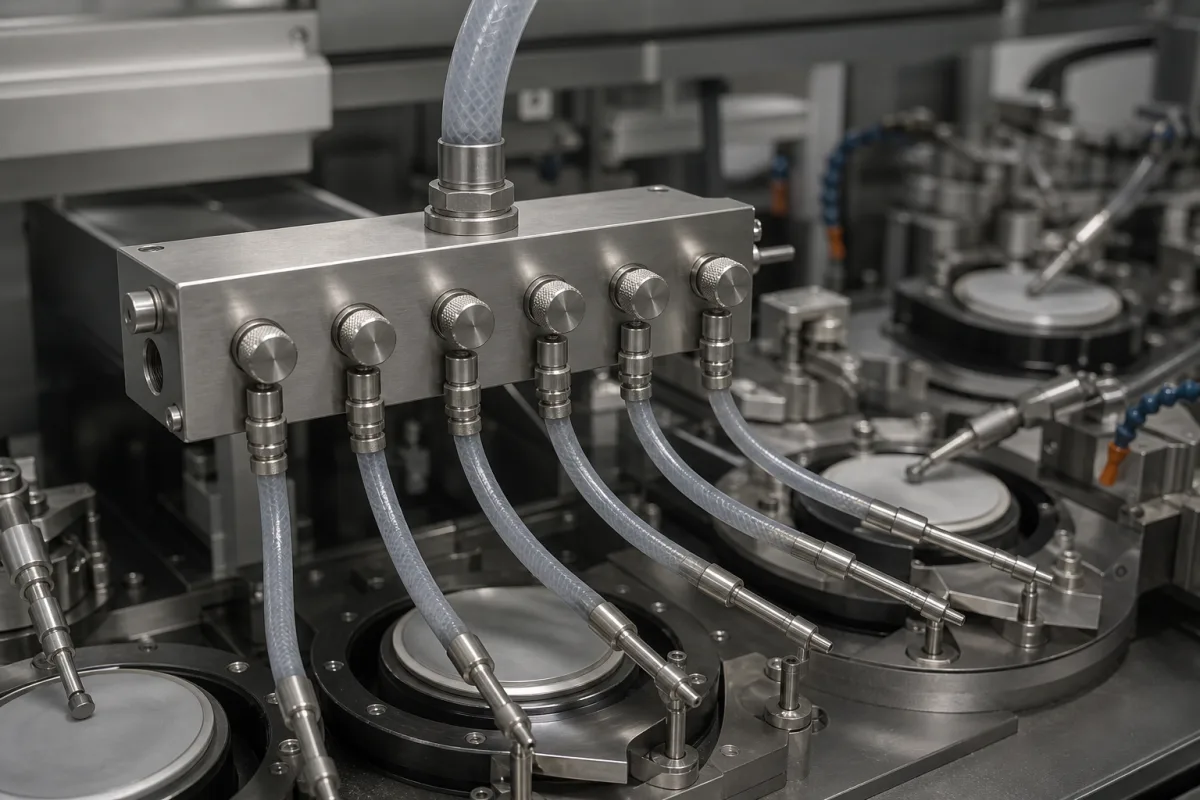
Distribution Manifold/Nozzle

Based on aggregated insights from multiple verified factory profiles within the CNFX directory, the standard Distribution Manifold/Nozzle used in the Machinery and Equipment Manufacturing sector typically supports operational capacities ranging from standard industrial configurations to heavy-duty production requirements.

Technical Definition & Core Assembly

A canonical Distribution Manifold/Nozzle is characterized by the integration of Manifold Body and Nozzle Tip/Insert. In industrial production environments, manufacturers listed on CNFX commonly emphasize Tungsten carbide construction to support stable, high-cycle operation across diverse manufacturing scenarios.

A component that directs and controls the flow of abrasive slurry to multiple outlets or application points.
Product Specifications

Technical details and manufacturing context for Distribution Manifold/Nozzle

Definition
In an Abrasive Slurry Delivery System, the Distribution Manifold/Nozzle is a critical part responsible for receiving the pressurized abrasive slurry mixture from the main delivery line and precisely distributing it to multiple nozzles or discharge points. It ensures uniform flow distribution, controls slurry velocity, and directs the abrasive material to the target surface for cutting, cleaning, or surface preparation applications.
Working Principle
The manifold receives high-pressure abrasive slurry from the pump system. Internal channels and valves within the manifold divide the flow into multiple streams. The nozzle component then accelerates and focuses the slurry into a coherent jet through a precisely engineered orifice, converting pressure energy into kinetic energy for effective material removal or surface treatment.
Common Materials
Tungsten carbide, Ceramic, Hardened steel
Technical Parameters
  • Orifice diameter of the nozzle, critical for determining slurry flow rate and jet characteristics (mm) Per Request
Components / BOM
  • Manifold Body
    Main housing that contains internal flow channels and distributes slurry to multiple outlets
    Material: Stainless steel
  • Nozzle Tip/Insert
    Wear-resistant component that forms the final jet orifice and controls slurry flow characteristics
    Material: Tungsten carbide
  • Connection Ports
    Threaded or flanged interfaces for connecting to slurry lines and downstream components
    Material: Steel
Engineering Reasoning
0.5-15.0 bar (7.25-217.5 psi)
18.0 bar (261 psi) internal pressure or 0.8 mm (0.0315 in) wall thickness erosion
Design Rationale: Cavitation-induced erosion at flow velocities exceeding 25 m/s (82 ft/s) due to Bernoulli principle pressure drops below slurry vapor pressure
Risk Mitigation (FMEA)
Trigger Silica particle concentration exceeding 45% by weight in slurry
Mode: Accelerated wall thinning at flow direction changes exceeding 0.8 mm/year erosion rate
Strategy: Hardened tungsten carbide liner (HV 1500) at all directional transitions with 3.0 mm minimum thickness
Trigger Cyclic pressure fluctuations between 2-12 bar at 5-15 Hz frequency
Mode: High-cycle fatigue cracking initiating at weld heat-affected zones after 1×10^7 cycles
Strategy: Integral forged 316L stainless steel construction with shot peening (Almen intensity 0.008A) on all internal surfaces

Industry Taxonomies & Aliases

Commonly used trade names and technical identifiers for Distribution Manifold/Nozzle.

Applied To / Applications

This component is essential for the following industrial systems and equipment:

Industrial Ecosystem & Supply Chain DNA

Complementary Systems
Downstream Applications
Specialized Tooling

Application Fit & Sizing Matrix

Operational Limits
pressure: Up to 10 bar (150 psi)
flow rate: 0.5-50 L/min per outlet
temperature: -20°C to 120°C
slurry concentration: Up to 40% solids by weight
Media Compatibility
✓ Silica sand slurry ✓ Garnet abrasive media ✓ Ceramic bead suspensions
Unsuitable: Hydrochloric acid solutions (corrosive to standard materials)
Sizing Data Required
  • Required total flow rate (L/min)
  • Number of outlet ports needed
  • Maximum particle size in slurry (mm)

Reliability & Engineering Risk Analysis

Failure Mode & Root Cause
Abrasive erosion
Cause: High-velocity flow carrying solid particles (e.g., sand, scale) that gradually wear away the internal surfaces, particularly at bends and restrictions, leading to wall thinning and eventual leaks or structural failure.
Cavitation
Cause: Rapid pressure drops in the fluid flow causing vapor bubble formation and subsequent violent collapse against the manifold/nozzle walls, resulting in pitting, material fatigue, and eventual perforation or cracking.
Maintenance Indicators
  • Visible external leaks, drips, or weeping at joints, welds, or nozzle connections, indicating seal degradation or material failure.
  • Abnormal audible hissing, whistling, or rumbling noises during operation, suggesting flow restriction, cavitation, or internal erosion.
Engineering Tips
  • Implement regular ultrasonic thickness testing (UTT) on critical areas like bends and nozzle necks to monitor wall thinning from erosion/corrosion, allowing proactive replacement before failure.
  • Optimize flow parameters (e.g., reduce velocity, maintain pressure above vapor pressure) and install flow straighteners or filters upstream to minimize turbulence, particle ingress, and cavitation risk.

Compliance & Manufacturing Standards

Reference Standards
ISO 9001:2015 - Quality Management Systems ASME B31.3 - Process Piping EN 1092-1 - Flanges and their joints
Manufacturing Precision
  • Bore diameter: +/-0.05mm
  • Surface flatness: 0.08mm across mating surfaces
Quality Inspection
  • Hydrostatic Pressure Test
  • Dimensional Verification with CMM

Factories Producing Distribution Manifold/Nozzle

Verified manufacturers with capability to produce this product in China

✓ 95% Supplier Capability Match Found

S Sourcing Manager from Brazil Feb 21, 2026
★★★★★
"Found 58+ suppliers for Distribution Manifold/Nozzle on CNFX, but this spec remains the most cost-effective."
Technical Specifications Verified
P Procurement Specialist from Canada Feb 18, 2026
★★★★☆
"The technical documentation for this Distribution Manifold/Nozzle is very thorough, especially regarding technical reliability. (Delivery took slightly longer than expected, but technical support was excellent.)"
Technical Specifications Verified
T Technical Director from United States Feb 15, 2026
★★★★★
"Reliable performance in harsh Machinery and Equipment Manufacturing environments. No issues with the Distribution Manifold/Nozzle so far."
Technical Specifications Verified
Verification Protocol

“Feedback is collected from verified sourcing managers during RFQ (Request for Quote) and factory evaluation processes on CNFX. These reports represent historical performance data and technical audit summaries from our B2B manufacturing network.”

16 sourcing managers are analyzing this specification now. Last inquiry for Distribution Manifold/Nozzle from Mexico (1h ago).

Supply Chain Compatible Machinery & Devices

Automated Assembly Line System

Integrated production system for sequential component assembly operations

Explore Specs →
Automated Powder Coating System

Integrated industrial system for applying dry powder coatings to metal substrates.

Explore Specs →
Centrifugal Pump Impeller

Rotating component that transfers energy to fluid in centrifugal pumps.

Explore Specs →
High-Precision CNC Laser Cutting Machine

Computer-controlled industrial machine using focused laser beams to cut sheet metal with micron-level accuracy.

Explore Specs →

Frequently Asked Questions

What materials are best for abrasive slurry distribution manifolds?

Tungsten carbide offers superior wear resistance for highly abrasive slurries, ceramic provides excellent corrosion resistance, and hardened steel balances durability with cost-effectiveness for moderate applications.

How does a distribution manifold/nozzle improve slurry application efficiency?

It precisely directs and controls slurry flow to multiple outlets from a single source, ensuring consistent application, reducing waste, and minimizing pressure drops in machinery systems.

What maintenance is required for slurry distribution manifolds?

Regular inspection of nozzle tips/inserts for wear, cleaning of connection ports to prevent clogging, and checking manifold body integrity. Material choice significantly impacts maintenance intervals.

Can I contact factories directly on CNFX?

CNFX is an open directory, not a transaction platform. Each factory profile provides direct contact information and production details to help you initiate direct inquiries with Chinese suppliers.

Get Quote for Distribution Manifold/Nozzle

Request technical pricing, lead times, or customized specifications for Distribution Manifold/Nozzle directly from verified manufacturing units.

Your business information is encrypted and only shared with verified Distribution Manifold/Nozzle suppliers.

Thank you! Your message has been sent. We'll respond within 1–3 business days.

Need to Manufacture Distribution Manifold/Nozzle?

Connect with verified factories specializing in this product category

Add Your Factory Contact Us
Previous Product
Distribution Manifold/Block
Next Product
Distribution Nozzle Array