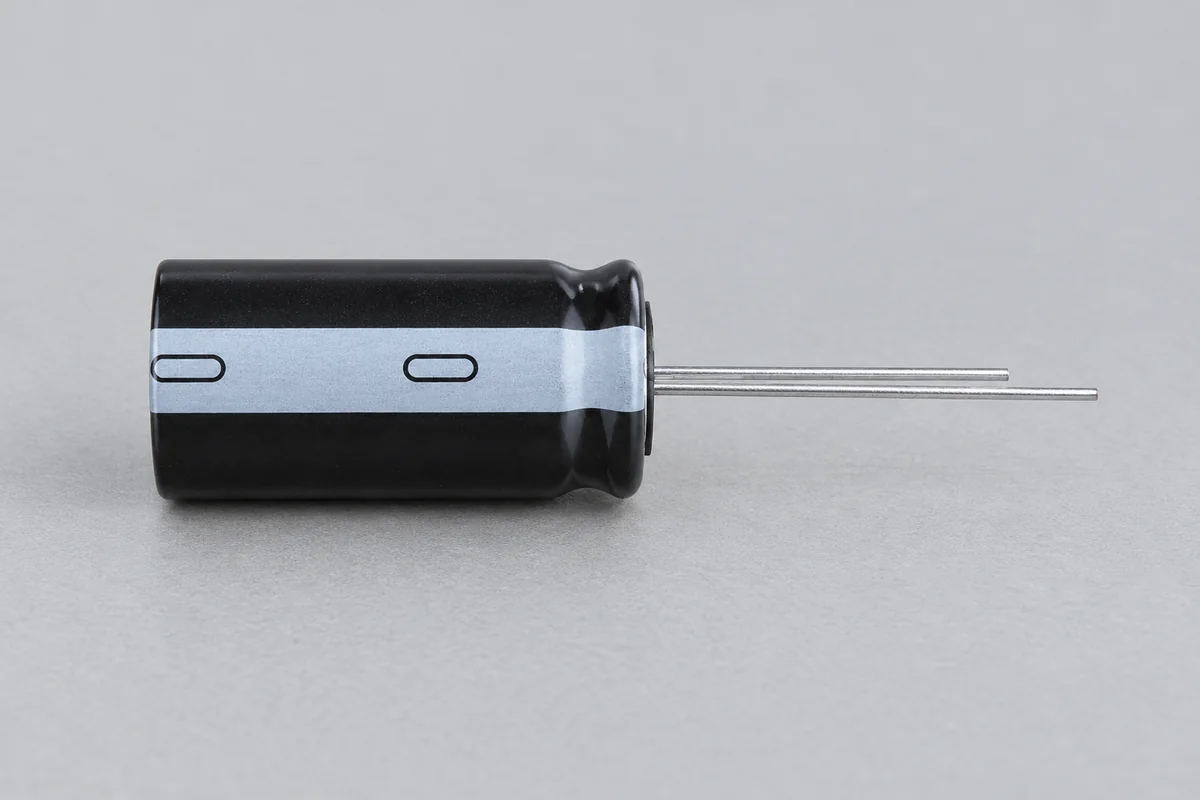
Aluminium electrolytic capacitors for power supplies, inverters, lighting, automotive and audio · liquid electrolyte vs conductive polymer and hybrid, chip, radial, snap-in and screw-terminal, rated voltage and temperature, load life hours, ripple current, ESR, life halving per 10 °C
An aluminium electrolytic capacitor gives high capacitance in a small volume and is used for bulk storage, filtering and smoothing in power supplies, inverters, lighting drivers, automotive electronics and audio. Ask three things first: the voltage, capacitance and ripple current the circuit puts on it; how hot it will run, since life falls steeply with temperature; and whether a liquid-electrolyte, conductive-polymer or hybrid construction, and which case style, suits the board and the lifetime target.
Aluminium electrolytic capacitors — liquid-electrolyte, conductive-polymer solid and polymer hybrid types, in chip (SMD), radial-lead, snap-in and screw-terminal large-can styles, including motor-start types. Film, ceramic, tantalum and supercapacitors (separate pages) are outside this page except where compared.
CNFX editorial research · Sources checked October 11, 2026 · 4 sources
Nichicon, a capacitor maker, explains that capacitor lifetime calculations estimate how long a capacitor will stay within its specified electrical parameters under given conditions, using models driven by temperature, ripple current and operating voltage. The foundation is the Arrhenius relation, which suggests that life is halved for every 10 °C rise in temperature, although some polymer capacitors follow a steeper relation. Nichicon says total life is limited by a wear-out mechanism — gradual evaporation of the liquid electrolyte in conventional aluminium electrolytic capacitors, or thermal degradation of the conductive polymer in solid polymer types — and the aim is to prevent failures from parametric drift such as falling capacitance or rising equivalent series resistance (ESR). [1]
Editorial calculation: applying the 10 °C rule to a part rated 5,000 hours at 105 °C, running it at 65 °C (40 °C cooler, four halvings) gives about 5,000 × 16 = 80,000 hours, roughly nine years of continuous operation; at 115 °C it would fall to about 2,500 hours. Ripple current heats the capacitor above ambient, so the temperature that counts is the capacitor's own. [1]
Nippon Chemi-Con, a second maker, sets the limits of the 10 °C rule. It attributes wear-out mainly to electrolyte diffusing through the rubber seal and gives the practical estimate Lx = Lo × Bt^((To − Tx)/10), where Lo is the specified life at the upper category temperature To and the temperature acceleration factor Bt is approximately 2 over ambient temperatures from 60 °C to 95 °C; for parts rated 105 °C or higher Bt needs modifying by temperature range. Because no test data cover lower temperatures and seal ageing adds other factors, Chemi-Con says Tx should be taken as 40 °C at the lowest and the estimated life as 15 years at the longest. For ripple, it approximates the internal temperature rise as ΔT = (Ix/Io)² × ΔTo, where ΔTo is the rise at rated ripple current and differs by series, and gives example ΔT limits of 15 °C at ambients of 85 °C or below and 5 °C at 105 °C. It adds that leakage current at maximum operating temperature can be 5 to 10 times the value measured at 20 °C, that applied voltage below rating has a negligible effect on life except for screw-terminal types rated 350 V DC or higher, and that ripple ratings are stated as r.m.s. values at 120 Hz or 100 kHz, with losses at each frequency summed for mixed ripple. [3]
Editorial calculation with Chemi-Con's ripple formula: running at 70% of rated ripple current gives ΔT = 0.7² × ΔTo = 0.49 × ΔTo, so a series with a 5 °C rise at rated ripple would heat about 2.5 °C. The 80,000-hour result in the example above is about 9.1 years, inside Chemi-Con's 15-year cap; at a 40 °C ambient the same 10 °C rule would give 5,000 × 2^6.5 ≈ 453,000 hours, far beyond that cap, so cap such estimates at 15 years. [3]
Editorial note: makers apply their own life formulas, including ripple and voltage factors; ask the supplier to calculate life with its formula for your temperature profile and ripple current.
A user-side example shows the same method applied to an installed fleet. Oak Ridge National Laboratory's Spallation Neutron Source runs more than 500 power supplies holding over 1,000 electrolytic capacitors, in operation since 2007 and described by ORNL as well over or close to the manufacturer-provided lifetime. Its power conversion group simulated each supply in MATLAB/Simulink to quantify capacitor ripple current and operating voltage, combined the results with manufacturer data to estimate life, used ambient temperature and ripple current to assess end of life, and ranked supplies for capacitor replacement. [4]
Editorial calculation: continuous operation from 2007 to the 2022 paper is about 15 years, or roughly 15 × 8,760 ≈ 131,000 hours, against rated lives of 2,000–12,000 hours at 105 °C in Nichicon's examples; that gap is covered only if ambient and ripple heating keep the core far below the rated temperature (each 10 °C lower roughly doubling life), and Nippon Chemi-Con caps estimated life at 15 years in any case. [4][2][1][3]
Give the supplier the rated voltage and capacitance with tolerance, polarity (polar or bipolar), ripple current and frequency, ESR or impedance limit, ambient and hot-spot temperature, life target in hours, construction (liquid electrolyte, polymer, hybrid), case style and size (chip, radial, snap-in, screw terminal; diameter and height), leakage current, qualification (AEC-Q200) and RoHS, vibration requirements, and quantity.
02
Choose construction and case style
Nichicon's aluminium range shows how construction and case style map to duty. It develops its own electrode foil, electrolyte and etching technology, and lists chip, miniature radial and large-can types alongside conductive-polymer solid and polymer-hybrid capacitors. Examples include radial series with 10,000 to 12,000 hours at 105 °C for power supplies and lighting, a series with 20,000 hours at 85 °C for industrial inverters, screw-terminal large-can series for UPS and telecom base stations, a 450 V series for base stations, automotive series rated 1,000 hours at 150 °C or 2,000–4,000 hours at 135 °C with AEC-Q200 compliance, polymer chip types with 5,000 hours at 125 °C, a radial polymer type with ESR as low as 7 mΩ, and a bipolarised series for audio signal circuits. Chip series reach operating ranges of −55 °C to +105 °C. [2]
Editorial note: compare series on the same basis — rated life at a stated temperature and ripple current — and treat higher temperature ratings as headroom rather than as a guarantee at lower temperatures.
03
Compare what suppliers offer
Suppliers linked to this page list aluminium electrolytic capacitors; each card links to the page reviewed.
Listings include lead-type, snap-in (solder-tag) and screw-terminal aluminium electrolytic capacitors, solid polymer aluminium capacitors, CD60 motor-starting capacitors and general aluminium electrolytic lines; ask each for the series data sheet, life formula, ripple current rating and qualification reports.
04
Trace what limits performance
This is a functional reference built from the sources cited; it is not one maker's design.
Fill the specification fields with values for your project
An aluminium electrolytic capacitor quotation needs values for your project. The table explains each field, gives published values where a reviewed source states them, and says what to obtain from the supplier.
Life estimated from simulated ripple current, operating voltage and ambient temperature, with replacements ranked by remaining life (ORNL SNS, over 1,000 capacitors). [4]
Life formula inputs and end-of-life criteria for your duty.
06
Send the electrical stress and temperature together
Paste it into your enquiry below or into an email to a maker, then replace every bracket.
Explore company information and manufacturing capabilities, then discuss the scope of your project with a relevant supplier.
Compiled and source-reviewed by the CNFX editorial team.
Published product pages show what a company offers, not tested performance. Confirm the legal seller, factory and scope for your order. How we source and review
· Page last updated 11 October 2026
How does temperature affect aluminium electrolytic capacitor life?
Nichicon says life models rest on the Arrhenius relation: life roughly halves for every 10 °C rise in temperature. [1]
What wears out an aluminium electrolytic capacitor?
Gradual evaporation of the liquid electrolyte, showing as falling capacitance and rising ESR; polymer types degrade thermally instead. [1]
How long do they last at 105 °C?
Nichicon series examples range from 2,000 to 12,000 hours at 105 °C, depending on series and size. [2]
Is there a limit to the 10 °C life-doubling rule?
Yes. Nippon Chemi-Con says its acceleration factor of about 2 per 10 °C holds from 60 °C to 95 °C ambient, that calculations should use 40 °C as the lowest ambient, and that estimated life should be capped at 15 years. [3]
How do large installations decide when to replace electrolytic capacitors?
ORNL's Spallation Neutron Source, with over 1,000 capacitors in more than 500 supplies running since 2007, simulated ripple current and voltage per supply, combined them with maker life data and ambient temperature, and ranked supplies for replacement. [4]
Sources and what still needs a direct check
Sources checked 2026-10-11. Nichicon and Nippon Chemi-Con are capacitor makers describing their own products and life-estimation methods; Oak Ridge National Laboratory describes how it applied such estimates to its own power supplies.