Power factor correction · kvar sizing, detuning reactors for harmonics, switching inrush and discharge to 75 V
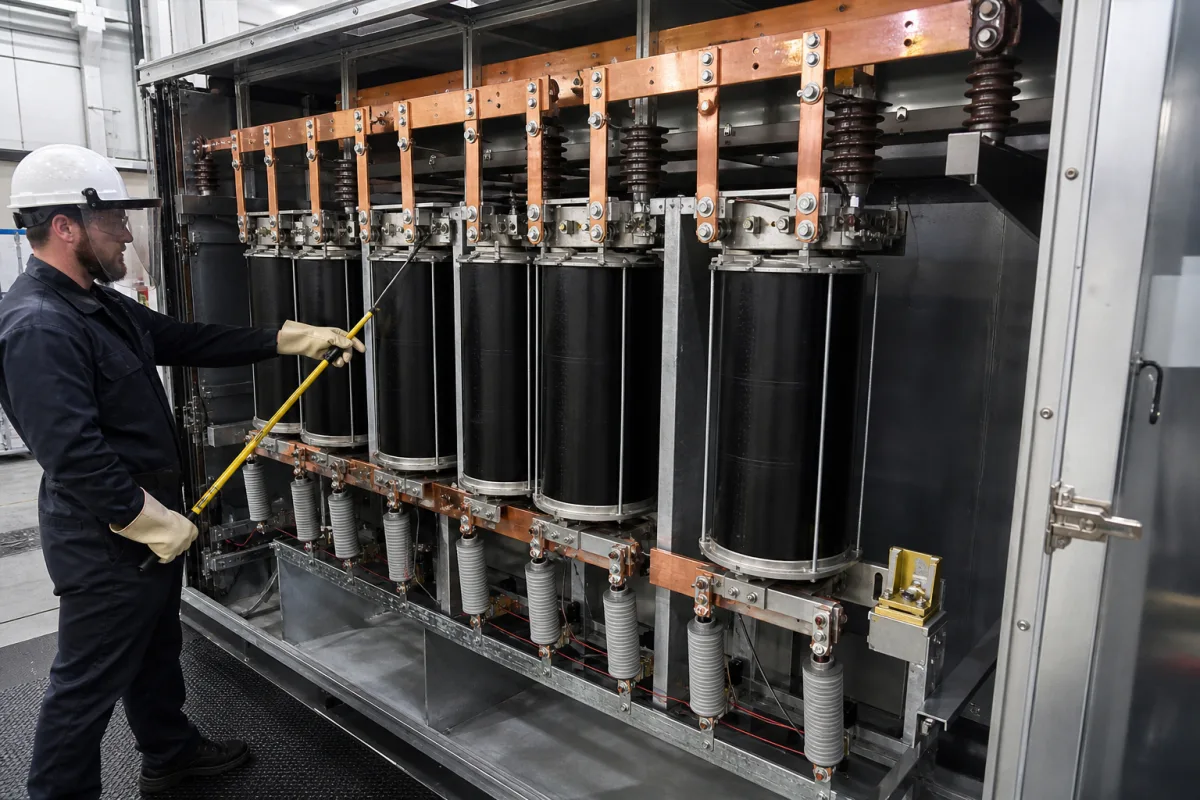
A capacitor bank for power factor correction generates locally the reactive energy that inductive loads would otherwise exchange with the network; ABB describes the system as capacitors with a protective device, a contactor, discharge resistors and, for automatic banks, a controller. Ask three things first: how many kvar you need and in how many steps, whether harmonics require detuning reactors, and how the bank is switched, protected and discharged.
Low- and medium-voltage shunt capacitor banks for power factor correction, including fixed, automatic (stepped) and detuned banks. Pulse-discharge capacitor banks for capacitor discharge welding, induction heating capacitors, static var generators and active harmonic filters are outside this page.
CNFX editorial research · Sources checked October 11, 2026 · 4 sources
ABB's technical application paper gives the capacitor bank power as Qc = (tanφ1 − tanφ2) · P, where P is the installed active power, φ1 the phase angle before correction and φ2 the angle to be obtained, and tabulates the factor K in kvar per kW. For an initial cosφ of 0.75 the table gives 0.398 kvar/kW to reach 0.90 and 0.553 kvar/kW to reach 0.95. [1]
Editorial calculation: a 200 kW load at cosφ 0.75 raised to 0.95 needs about 200 × 0.553 ≈ 111 kvar; raised only to 0.90 it needs about 200 × 0.398 ≈ 80 kvar. [1]
Where the reactive power drawn varies, ABB describes automatic systems that use current and voltage sensors, a power factor regulator, a power board with switching and protection devices, and capacitor banks switched step by step; control accuracy is greater with more steps and smaller differences between them. ABB also warns that a bank connected directly to a motor can let the motor self-excite after disconnection, with overvoltages up to twice rated voltage. [1]
Rated kvar applies at rated voltage: ABB's example is a 100 kvar capacitor rated at 500 V delivering 64 kvar at 400 V. Editorial calculation: reactive power scales with voltage squared, (400/500)² = 0.64. For low-voltage banks ABB gives the reason it favours the delta connection: each phase needs one-third of the star-connected capacitance for the same kvar. [1]
Give the supplier the active power and load profile, measured or billed power factor and the target, network voltage and frequency, the transformer rating, the harmonic measurements if any, the number and size of steps, installation location and ambient temperature.
02
Detune the bank where harmonics are present
ABB explains that a capacitor bank and the inductance of the network form a resonant circuit; if a harmonic lies near the resonance frequency, currents or voltages can be amplified and capacitor life shortened. The solution described in IEC 61642 is a reactor in series with each capacitor so that the resonance frequency falls below the lowest significant harmonic. [1]
Circutor describes detuned reactors with p = 7% giving a resonance frequency of 189 Hz on 50 Hz networks (227 Hz on 60 Hz), as the tuning it uses to avoid resonance with the 5th harmonic and over; the set absorbs part of the 5th harmonic current. [2] Block's DR3 50/7 reactor for a 50 kvar, 400 V, 50 Hz step lists 0.750 mH per phase, 72 A, p = 7%, 189 Hz and 180 W power loss. [3]
Editorial calculation: the tuning frequency is the supply frequency divided by √p, so 50 / √0.07 ≈ 189 Hz and 60 / √0.07 ≈ 227 Hz, below the 5th harmonic at 250 Hz or 300 Hz. [2][3]
ABB distinguishes passive filters, a capacitor and inductor tuned to the harmonic to be removed, from active filters, which inject compensating currents and have the advantage of "filtering simultaneously dozens of harmonics". [1]
03
Switch, protect and discharge the bank safely
ABB states that energising a capacitor bank produces transient currents at 1 to 15 kHz, lasting 1 to 3 ms, with peaks of 25 to 200 times rated current; the peak should not exceed 100 times the bank's rated current, and banks switched while others are energised need limiting inductances, for which ABB describes air-core inductors without a magnetic core and lists values of 50, 100 or 150 μH. [1]
ABB cites IEC 60831-1 and IEC 60931-1: capacitors must operate continuously at up to 30% above rated current, and capacitance tolerance is +10% up to 100 kvar and 5% above. The maximum current is therefore 1.43 × rated current up to 100 kvar and 1.365 × above; circuit breakers are sized above it, with magnetic trip settings of at least 10 times it, and contactors must carry it and withstand the inrush. [1]
ABB quotes IEC 60831-1 clause 22: each capacitor unit or bank shall have a means of discharging each unit to 75 V or less within 3 minutes from an initial peak of √2 × rated voltage, and notes that some countries require shorter times and lower voltages. [1] Editorial calculation: on a 400 V bank that starting peak is about 566 V.
Ask for the switching method (contactors with inrush limiting, or thyristor switching), protection settings, discharge resistor data and the time to reach a safe voltage, and agree the lock-out and earthing procedure before anyone touches the busbars.
04
From loose capacitors to complete detuned banks
Listings range from power capacitors, contactors, controllers and reactors to complete automatic and detuned banks, medium-voltage shunt capacitor banks and switchgear lines that include compensation cabinets.
05
Check the capacitor units' overvoltage, current, losses and life
TDK's data sheet for its PhaseCap Energy Plus B25674C* units, three-phase delta-connected capacitors of self-healing metallised polypropylene film, filled with nitrogen gas and fitted with a three-phase overpressure disconnector and discharge resistors, gives the unit limits a bank builder works to, referenced to IEC 60831-1/2 (2014). Outputs run up to 33.1 kvar per can at up to 690 V. [4]
Editorial calculation: the sheet's 400 V, 25.0 kvar unit lists 3 × 165.8 µF; 25,000 ÷ (3 × 400² × 2π × 50) ≈ 165.8 µF per phase in delta, and its line current is 25,000 ÷ (√3 × 400) ≈ 36.1 A, the value in the 50 Hz current column. [4]
Editorial calculation: an assumed 200 kvar bank of these units dissipates about 200 × 0.35 to 0.45 ≈ 70 to 90 W in the capacitors, before reactor losses such as the 180 W per 50 kvar step of the Block DR3 reactor above. TDK's 60 s to 50 V is within the IEC 60831-1 requirement of 75 V or less in 3 minutes quoted by ABB. [4][3][1]
B25674C* rating
Published value
Check in the bank design
Maximum voltage
VN +10% up to 8 h daily; +15% 30 min; +20% 5 min; +30% 1 min
Network voltage plus harmonic and reactor voltage rise
Maximum current
1.6 to 2.0 × IN, including harmonics, overvoltage and capacitance tolerance
Fuse, cable and contactor rating
Inrush current
Up to 500 × IN by type; max. 15,000 switchings per year
Inrush limiting and step switching count
Losses
Below 0.2 W/kvar dielectric; about 0.35 to 0.45 W/kvar total, excluding discharge resistor
Cabinet heat and ventilation
Temperature class −40/60
Max. +60 °C short time, +50 °C 24 h mean, +40 °C yearly mean
Air temperature inside the cabinet
Mean life
Up to 220,000 h (−40/D, hotspot ≤ 65 °C); up to 200,000 h (−40/60)
Life at your temperature
Discharge
≤ 60 s to 50 V or less
Time before access
Ask the bank supplier which capacitor units are fitted, their temperature class, maximum current and inrush rating, and the cabinet temperature rise at full output.
06
What sits inside the cabinet
Part
Role
Fix in the order
Capacitor units
Supply the reactive power; rated kvar at rated voltage. [1]
kvar, voltage, connection.
Detuning reactors
Shift resonance below the 5th harmonic, e.g. p = 7%, 189 Hz. [2]
Tuning factor and losses.
Contactors or switches
Switch steps; carry maximum current and inrush. [1]
Capacitor-duty rating.
Protection
Circuit breaker sized for maximum current and inrush. [1]
Ratings and settings.
Discharge resistors
Reduce terminal voltage to 75 V or less within 3 min. [1]
Kvar, voltage and detuning factor follow from the sizing and harmonic sections above; temperature, enclosure, weight and size depend on where the bank will stand.
Zhiyue, Jiukang and Shangdian list power capacitors and complete banks; Lafaelt pairs its banks with detuned reactors and thyristor switch controllers, Giantele with detuned reactors and capacitor contactors, and Shanghai Zhiyou lists banks next to static var generators.
ZHIYUE GROUP CO. LTD
Manufacturing site to be confirmed for the order
Lists low- and high-voltage power capacitors, capacitor banks, capacitor-switching contactors, reactive power controllers and reactors.
Lists capacitor banks, detuned reactors, power factor controllers and thyristor switch controllers, with static var generators and active harmonic filters.
Lists power factor correction capacitor banks, automatic correction panels, power capacitors, detuned reactors and capacitor contactors with switchgear.
Explore company information and manufacturing capabilities, then discuss the scope of your project with a relevant supplier.
Share this page
Compiled and source-reviewed by the CNFX editorial team.
Each manufacturer above links to the page on that company's own website where the product is listed, with the date we checked it. How we source and review
· Page last updated 13 October 2026
Buyer questions
How do I calculate the kvar of a capacitor bank?
ABB gives Qc = (tanφ1 − tanφ2) · P; for example 0.553 kvar per kW to raise cosφ from 0.75 to 0.95. [1]
Why use a detuned capacitor bank?
Where harmonics are present a bank can resonate with the network; a series reactor tuned to p = 7% (189 Hz on 50 Hz networks), the tuning Circutor describes for avoiding resonance with the 5th harmonic and over, keeps resonance below the 5th harmonic. [1][2]
How fast must a capacitor bank discharge?
ABB quotes IEC 60831-1 clause 22: to 75 V or less within 3 minutes from √2 × rated voltage; some countries require less. [1]
How much overvoltage can a PFC capacitor unit take?
TDK's PhaseCap Energy Plus data sheet allows VN +10% for up to 8 h daily, +15% for 30 min, +20% for 5 min and +30% for 1 min daily. [4]
Sources and what still needs a direct check
Sources checked 2026-10-11. ABB's paper is a manufacturer's technical guide that quotes IEC 60831-1; Circutor and Block are reactor makers describing their own products. Standards should be read in their current editions.