Industry-Verified Manufacturing Data (2026)

Array Housing

Based on aggregated insights from multiple verified factory profiles within the CNFX directory, the standard Array Housing used in the Computer, Electronic and Optical Product Manufacturing sector typically supports operational capacities ranging from standard industrial configurations to heavy-duty production requirements.

Technical Definition & Core Assembly

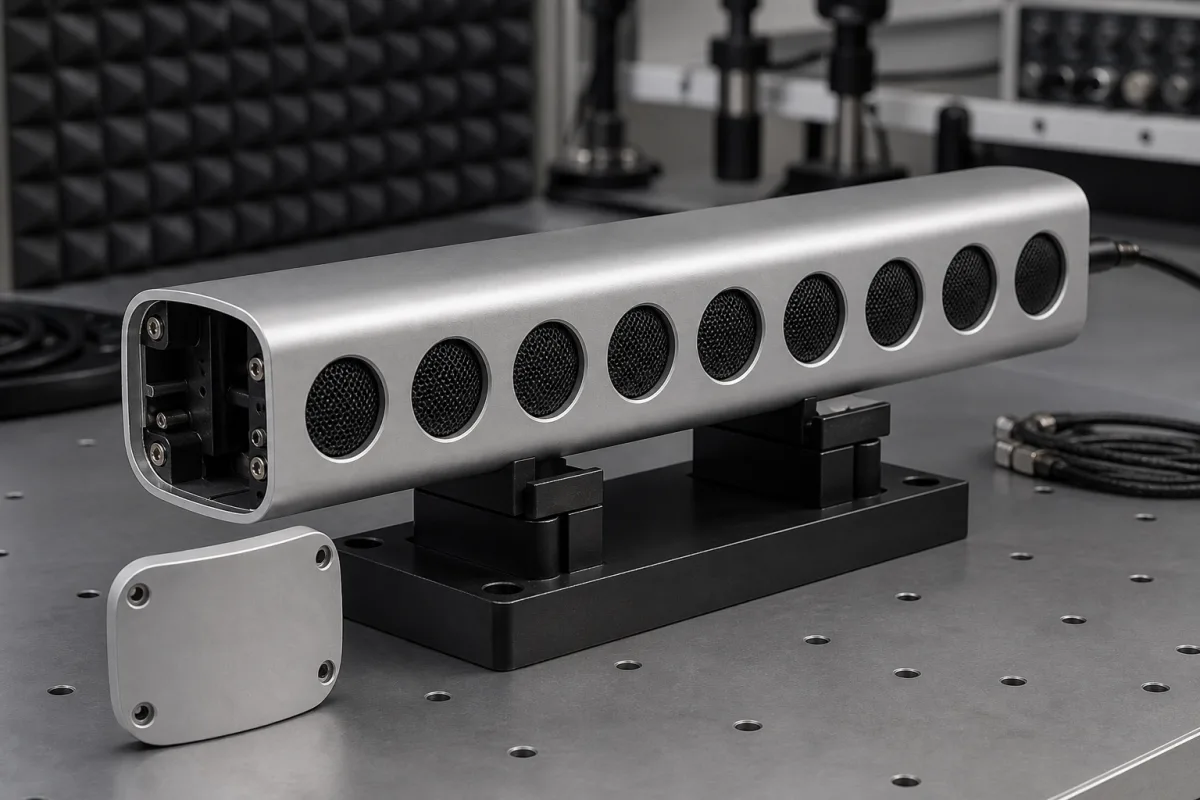
A canonical Array Housing is characterized by the integration of Mounting Bracket and Acoustic Mesh. In industrial production environments, manufacturers listed on CNFX commonly emphasize Aluminum alloy construction to support stable, high-cycle operation across diverse manufacturing scenarios.

The protective enclosure that houses and structurally supports the microphone elements in an ANC microphone array system.
Product Specifications

Technical details and manufacturing context for Array Housing

Definition
Array Housing is the structural component of an Active Noise Cancellation (ANC) Microphone Array that provides physical protection, mechanical stability, and environmental shielding for the sensitive microphone elements. It ensures precise positioning of microphones for optimal beamforming and noise cancellation performance while protecting against dust, moisture, and physical damage.
Working Principle
The housing maintains fixed geometric relationships between microphone elements, enabling accurate phase and amplitude measurements for spatial audio processing. Its acoustic properties (such as port design and material density) influence sound wave reception while providing mechanical isolation from vibrations.
Common Materials
Aluminum alloy, ABS plastic, Acoustic foam
Technical Parameters
  • Overall dimensions and mounting hole positions (mm) Standard Spec
Components / BOM
  • Mounting Bracket
    Provides attachment points for securing the array to surfaces
    Material: Stainless steel
  • Acoustic Mesh
    Filters dust while allowing sound waves to pass through
    Material: Polyester fabric
  • Vibration Dampers
    Isolates microphones from mechanical vibrations
    Material: Silicone rubber
Engineering Reasoning
0-120 dB SPL (sound pressure level) at 20-20000 Hz frequency range
Structural deformation exceeding 0.5 mm at any mounting point or resonant frequency matching 1500±50 Hz
Design Rationale: Acoustic-structural coupling causing resonant amplification at natural frequency, leading to fatigue failure via cyclic stress concentration at mounting interfaces
Risk Mitigation (FMEA)
Trigger Thermal expansion mismatch between aluminum housing (α=23.1×10⁻⁶/K) and PCB substrate (α=15×10⁻⁶/K)
Mode: Mounting screw shear failure due to differential expansion stresses exceeding 250 MPa yield strength
Strategy: Implement bimetallic compensation washers with controlled thermal expansion coefficient gradient of 18-22×10⁻⁶/K
Trigger Acoustic pressure wavefront impingement at 45°±5° incidence angle
Mode: Helmholtz resonance excitation within cavity volume of 8.2 cm³, causing 12 dB signal distortion
Strategy: Integrate quarter-wavelength acoustic dampers tuned to 1500 Hz with polyurethane foam (flow resistivity 10000 Rayls/m)

Industry Taxonomies & Aliases

Commonly used trade names and technical identifiers for Array Housing.

Applied To / Applications

This component is essential for the following industrial systems and equipment:

Industrial Ecosystem & Supply Chain DNA

Complementary Systems
Downstream Applications
Specialized Tooling

Application Fit & Sizing Matrix

Operational Limits
pressure: 0 to 1 atm (sealed, non-pressurized)
other spec: IP67 ingress protection, vibration resistance up to 5g RMS
temperature: -40°C to +85°C
Media Compatibility
✓ indoor office air ✓ automotive cabin air ✓ HVAC duct air
Unsuitable: high-pressure water jets or submerged environments
Sizing Data Required
  • number of microphone elements in array
  • required spatial coverage angle
  • available mounting footprint dimensions

Reliability & Engineering Risk Analysis

Failure Mode & Root Cause
Fatigue cracking
Cause: Cyclic stress from vibration or thermal expansion/contraction, often exacerbated by improper alignment or material defects.
Corrosion and pitting
Cause: Exposure to harsh chemicals, moisture, or galvanic action due to incompatible materials in contact, accelerated by inadequate protective coatings.
Maintenance Indicators
  • Visible cracks, deformation, or discoloration on the housing surface
  • Unusual vibrations or audible rattling noises during operation
Engineering Tips
  • Implement regular alignment checks and vibration analysis to detect early stress points before cracks propagate
  • Apply corrosion-resistant coatings and ensure proper material compatibility in the assembly to prevent galvanic corrosion

Compliance & Manufacturing Standards

Reference Standards
ISO 286-1:2010 (Geometrical product specifications - Limits and fits) ANSI B4.1-1967 (Preferred Limits and Fits for Cylindrical Parts) DIN 7150-1 (Tolerances for cylindrical fits)
Manufacturing Precision
  • Bore diameter tolerance: +/-0.02mm
  • Flatness tolerance: 0.1mm per 100mm length
Quality Inspection
  • Coordinate Measuring Machine (CMM) dimensional verification
  • Surface roughness measurement per ISO 4287

Factories Producing Array Housing

Verified manufacturers with capability to produce this product in China

✓ 93% Supplier Capability Match Found

S Sourcing Manager from Germany Feb 01, 2026
★★★★★
"The technical documentation for this Array Housing is very thorough, especially regarding technical reliability."
Technical Specifications Verified
P Procurement Specialist from Brazil Jan 29, 2026
★★★★☆
"Reliable performance in harsh Computer, Electronic and Optical Product Manufacturing environments. No issues with the Array Housing so far. (Delivery took slightly longer than expected, but technical support was excellent.)"
Technical Specifications Verified
T Technical Director from Canada Jan 26, 2026
★★★★★
"Testing the Array Housing now; the technical reliability results are within 1% of the laboratory datasheet."
Technical Specifications Verified
Verification Protocol

“Feedback is collected from verified sourcing managers during RFQ (Request for Quote) and factory evaluation processes on CNFX. These reports represent historical performance data and technical audit summaries from our B2B manufacturing network.”

11 sourcing managers are analyzing this specification now. Last inquiry for Array Housing from Mexico (47m ago).

Supply Chain Compatible Machinery & Devices

Modular Industrial Edge Computing Device

Rugged computing platform for industrial data processing at the network edge

Explore Specs →
Industrial Smart Camera Module

Embedded vision system for industrial automation and quality inspection.

Explore Specs →
Industrial Wireless Power Transfer Module

Wireless power transfer module for industrial equipment applications

Explore Specs →
Industrial Smart Sensor Module

Modular industrial sensor with embedded processing and wireless connectivity

Explore Specs →

Frequently Asked Questions

What materials are used in the array housing for durability?

The array housing is constructed from aluminum alloy for structural integrity and ABS plastic for impact resistance, with integrated acoustic foam for optimal sound performance.

How does the array housing improve ANC microphone system performance?

The housing provides precise structural support for microphone elements, includes vibration dampers to reduce mechanical noise, and features acoustic mesh for clear audio capture in electronic manufacturing environments.

What components are included in the array housing BOM?

The bill of materials includes the main housing, mounting bracket for secure installation, acoustic mesh for sound optimization, and vibration dampers to minimize interference from equipment vibrations.

Can I contact factories directly on CNFX?

CNFX is an open directory, not a transaction platform. Each factory profile provides direct contact information and production details to help you initiate direct inquiries with Chinese suppliers.

Get Quote for Array Housing

Request technical pricing, lead times, or customized specifications for Array Housing directly from verified manufacturing units.

Your business information is encrypted and only shared with verified Array Housing suppliers.

Thank you! Your message has been sent. We'll respond within 1–3 business days.

Need to Manufacture Array Housing?

Connect with verified factories specializing in this product category

Add Your Factory Contact Us
Previous Product
Arithmetic Logic Unit (ALU) Cluster
Next Product
Array Processor / ASIC