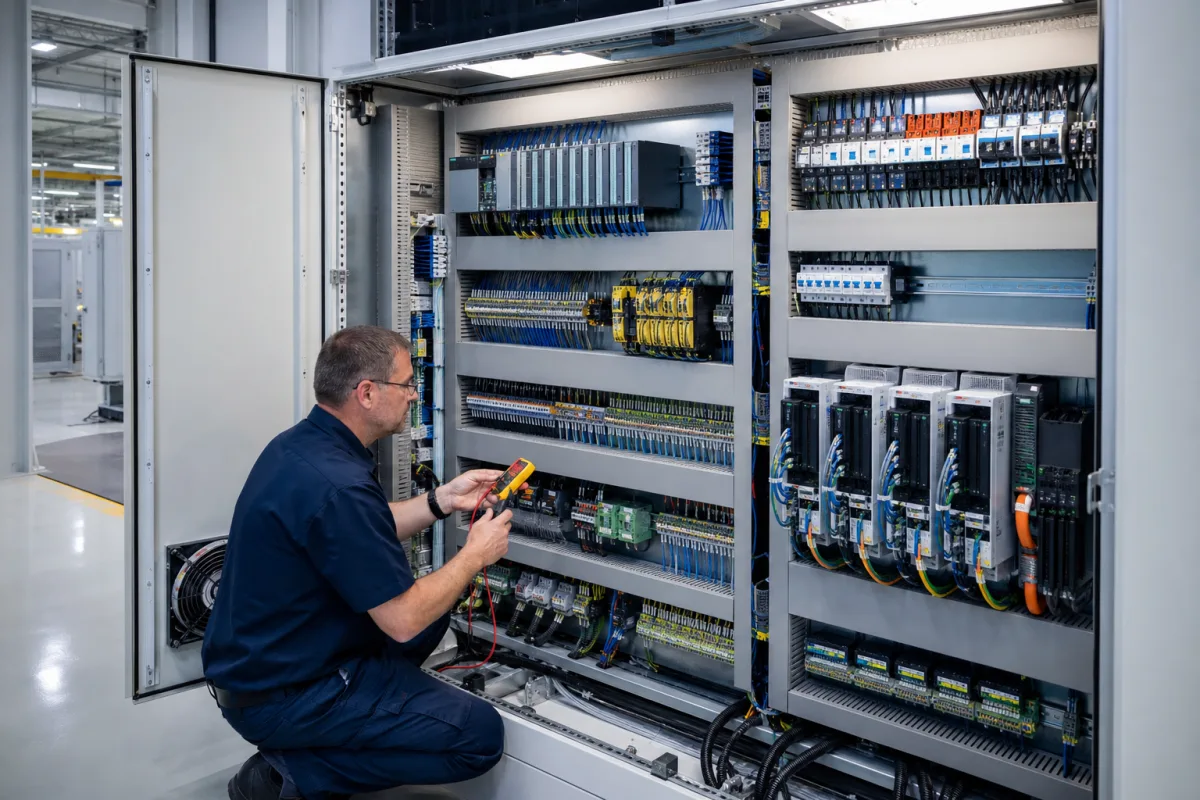
Control system cabinet tested before it ships: routine verification and machine electrical tests on a finished PLC and drive cabinet
Machine control cabinets · the panel builder's final tests before shipment: IEC 61439 routine verification, the 1 s power-frequency dielectric test or 500 V DC insulation alternative, and IEC 60204-1 bonding, insulation, voltage and residual-voltage tests
A finished control cabinet, with its PLC rack, terminal rows, safety relays and servo drives wired in, has to be tested as an assembly before it is shipped, because faults in materials and workmanship only show up once everything is assembled. Two sets of tests apply: the routine verifications of the low-voltage assembly standard IEC 61439, which the panel builder carries out on every cabinet, and the tests IEC 60204-1 sets for the electrical equipment of the machine the cabinet controls. A buyer should agree which tests are done, at what test voltages and currents, which components are disconnected for them, and what goes into the test report.
Final electrical testing and inspection of finished machine control cabinets at the panel builder: IEC 61439-1/-2 routine verifications (enclosure, clearances and creepage, protective circuit, built-in components, wiring and terminals, mechanical operation, dielectric properties and function), the dielectric test and its insulation-resistance alternative, IEC 60204-1 tests on the machine's electrical equipment, the instruments used and the test report. Cabinet heat balance, protective-device ratings and working space are covered on the Control system cabinet: the machine control panel that houses PLC, drives and protection page; IP rating, temperature rise and short-circuit current rating on the Control cabinet page; I/O loop tests, the application program and factory and site acceptance of a PLC system on the PLC control system as an engineered delivery page; wiring segregation, grounding and noise on the PLC control panel page; controller mounting and 24 V DC control power on the PLC control cabinet page; cell-level safety relays and supply duties on the Central control cabinet for a machining cell page; network security of PLC and HMI on the HMI/PLC control system hardened against network attack page; operator desks on the Control Console page; medium-voltage switchgear test rooms on the Final test chamber for medium-voltage switchgear panels page; the test instruments themselves on the Dielectric strength (hipot) tester page.
CNFX editorial research · Sources checked October 13, 2026 · 4 sources
IEC 61439 routine verification: nine checks on every cabinet, ending with a 1 s power-frequency dielectric test
ABB's guide to building low-voltage assemblies to IEC 61439 describes the routine verifications as the last technical job of the assembly manufacturer before delivery, carried out on each assembly after assembling and wiring to detect faults in materials and workmanship. IEC 61439-2 lists them in this order: degree of protection of the enclosure, which reduces to a visual inspection; clearances and creepage distances; protection against electric shock and integrity of the protective circuits, checked visually, by random tightness checks with a torque wrench and electrically by continuity; incorporation of built-in components against the manufacturing instructions; internal circuits and connections, with random checks of terminal tightness; terminals for external conductors against the wiring diagram; mechanical operation of levers and pushbuttons; dielectric properties; and wiring, operational performance and function, including the nameplate and any safety interlocks. [1]
ABB states that for assemblies above 250 A the 50 Hz test voltage from the table is applied for 1 second, with the assembly disconnected on supply and load sides and all protective and switching devices closed, or circuit by circuit; the test passes if no puncture or flashover occurs. Devices that the voltage would damage, such as windings, power supplies, measuring instruments and electronic residual-current devices, are disconnected first, and auxiliary circuits protected by devices of 16 A or less, or already proven by an electrical function test, need not be tested. [1]
For assemblies rated up to 250 A, ABB notes that IEC 61439-1 accepts an insulation-resistance measurement instead: 500 V d.c. between circuits and exposed conductive parts, passing at no less than 1000 Ω/V per circuit referred to the rated voltage to earth of that circuit, again with current-consuming devices disconnected. [1] Editorial calculation: for a circuit at 230 V to earth, 1000 Ω/V means at least 230 kΩ; at 400 V to earth, 400 kΩ.
ABB lists further checks during testing, carried out with a multimeter, an a.c./d.c. test bench to power the cabinet and a torque wrench: control, signalling, alarm, trip and reclosing circuits, protection and measuring circuits and the terminals and contacts in the terminal box, and it reminds installers that routine tests in the workshop do not relieve them of checking for transport and installation damage on site. [1]
Ask the panel builder for its routine-verification procedure and a sample test report, the rated insulation voltage and the dielectric test voltage it will apply, whether it will use the 500 V d.c. insulation alternative and on which circuits, and the list of devices it disconnects for the test.
02
IEC 60204-1 tests on the machine's electrical equipment: bonding continuity, 500 V DC insulation, 1000 V AC withstand and residual voltage below 60 V
When the cabinet is the control equipment of a machine, IEC 60204-1 adds its own tests. HT Instruments, which makes a combined machine and switchgear tester, lists the IEC 60204-1 measurements as a power-frequency dielectric withstand test at 1000 V AC, continuity of protective conductors at 200 mA, automatic disconnection of supply by RCD, circuit-breaker or fuse, insulation resistance at 500 V DC, and discharge of residual voltage to below 60 V within 5 s or 1 s; for IEC 61439-1/-2 it lists dielectric tests up to 3,400 or 5,100 V AC and earth and protective-conductor continuity at 10 A or more. [2]
Gossen Metrawatt's PROFITEST 204+, a tester for machinery to DIN EN 60204-1 and VDE 0113-1 with nominal voltages up to 1000 V, names the periodic tests to be performed under that standard as continuity of the protective conductor system with a 10 A test current, insulation resistance, voltage tests and residual voltage, with leakage current, voltage and frequency measurements in addition; loop impedance needs a separate instrument. It stores up to 2,800 measurements across up to 254 systems for the acceptance report. [3]
ICS Schneider Messtechnik, a German test-equipment distributor, describes the test order on machines and control cabinets as preparation with circuit diagrams and the risk assessment, then visual inspection, protective conductor test, insulation test, high-voltage test, residual voltage, leakage or differential current, functional tests and documentation. It cites 200 mA as a continuity test current, with 10 A or 25 A where the load capacity of a protective conductor connection is to be checked, that insulation test voltages of 100, 250, 500 or 1000 V DC are chosen by circuit, and that frequency inverters, EMC filters, surge protection and safety controllers can be damaged by unsuitable test voltages and must be checked first. Its minimum test report contents are machine identification, date, tester, instrument with serial number or calibration evidence, test points, measured values, evaluation and defects. [4]
ICS also points to capacitors, power supplies, frequency inverters, DC links and EMC filters as the parts that can hold dangerous residual voltage after shutdown, and to plug-connected machines and DC links as cases where it calls the residual-voltage test particularly important. [4] Editorial note: agree with the builder which points in the drive row and at the supply plug are measured, and the discharge time limit that applies to each.
Test
IEC 60204-1 measurements listed by HT Instruments
IEC 61439-1/-2 measurements listed by HT Instruments
Ask which IEC 60204-1 tests are done in the shop and which only after installation on the machine, the continuity test current, the insulation and withstand voltages and which drives, filters and electronics are disconnected for them, and the residual-voltage measuring points.
03
Test requirements to write into a cabinet order
Paste it into your enquiry below or into an email to a maker, then replace every bracket.
Standards: [IEC 61439-1/-2; IEC 60204-1; edition]
Ratings: [rated current; rated voltage; rated insulation voltage Ui]
Dielectric: [test voltage; 1 s; or 500 V DC insulation at 1000 Ω/V]
Protective circuit: [continuity test current; torque checks]
Machine tests: [insulation voltage; withstand voltage; residual voltage points]
Excluded devices: [drives; filters; power supplies; electronics disconnected]
Function: [control, interlock and protection circuits checked]
Report: [instrument and calibration; measured values; defects; witness]
Explore company information and manufacturing capabilities, then discuss the scope of your project with a relevant supplier.
Share this page
Compiled and source-reviewed by the CNFX editorial team.
Each manufacturer above links to the page on that company's own website where the product is listed, with the date we checked it. How we source and review
· Page last updated 13 October 2026
Buyer questions
How long is the dielectric test on a control cabinet?
ABB's IEC 61439 guide gives 1 second at 50 Hz, at the test voltage set by the rated insulation voltage, for example 1,890 V for 300–690 V. [1]
Can an insulation resistance test replace the dielectric test?
For assemblies up to 250 A, ABB notes that IEC 61439-1 accepts 500 V DC insulation measurement with at least 1000 Ω/V per circuit referred to its voltage to earth. [1]
What residual voltage limit do machine testers check?
HT Instruments lists discharge of residual voltage to below 60 V within 5 s or 1 s among its IEC 60204-1 measurements. [2]
What test current is used for protective conductor continuity?
Gossen's PROFITEST 204+ uses 10 A for IEC 60204-1; HT lists 200 mA for IEC 60204-1 and 10 A or more for IEC 61439. [3][2]
Sources and what still needs a direct check
Sources checked 2026-10-13. ABB's Technical Application Paper No. 11 on building low-voltage assemblies to IEC 61439, the product pages and datasheets of two tester makers, HT Instruments and Gossen Metrawatt, and a technical article by the distributor ICS Schneider Messtechnik. The standards themselves govern; the tester makers' lists show which tests they implement.