Editorial Technical Reference

Signal Conditioning Electronics

This page explains how Signal Conditioning Electronics is classified within Computer, Electronic and Optical Product Manufacturing. Technical values and manufacturer relationships are research references; confirm the current specification and supplier evidence for each order.

Technical Definition & Core Assembly

Signal conditioning electronics for position sensors, converting raw analog signals into standardized outputs for measurement and control systems.
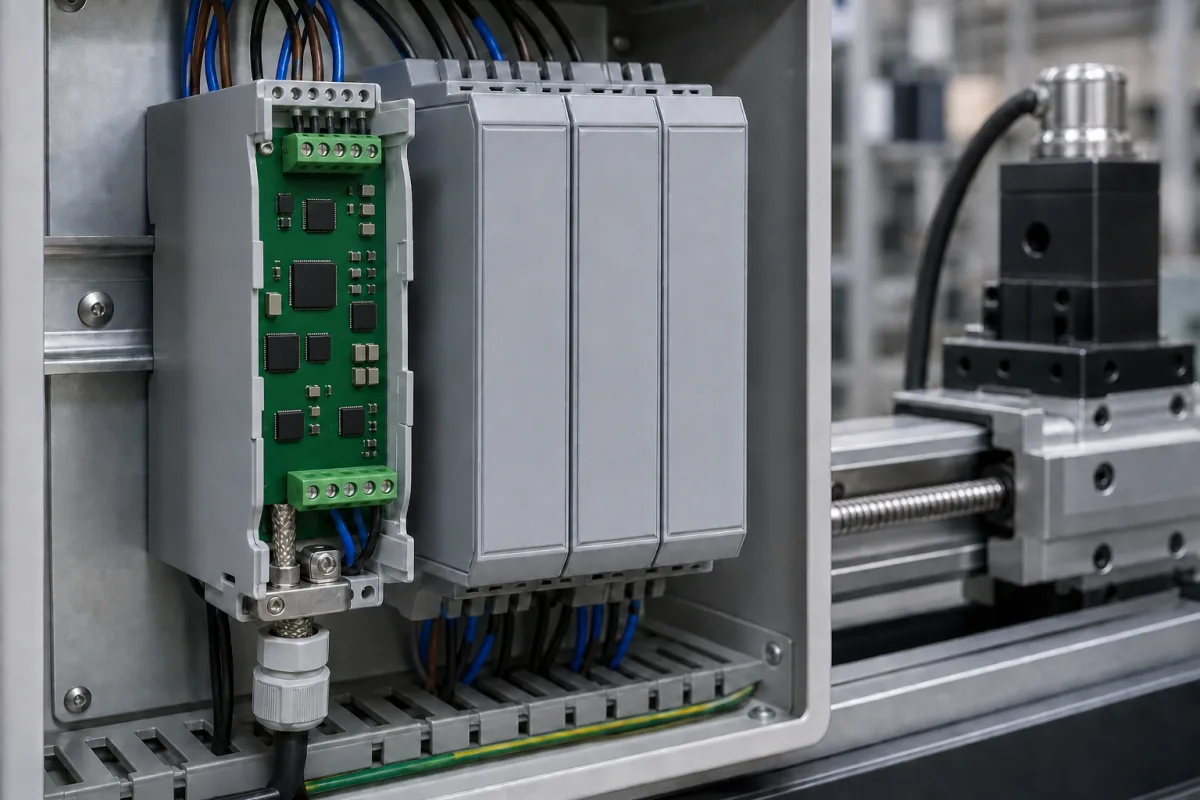
Representative product image. Confirm appearance and specifications with the manufacturer.

Product Specifications

Technical details and manufacturing context for Signal Conditioning Electronics

Definition
Signal conditioning electronics are specialized electronic components within position feedback sensors that amplify, filter, linearize, isolate, and convert raw analog signals from sensing elements into clean, standardized digital or analog outputs suitable for interface with controllers, data acquisition systems, or display units. These electronics are typically mounted on a printed circuit board (PCB) and include semiconductor components such as integrated circuits and transistors, passive components like resistors and capacitors, and connectors for input, output, and power interfaces. They are designed to process signals from various position sensing elements, including potentiometers, encoders, and LVDTs, ensuring that the output is accurate and reliable for industrial applications. Key parameters include input and output signal ranges (e.g., ±10 V, 0–20 mA, 4–20 mA), accuracy of ±0.1% of span, bandwidth of 100 kHz at -3 dB, and a supply voltage of 24 V DC ±10% with reverse polarity protection. Power consumption is ≤2 W at 24 V DC with no load. The operating temperature range is -40 to +85 °C, and storage temperature range is -55 to +105 °C, with relative humidity up to 95% non-condensing. The ingress protection rating is IP20 for indoor, cabinet-mounted use. Isolation voltage is 1500 V RMS between input, output, and power, and EMC compliance is per EN 61326-1 for industrial environments. Dimensions are 22.5 x 99 x 114.5 mm (W x H x D) for DIN rail mounting, and weight is approximately 150 g without packaging. These electronics are essential for ensuring signal integrity in measurement and control systems, but specific values and standards must be verified with the legal manufacturer for the actual model and application.
Working Principle
Signal conditioning electronics receive low-level, noisy analog signals from position sensing elements such as potentiometers, encoders, or LVDTs. They amplify the signal to increase strength, filter to remove electrical noise and interference, linearize to correct non-linear sensor responses, and often include analog-to-digital conversion to produce digital outputs that can be processed by microcontrollers or PLCs. The conditioned output is then provided in standardized formats like ±10 V or 4–20 mA for easy interface with control systems.
Common Materials
Printed Circuit Board (PCB), Semiconductor components (ICs, transistors), Passive components (resistors, capacitors), Connectors
Technical Parameters
ParameterTypical rangeNotes & selection driver
Input Signal Range±10 V, 0–20 mA, 4–20 mA V/mASelectable via jumpers or software
Output Signal Range±10 V, 0–10 V, 4–20 mA V/mAConfigurable for PLC or DAQ
Accuracy±0.1% % of spanIncludes linearity, hysteresis, repeatability
Bandwidth100 kHzAt -3 dB, for AC signals
Supply Voltage24 V DC ±10% V DCReverse polarity protected
Power Consumption≤2 WAt 24 V DC, no load
Operating Temperature Range-40–+85 °CExtended temperature for industrial useIEC 60068-2-1, IEC 60068-2-2
Storage Temperature Range-55–+105 °CNon-operatingIEC 60068-2-1, IEC 60068-2-2
Relative Humidity0–95% % RHNon-condensingIEC 60068-2-78
Ingress Protection RatingIP20 IP codeFor indoor, cabinet-mountedIEC 60529
Isolation Voltage1500 V RMSBetween input, output, and powerIEC 61010-1
EMC ComplianceEN 61326-1 standardIndustrial environmentEN 61326-1
Dimensions (W x H x D)22.5 x 99 x 114.5 mmDIN rail mount, 22.5 mm width
Weight150 gApproximate, without packaging

Ranges are indicative industry figures for RFQ preparation, not a supplier commitment. Confirm every value and standard with the legal manufacturer before ordering.

Components / BOM
  • Amplifier Circuit
    Increases the amplitude of weak sensor signals to usable levels
    Material: Semiconductor components on PCB
  • Filter Network
    Removes electrical noise and unwanted frequency components from the signal
    Material: Passive components (resistors, capacitors, inductors)
  • Analog-to-Digital Converter (ADC)
    Converts conditioned analog signals to digital format for processing
    Material: Integrated circuit
  • Power Supply Circuit
    Provides stable power to all electronic components
    Material: Voltage regulators, capacitors, transformers
  • Input/Output Connectors Part
    Provides electrical interface for sensor input and conditioned output
    Material: Metal contacts, plastic housing
  • Linearization Circuit
    Corrects the sensor's non-linear response so equal position steps give equal output steps.

Applied To / Applications

This component is essential for the following industrial systems and equipment:

Industrial Ecosystem & Supply Chain Structure

Complementary Systems
Downstream Applications
Specialized Tooling

Application Fit & Sizing Matrix

Operational Limits
pressure: Not applicable (electronic component)
other spec: Input signal range: ±10mV to ±10V, Output signal: 4-20mA or 0-10V, Power supply: 12-36VDC, Isolation voltage: 1500Vrms
temperature: -40°C to +85°C (operational), -55°C to +125°C (storage)
Media Compatibility
✓ Stainless steel pressure transducers ✓ Thermocouple sensors (Type J/K/T/E) ✓ Strain gauge load cells
Unsuitable: High-voltage arc welding environments (due to EMI interference)
Sizing Data Required
  • Input signal type and range (e.g., mV, V, mA)
  • Required output signal format (e.g., 4-20mA, 0-10V, digital protocol)
  • Environmental protection rating needed (e.g., IP65, NEMA 4X)

Reliability & Engineering Risk Analysis

Failure Mode & Root Cause
Signal Drift
Cause: Thermal stress on components causing parameter changes over time
Noise Amplification
Cause: Degradation of filtering components or poor grounding connections
Maintenance Indicators
  • Inconsistent or erratic output readings despite stable inputs
  • Audible humming or buzzing from the unit indicating component stress
Engineering Tips
  • Implement regular calibration schedules using traceable standards to detect early drift
  • Maintain clean, stable power supply with proper isolation to prevent electrical noise interference

Indicative industry ranges for design and RFQ preparation. Confirm the exact figures and applicable standard with the manufacturer before specifying.

Compliance & Manufacturing Standards

Applicable Standards
IEC 61000-6-2: Electromagnetic compatibility - Generic standards - Immunity for industrial environments IEC 61131-2: Programmable controllers - Equipment requirements and tests

Quoted from the published standard.

Manufacturing Precision
  • Signal accuracy: +/-0.1% of full scale
  • Temperature stability: +/-0.01% per °C
Quality Inspection
  • Environmental stress screening (temperature cycling, vibration)
  • Electrical performance verification (gain, linearity, noise floor)

Manufacturers of Signal Conditioning Electronics

Manufacturer profiles associated with Signal Conditioning Electronics.

Sourcing Signal Conditioning Electronics from China?
Tell us your specification and target quantity — we will match it against manufacturer records and come back with the factories that fit.
Request manufacturers We manufacture this

Manufacturer listings support early research and capability understanding. They are not certification, ranking, or transaction guarantees.

Technical documentation
Request current drawings, revision history, and a signed specification sheet.
Manufacturing capability
Verify equipment lists, process limits, capacity, and representative production evidence.
Inspection readiness
Confirm test methods, calibrated equipment, sampling plans, and traceable reports.
Supplier transparency
Check the legal entity, factory address, ownership, certifications, and direct contacts.

CNFX does not score or rank suppliers. Buyers must verify all claims and documents with the legal manufacturer before ordering.

Supply Chain Compatible Machinery & Devices

Industrial Smart Camera Module

The Industrial Smart Camera Module is a compact, self-contained vision processing unit designed for integration into industrial machinery and production lines.

Explore Specs →
Surface Mount Resistor

Passive electronic component for current limiting and voltage division in circuits

Explore Specs →
Surface Mount Capacitor

A surface mount capacitor is a fundamental electronic component used for energy storage, filtering, coupling, and decoupling in electronic circuits.

Explore Specs →
Surface Mount Technology (SMT) Pick-and-Place Machine

Automated machine that precisely places electronic components onto printed circuit boards.

Explore Specs →

Frequently Asked Questions

What is the typical input signal range for these signal conditioning electronics?

The input signal range is selectable via jumpers or software and can be ±10 V, 0–20 mA, or 4–20 mA. Verify the exact range for your model with the manufacturer.

What is the accuracy of these signal conditioning electronics?

The accuracy is ±0.1% of span, which includes linearity, hysteresis, and repeatability. This value should be confirmed for the specific model and application.

What is the operating temperature range?

The operating temperature range is -40 to +85 °C, and the storage temperature range is -55 to +105 °C. These are based on IEC 60068-2-1 and IEC 60068-2-2 standards.

What is the isolation voltage between input, output, and power?

The isolation voltage is 1500 V RMS, as per IEC 61010-1. This ensures electrical isolation for safety and noise reduction.

Data Basis

Editorial classification, named public sources where available, and source-reviewed manufacturer records.

Preliminary Technical Classification
This page supports structured research, RFQ preparation, and supplier evaluation. It does not replace buyer-led supplier qualification, standards review, or technical approval.
Buyer enquiry

Request manufacturing insight for Signal Conditioning Electronics

Ask for use case, specification boundaries, supplier type, and RFQ preparation information for this product.

Where it goes
Straight to the CNFX editorial desk, and to the manufacturer if this product is linked to a claimed profile. Nothing is broadcast to a supplier list.
Your details stay here
We do not sell or rent enquiry data, and we do not add you to a mailing list. Used only to answer this request.
No commission, no middleman
CNFX is a directory. We take no cut of any order and never negotiate on a supplier's behalf.
What we don't claim
A listing is not an endorsement. Qualify every supplier and verify every figure yourself before ordering.

Your business information is used only to process this request.

Thank you! Your message has been sent. We'll respond within 1–3 business days.
Sorry, we couldn't send your message. Please try again, or email us at contact@cnfx.com.

Need to Manufacture Signal Conditioning Electronics?

Compare manufacturer profiles with relevant product and process capability.

Previous Product
Signal Conditioning Circuit (ASIC)
Next Product
Signal Conditioning ICs
Get QuotesChat