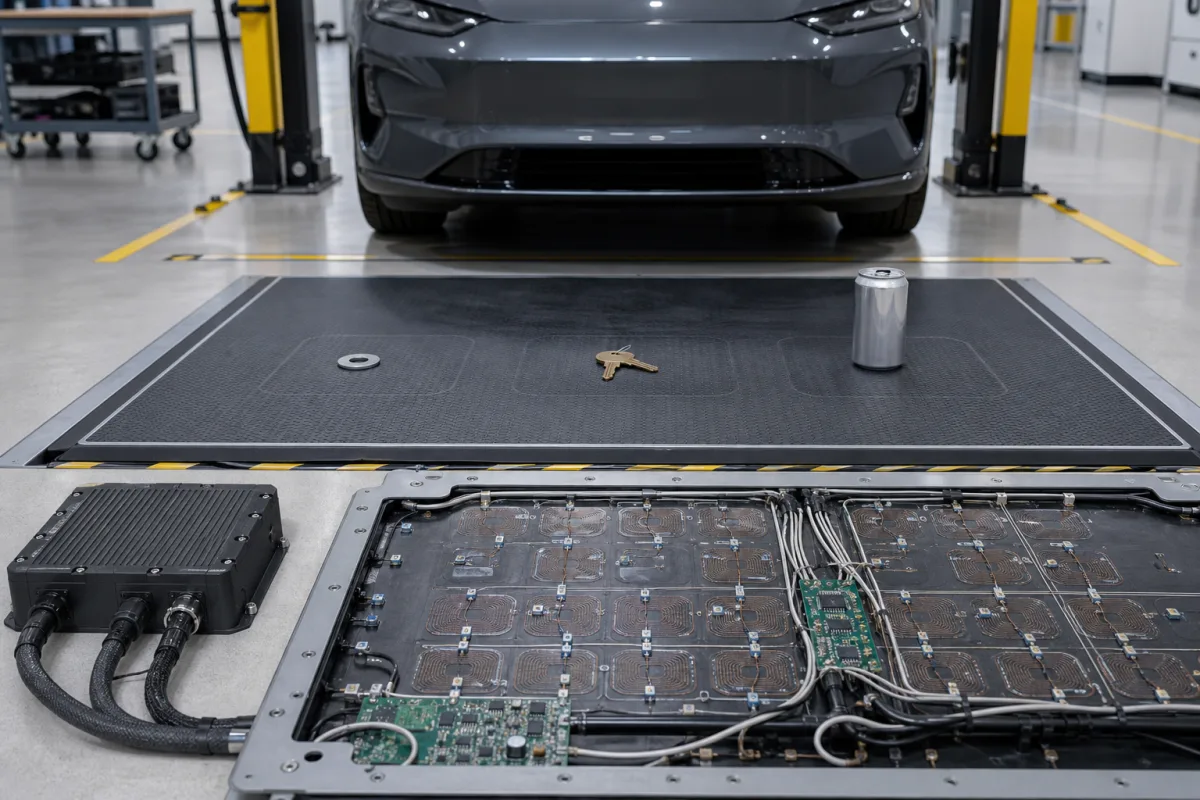
Foreign object detection for wireless EV charging: sensing metal and living objects over the ground pad before and during power transfer
Foreign object detection (FOD) for inductive EV charging · Metal and living objects over the ground pad, sensing-coil arrays, mutual-inductance and transmission-line sensing, camera and thermal fusion, and validation under power
This page covers foreign object detection for inductive wireless charging of electric vehicles: the sensors and logic in or around the ground assembly that find metal objects, which heat up in the magnetic field, and living objects before power transfer starts and while it runs. Ask three things first: which detection principle the system uses and where its blind spots are, which test objects and positions it was validated with, and what its detection rate is in real time and under power rather than offline.
Foreign object detection and living object detection for inductive wireless charging of electric vehicles, including sensing-coil arrays in the ground assembly, mutual-inductance monitoring, transmission-line, camera and thermal sensors, and the logic that stops power transfer. Bottle and package inspection on beverage lines is covered on the Inspection system page. X-ray and metal detectors on food and product lines, and FOD in phone chargers, are outside this page.
CNFX editorial research · Sources checked October 12, 2026 · 6 sources
Metal in an 85 kHz charging field heats up, so detection runs before and during transfer
A review of wireless power transfer standards describes SAE J2954 as the US standard for wireless charging of light-duty plug-in and electric vehicles, with power classes of 3.7, 7.7 and 11 kW, resonant inductive coupling and an operating band of 81.38–90 kHz around 85 kHz; it notes that WiTricity's J2954-compatible systems include foreign object detection, live object detection and position detection. [4] A paper on double DD coils explains that the field induces voltage in metal objects between the pads, such as cans, coins and keys, which then heat from eddy currents, can injure people and animals and raise system losses. [2]
A 2026 study of a sensing-coil array states that SAE J2954 requires safety verification both before power transfer starts and continuously during it. [1] A study of transmission-line sensors divides detection into living object detection and metal object detection, and groups methods as system-parameter-based (current, power loss, quality factor, inductance, frequency, temperature, weight), wave-based (imaging or thermal cameras, ultrasonic, radar) and field-based (sensor loops below the ground-assembly coil that see the field change). [3]
Give the supplier the ground-assembly coil size and power class, the vehicle ground clearance, indoor or outdoor installation, the test objects and positions you require, whether living object detection is needed, and how a detection must stop or derate power transfer.
02
Sensing-coil arrays, mutual inductance, transmission lines and camera-plus-thermal fusion
The transmission-line study notes that field-based designs need multiple sensor coils to cover the whole ground-assembly surface, connected in pairs to cancel the main coil's induced voltage and noise and multiplexed to one circuit, and that an object lying exactly between two coils can cancel out and be missed, so blind spots take design effort; it proposes time-domain reflectometry on transmission-line sensors, tested with a EUR 2 coin on PTFE spacers. [3]
Principle
How it detects
Stated trade-off
Mutual inductance between double DD pads
One DD pair transfers power, the other measures coupling; phase-shifted fields separate an object from a change in pad distance. [2]
Using one pair for measurement halves transfer efficiency; a 2DDq topology is used instead. [2]
Offline accuracy against real-time and under-power detection
The planar coil-array study collected 17,800 labelled frames over object types, positions, orientations and multi-object layouts in accordance with SAE J2954, with the rig built to its Section 15.1.1. All four classifiers exceeded 97% accuracy offline, but in real-time deployment across separate measurement sessions accuracy fell to 42–62% without feature engineering; with 13 engineered features it rose to 78–98%, and Random Forest and XGBoost with median and Savitzky–Golay filtering reached 98%. Under active power transfer both stayed above 96%, from 300 samples per class at a single power level. [1]
Editorial note: the gap between over 97% offline and 42–62% in real time is the figure to ask about. Request detection and false-alarm rates measured across sessions and under power at your power class, with the J2954 test objects, rather than single-session offline accuracy.
04
Send the pad, power class and test requirements together
Paste it into your enquiry below or into an email to a maker, then replace every bracket.
Pad: [ground-assembly coil size; power class; frequency]
Site: [indoor or outdoor; surface; ground clearance]
Objects: [J2954 test objects; positions; living objects]
Method: [coil array; inductance; camera; thermal]
Response: [stop or derate; time to act]
Validation: [real-time; under power; cross-session data]
Explore company information and manufacturing capabilities, then discuss the scope of your project with a relevant supplier.
Share this page
Compiled and source-reviewed by the CNFX editorial team.
Each manufacturer above links to the page on that company's own website where the product is listed, with the date we checked it. How we source and review
· Page last updated 13 October 2026
Buyer questions
Why does a wireless EV charger need foreign object detection?
Metal objects such as cans, coins and keys between the pads are heated by induced eddy currents, which can injure people and animals and raise losses; SAE J2954 expects checks before and during power transfer. [2][1]
What methods detect foreign objects on a wireless charging pad?
Published methods include sensing-coil arrays under the pad, mutual-inductance monitoring between pads, transmission-line sensors, and cameras combined with temperature sensors. [3][2][1][5]
How accurate is coil-array foreign object detection?
One 2026 study reported over 97% offline, 42–62% in real time without drift correction, 78–98% with feature engineering and above 96% under active power transfer. [1]
Sources and what still needs a direct check
Sources checked 2026-10-12. Three studies and one review in Sensors (MDPI) describe FOD methods and their results; two US patents, assigned to Delphi and Denso, describe camera and temperature-based detection.