Environmental sensing · Relative humidity, temperature effects, accuracy bands, sampling and calibration
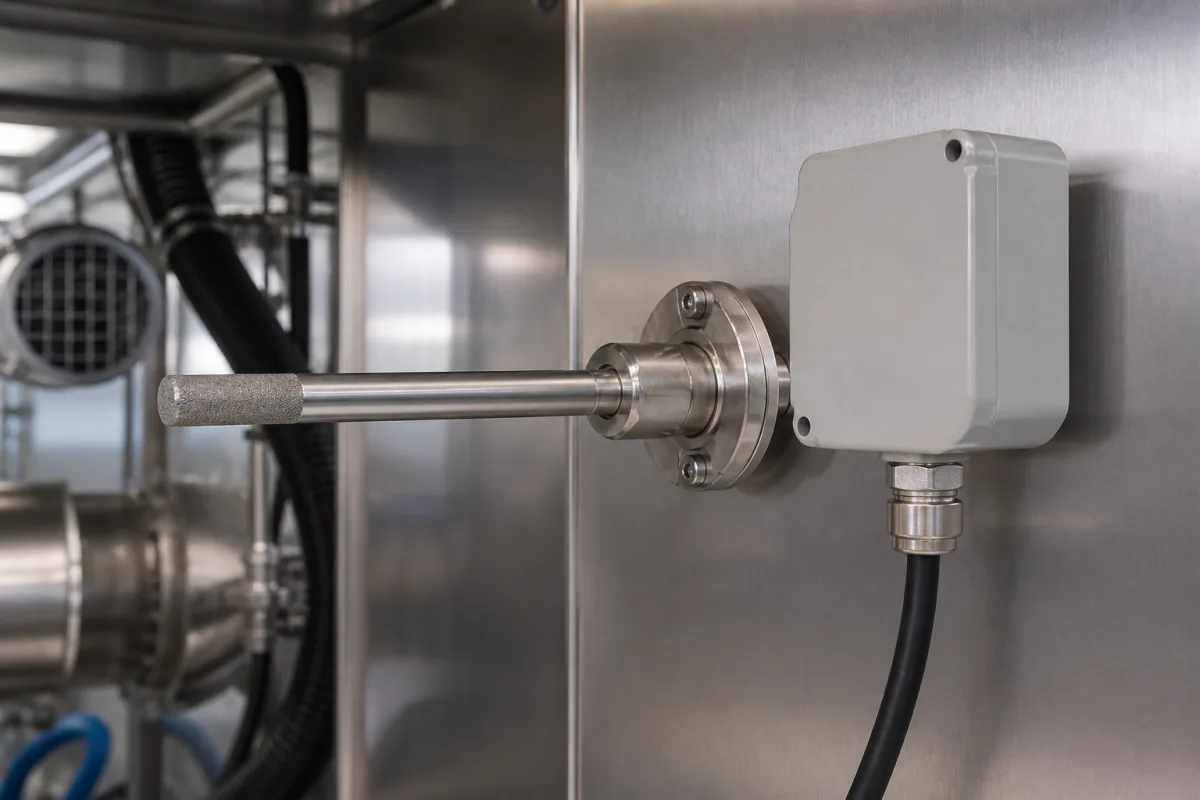
A humidity sensor measures water vapour in air or gas; a relative humidity sensor uses an element that absorbs water vapour and changes its capacitance or resistance. Ask three things first: the humidity and temperature range, the accuracy across that range and how it is stated, and how the probe will be mounted, protected and calibrated.
Relative humidity sensors, probes and transmitters for HVAC, industrial, agricultural and building use, including sensor modules and wireless sensors. Dew-point analyzers for very dry gases, moisture analyzers for solids and water-vapour permeability testers are outside this page.
CNFX editorial research · Sources checked October 12, 2026 · 4 sources
The UK National Physical Laboratory's beginner's guide describes relative humidity sensors as electronic components that absorb water vapour and change electrical impedance, resistance or capacitance, an instrument NPL says "is usually in the form of a probe" connected to an electronics unit; dew-point probes, chilled-mirror hygrometers and psychrometers are other methods. Relative humidity is relative to temperature: at 50 %rh a rise from 20 °C to 21 °C lowers relative humidity by about 3 %rh, which is why, NPL says, relative humidity instruments "generally have integral temperature sensors". [1]
Editorial calculation: at about 3 %rh per °C, a probe reading 0.7 °C away from the air it is meant to represent shifts relative humidity by about 2 %rh, as much as the ±2 %RH accuracy of the example sensor below. [1][2]
NPL advises avoiding cold spots, pooled water and condensation in sampling lines, using trace heating where condensation is possible, and taking repeated readings when conditions cycle. [1]
Give the supplier the humidity and temperature range, required accuracy across that range, response time, condensation or washdown exposure, chemicals or dust, mounting (duct, wall, immersion, OEM module), output signal or wireless protocol, power, and calibration certificate requirements.
02
Read a humidity sensor datasheet: a worked example
Amphenol's Telaire T9602 humidity and temperature sensor, in an IP67 package, specifies ±2.0 %RH accuracy from 20 to 80 %RH but ±3.5 %RH from 0 to 20 % and 80 to 100 %, repeatability ±0.2 %RH, hysteresis ±1.0 %RH, response time of 29 s or less (T63, 30 %RH step at 25 °C in 1 m/s air flow), a temperature coefficient of 0.13 %RH/°C, an operating range of 0 to 95 %RH, and ±0.5 °C temperature accuracy over −20 to 70 °C. Outputs are I²C digital or pulse-density modulated. [2]
Accuracy stated at 25 °C and in a mid-range band does not hold everywhere: compare each supplier's accuracy over your actual humidity and temperature range, and the test conditions behind response time. [2]
NPL notes that hygrometers drift through use and ageing, that calibration is not the same as adjustment, and that relative humidity instruments might be calibrated every 6 to 12 months, "or more often if they are harshly treated". [1]
03
For battery and IoT sensors, read typical against maximum accuracy and the current at your sampling rate
Texas Instruments' HDC2080 product page describes a capacitive humidity and temperature sensor with an integrated heating element to dissipate condensation and moisture, programmable interrupt thresholds and an auto measurement mode that lets the host microcontroller stay in deep sleep. It lists a 0–100 % RH range, humidity accuracy of ±2 % typical and ±3 % maximum, temperature accuracy of ±0.2 °C typical and ±0.4 °C maximum, a 1.62–3.6 V supply, an operating range of −40 to 85 °C and a functional range of −40 to 125 °C, in a 3 × 3 mm WSON package with an I²C interface. [4]
Current depends on what is measured and how often: the page lists 50 nA typical (100 nA maximum) in sleep mode, and at one measurement per second an average of 300 nA for 11-bit humidity alone or 550 nA for 11-bit humidity plus 11-bit temperature. The same page points to the newer HDC3020, listed at ±0.5 %RH, 0.19% long-term drift, 400 nA, a 4-second response time and NIST traceability. [4]
Editorial calculation: at 550 nA average, an assumed 220 mAh coin cell would last 0.220 ÷ 0.00000055 ≈ 400,000 h, about 46 years, for the sensor alone, so in a wireless node the radio, microcontroller and battery self-discharge set the service life, not the sensor. The gap between ±2 % typical and ±3 % maximum also matters: write the maximum, over your range, into the specification, and compare it with the ±2.0 %RH (20–80 %RH) of the Telaire T9602 on the same basis. [4][2]
Suppliers linked to this page list humidity sensors or transmitters; each card links to the page reviewed.
HENGKO lists industrial humidity transmitters and probes with sintered filters; Amphenol lists Telaire humidity sensors and transmitters; Renke, Rika and NiuBoL list temperature and humidity sensors with weather and environmental monitoring equipment; E-Top lists surface humidity and condensation sensors for HVAC; HKT and OWON list LoRaWAN and Zigbee wireless sensors; HopeRF lists temperature and humidity sensor components.
05
Ask how the sensor behaves at high humidity and over the years
Sensirion's datasheet for its SHT4x sensor family states that the sensors perform best within a recommended range of 5 °C to 60 °C and 20 %RH to 80 %RH. Long exposure outside that range, especially at high relative humidity, may temporarily offset the RH signal, with the example of +3 %RH after 60 h at above 80 %RH; the sensor recovers to within specification by itself once back in the normal range, while prolonged extreme conditions may accelerate ageing. Long-term drift is given as a typical value of below 0.2 %RH per year in normal conditions, a figure the maker says may be higher near vaporized solvents, outgassing tapes, adhesives or packaging materials. [3]
The same datasheet describes an on-package heater with settings of 20, 110 and 200 mW for 0.1 or 1 s, a maximum duty cycle of 10%, and use cases of removing condensed or spray water and allowing creep-free measurement in humid air. It warns that liquid water on the sensor surface makes it non-responsive to RH changes, that sensor specifications are not valid while the heater runs, and that the heater should only be operated in ambients below 65 °C. Response time is stated as 4 s (63% of a humidity step at 25 °C and 1 m/s airflow). [3]
Editorial note: if your application sits above 80 %RH for long periods or sees condensation, ask each supplier how its probe handles offset at high humidity (heating, purge or recovery period), what drift it states per year and under what conditions, and which materials near the sensor it advises against.
06
Trace the sensor components
This is a functional reference built from the sources cited; it is not one maker's parts list.
Fill the specification fields with values for your application
A humidity sensor quotation needs values for your conditions. The table explains each field, gives published values where a reviewed source states them, and says what to obtain from the supplier.
Explore company information and manufacturing capabilities, then discuss the scope of your project with a relevant supplier.
Share this page
Compiled and source-reviewed by the CNFX editorial team.
Published product pages show what a company offers, not tested performance. Confirm the legal seller, factory and scope for your order. How we source and review
· Page last updated 13 October 2026
Buyer questions
Why does a humidity sensor also measure temperature?
Relative humidity depends on temperature: at 50 %rh, a 1 °C rise from 20 °C lowers it by about 3 %rh. [1]
Is datasheet accuracy the same across the whole range?
Not always. The example T9602 is ±2.0 %RH from 20 to 80 %RH but ±3.5 %RH near dry and saturated conditions. [2]
How often should a humidity sensor be calibrated?
NPL suggests relative humidity instruments might be calibrated every 6 to 12 months, "or more often if they are harshly treated". [1]
Does a humidity sensor read high after long periods in very humid air?
Sensirion's SHT4x datasheet gives an example temporary offset of +3 %RH after 60 h above 80 %RH, which recovers by itself back in the normal range, and describes a built-in heater for creep-free operation at high humidity. [3]
How much current does a digital humidity sensor draw?
TI's HDC2080 lists 50 nA typical in sleep and 550 nA average for humidity plus temperature at one measurement per second. [4]
Sources and what still needs a direct check
Sources checked 2026-10-12. NPL is the UK's national measurement institute. Amphenol, Sensirion and Texas Instruments are sensor makers; their datasheets and product pages are used as worked examples, not recommendations.