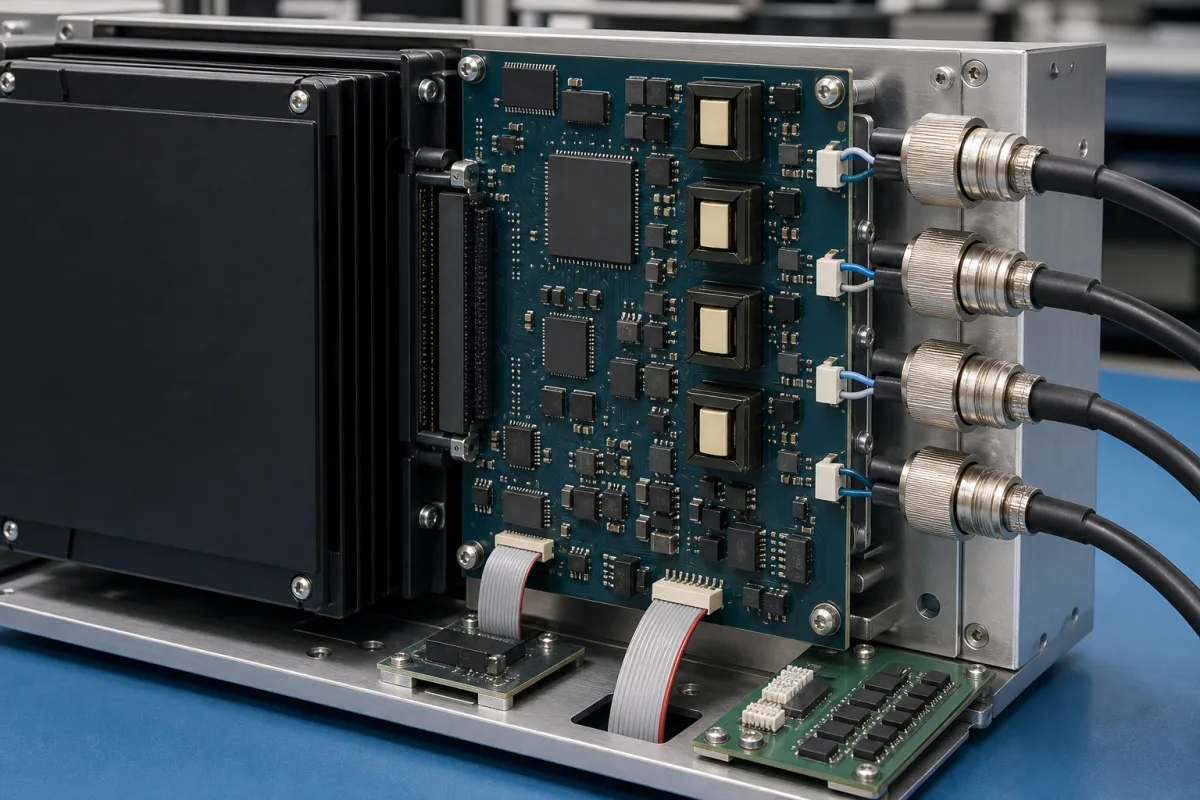
Interface board for a vision processing unit: multi-port GigE Vision PoE+ camera interface
The board between a vision processor and its GigE Vision cameras · four PoE+ ports, per-port 25.5–30 W against a 20, 60 or 120 W board budget, 12 V feed, temperature derating
In a machine-vision system the processing unit and its cameras are linked by an interface board: a GigE Vision frame grabber or network board with one Gigabit Ethernet port per camera, which can also power the camera over the same cable (Power over Ethernet). The board's per-port PoE rating is only half of the power question; the other half is how much 12 V power the board itself can draw and pass on, and at what temperature. Fix the number of cameras and their power draw first, then the board's feed.
Multi-port GigE Vision interface boards and frame grabbers with Power over Ethernet (IEEE 802.3af/at) that connect a vision processing unit or industrial PC to its cameras, as PCIe cards or as boards inside the vision unit, with their ports, PoE power budget, power feed and operating limits. RS-232, RS-422 and RS-485 serial interfaces, modules and converters are covered on the Serial communication interface page. CoaXPress and Camera Link frame grabbers, network switches and bare PCB or PCBA manufacturing services are outside this page.
CNFX editorial research · Sources checked October 12, 2026 · 3 sources
Per-port PoE+ rating against the board's total power budget and 12 V feed
Every four-port board below quotes a per-port PoE+ figure; whether all four cameras can draw it at once depends on the board's own 12 V supply.
ADLINK's PCIe-GIE7xP frame grabbers support IEEE 802.3at PoE+ with power-device detection and classification for classes 0 to 4 at up to 30 W per port, and quote a total PoE power of up to 20 W from the PCIe bus, 60 W from a 4-pin Molex connector and 120 W from a 6-pin Molex connector. The specification table gives a maximum of 61.6 W with either a 4-pin or a 6-pin connector (+12 V at 6 A), 120 W only with both connected (PRO version), and 20 W from the PCIe slot alone (+12 V at 2.1 A); the operating range is 0 to 70 °C at 60 W of PoE but 0 to 40 °C at 120 W. ADLINK also lists PoE overcurrent and overvoltage protection and automatic power budget control. [1]
Neousys's PCIe-PoE354at gives up to 25.5 W per port under IEEE 802.3at-2009, with per-port PoE on/off control, and draws its 12 V for PoE either from the PCIe bus or from an on-board 4-pin connector selected by jumper, up to 9.6 A at 12 V and 1.2 A at 3.3 V; the two-port 352at takes up to 4.8 A at 12 V from the bus only. [2] Basler's four-port GigE interface card lists IEEE 802.3af (up to 15.4 W per port) and 802.3at (up to 25.5 W per port) and a card consumption of 5.0 W. [3]
Editorial calculation: four cameras at ADLINK's 30 W would need 120 W, which only the dual-feed configuration supplies, and then only up to 40 °C; at 25.5 W, four cameras need 102 W, more than the 61.6 W single-feed limit. Neousys's 9.6 A at 12 V is about 115 W of input. From the PCIe slot alone, ADLINK's 20 W covers one camera at 15.4 W but not one at 25.5 W.
List each camera's PoE class and maximum power, the number of cameras per board, the 12 V supply available in the vision unit (slot only, 4-pin or 6-pin), the enclosure air temperature, cable length and category, and whether cameras must be power-cycled individually.
02
Ethernet controllers, bus lanes, cables and timing on four-port boards
Each port is an independent Gigabit link; the board shares one PCIe x4 connection to the processor.
Basler gives a packet-size limit of 8,192 bytes for its ace 2 cameras, with exceptions, against up to 16,332 bytes for its ace 2 5GigE and racer 2 S 5GigE cameras, so the jumbo-frame setting on the board is matched to the camera. [3] ADLINK's PRO versions add firmware-based Trigger over Ethernet with Action Command for synchronising camera acquisitions. [1]
Editorial calculation: four Gigabit ports at 1 Gb/s each total 4 Gb/s, or about 0.5 GB/s, within the 2 GB/s that Neousys gives for its x4 Gen2 bus.
Explore company information and manufacturing capabilities, then discuss the scope of your project with a relevant supplier.
Share this page
Compiled and source-reviewed by the CNFX editorial team.
Each manufacturer above links to the page on that company's own website where the product is listed, with the date we checked it. How we source and review
· Page last updated 13 October 2026
Buyer questions
How much power can a four-port PoE vision board supply?
Per port, Neousys and Basler give 25.5 W and ADLINK up to 30 W, but ADLINK's total is 20 W from the PCIe slot, 61.6 W with one Molex feed and 120 W with two. [2][3][1]
Does PoE power output depend on temperature?
ADLINK rates its PCIe-GIE7xP boards at 0–70 °C with 60 W of PoE, but only 0–40 °C at 120 W. [1]
What cable does a GigE PoE interface board need?
Neousys specifies CAT-5e or CAT-6 cable up to 100 m for its PCIe-PoE354at. [2]
Sources and what still needs a direct check
Sources checked 2026-10-12. Neousys, Basler and ADLINK publish specifications for their own four-port GigE PoE boards; figures apply to the models named.