Editorial Technical Reference

Interface PCB

This page explains how Interface PCB is classified within Computer, Electronic and Optical Product Manufacturing. Technical values and manufacturer relationships are research references; confirm the current specification and supplier evidence for each order.

Technical Definition & Core Assembly

A printed circuit board designed specifically for interfacing between test equipment and devices under test within a test fixture system.
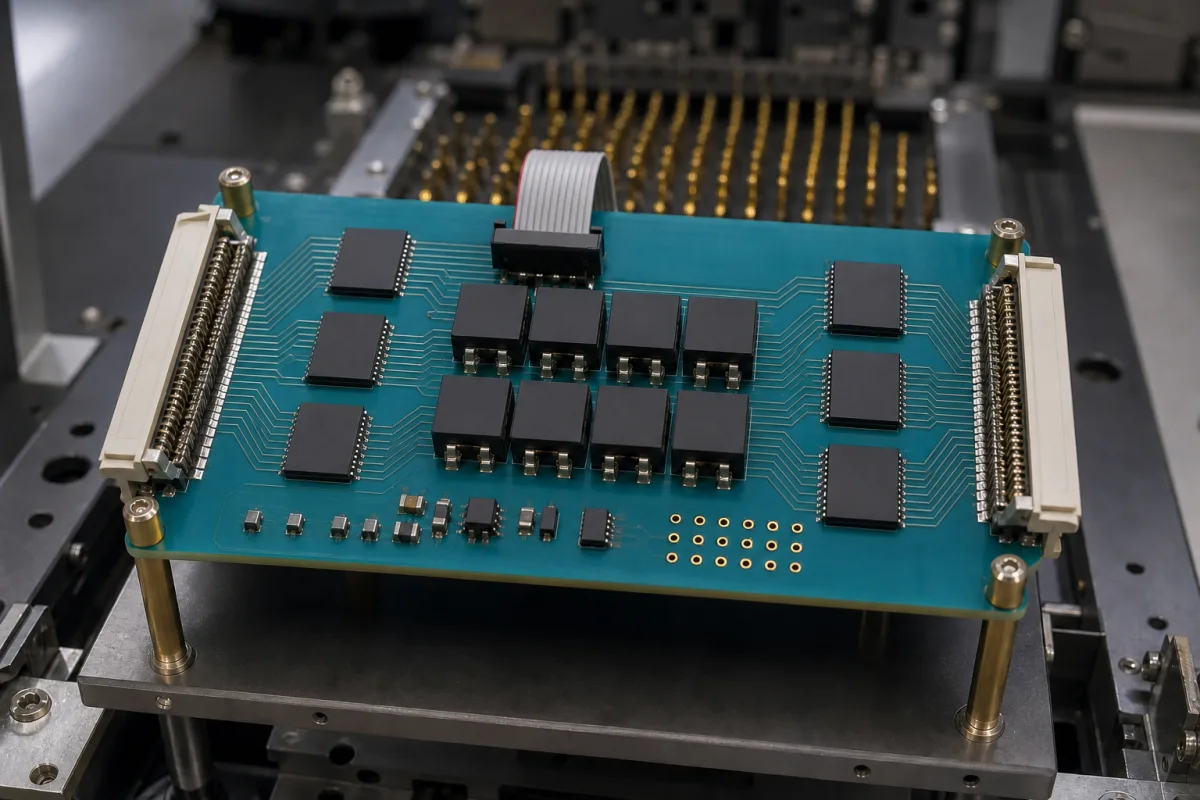
Representative product image. Confirm appearance and specifications with the manufacturer.

Product Specifications

Technical details and manufacturing context for Interface PCB

Definition
The Interface PCB is a critical component of the Test Fixture Interface that provides electrical connectivity, signal routing, and conditioning between automated test equipment (ATE) and the device under test (DUT). It serves as the physical and electrical bridge that enables precise testing, measurement, and validation of electronic components or assemblies by translating test signals, managing power distribution, and ensuring proper impedance matching. The board is manufactured on FR-4 substrate with copper traces, solder mask, and silkscreen. It is available in custom sizes ranging from 100 to 300 mm, with board thickness from 1.6 to 3.2 mm. The number of layers can vary from 4 to 12, depending on routing complexity, and copper thickness ranges from 35 to 105 µm. Minimum trace width and spacing are between 0.1 and 0.2 mm, with impedance tolerance of ±10%. The operating temperature range is -40 to 85 °C, storage temperature range is -55 to 125 °C, and humidity range is 5 to 95% RH (non-condensing). Insulation resistance is at least 100 MΩ at 500 V DC, and dielectric withstanding voltage is 500 to 1500 V AC for 1 minute. Surface finishes include ENIG, HASL, and OSP. Connector types include D-Sub, IDC, and BNC. Weight ranges from 0.05 to 0.5 kg. These parameters are reference ranges and must be verified with the legal manufacturer or supplier for specific models and applications. Standards such as IPC-6012, IPC-2221, IPC-2141, IEC 60068-2-1/2, IEC 60068-2-78, IPC-4552, and IEC 60807 are procurement references, not proof of certification.
Working Principle
The Interface PCB operates by receiving test signals and power from the ATE through connectors, routing these signals through carefully designed traces to maintain signal integrity, and delivering them to the DUT via test points or sockets. It may incorporate passive components (resistors, capacitors) for signal conditioning, active components for signal amplification or switching, and protection circuits to prevent damage to either the ATE or DUT during testing. The board's design ensures proper impedance matching and power distribution, enabling accurate and reliable testing.
Common Materials
FR-4 substrate, Copper traces, Solder mask, Silkscreen
Technical Parameters
ParameterTypical rangeNotes & selection driver
Board Dimensions100–300 mmCustom sizes available
Number of Layers4–12 layersHigher layer count for complex routingIPC-6012
Copper Thickness35–105 µmHeavier copper for high currentIPC-6012
Minimum Trace Width/Space0.1–0.2 mmTighter for high densityIPC-2221
Impedance Tolerance±10 %Critical for high-speed signalsIPC-2141
Operating Temperature Range-40–85 °CExtended range availableIEC 60068-2-1/2
Storage Temperature Range-55–125 °CFor long-term storageIEC 60068-2-1/2
Humidity Range5–95 % RHNon-condensingIEC 60068-2-78
Insulation Resistance≥100 At 500 V DCIPC-6012
Dielectric Withstanding Voltage500–1500 V ACFor 1 minuteIPC-6012
Surface FinishENIG, HASL, OSPENIG for flatness and shelf lifeIPC-4552
Board Thickness1.6–3.2 mmStandard 1.6 mmIPC-6012
Weight0.05–0.5 kgDepends on size and layers
Connector TypeD-Sub, IDC, BNCCustom pinouts availableIEC 60807

Ranges are indicative industry figures for RFQ preparation, not a supplier commitment. Confirm every value and standard with the legal manufacturer before ordering.

Components / BOM
  • Test Point Array Part
    Provides electrical contact points for connecting probes or pogo pins to the device under test
    Material: Gold-plated copper
  • ATE Connector
    Interface for connecting to automated test equipment cables and connectors
    Material: High-density plastic with gold contacts
  • Signal Conditioning Circuitry
    Filters, buffers, or amplifies test signals to ensure accurate measurements
    Material: Surface-mount resistors, capacitors, and ICs
  • Ground Plane Part
    Provides low-impedance return path for signals and reduces electromagnetic interference
    Material: Copper layer
  • Protection Circuit
    Clamps faults so neither the test equipment nor the device under test is damaged.

Applied To / Applications

This component is essential for the following industrial systems and equipment:

Industrial Ecosystem & Supply Chain Structure

Complementary Systems
Downstream Applications
Specialized Tooling

Application Fit & Sizing Matrix

Operational Limits
pressure: Not applicable (no fluid handling)
other spec: Max current per trace: 3A, Max voltage: 250V AC/DC, Signal frequency: DC to 1GHz
temperature: 0°C to 70°C (operational), -40°C to 85°C (storage)
Media Compatibility
✓ Clean room environments ✓ Electronics test fixtures ✓ Laboratory measurement systems
Unsuitable: High-vibration industrial machinery (exceeds shock/vibration ratings)
Sizing Data Required
  • Number of required test points/interfaces
  • Maximum signal frequency/bandwidth requirements
  • Available mounting space/PCB dimensions

Reliability & Engineering Risk Analysis

Failure Mode & Root Cause
Solder joint fatigue
Cause: Thermal cycling and mechanical vibration causing expansion/contraction stress on solder connections
Electrochemical migration
Cause: Contamination (flux residue, moisture, ionic contaminants) creating conductive dendrites between traces
Maintenance Indicators
  • Intermittent or erratic system behavior (random resets, data corruption)
  • Visible signs of corrosion, discoloration, or charring on PCB surface
Engineering Tips
  • Implement conformal coating to protect against moisture, dust, and chemical contamination
  • Use vibration-damping mounts and ensure proper thermal management with adequate airflow/cooling

Indicative industry ranges for design and RFQ preparation. Confirm the exact figures and applicable standard with the manufacturer before specifying.

Compliance & Manufacturing Standards

Applicable Standards
IPC-A-610 - Acceptability of Electronic Assemblies IEC 61131-2 - Programmable Controllers - Equipment Requirements and Tests

Quoted from the published standard.

Manufacturing Precision
  • Trace Width: +/-0.05mm
  • Hole Position: +/-0.1mm
Quality Inspection
  • Automated Optical Inspection (AOI)
  • In-Circuit Test (ICT)

Manufacturers of Interface PCB

Manufacturer profiles associated with Interface PCB.

Sourcing Interface PCB from China?
Tell us your specification and target quantity — we will match it against manufacturer records and come back with the factories that fit.
Request manufacturers We manufacture this

Manufacturer listings support early research and capability understanding. They are not certification, ranking, or transaction guarantees.

Technical documentation
Request current drawings, revision history, and a signed specification sheet.
Manufacturing capability
Verify equipment lists, process limits, capacity, and representative production evidence.
Inspection readiness
Confirm test methods, calibrated equipment, sampling plans, and traceable reports.
Supplier transparency
Check the legal entity, factory address, ownership, certifications, and direct contacts.

CNFX does not score or rank suppliers. Buyers must verify all claims and documents with the legal manufacturer before ordering.

Supply Chain Compatible Machinery & Devices

Modular Industrial Edge Computing Device

This modular industrial edge computing device is a ruggedized system designed for deployment in harsh industrial environments to perform real-time data processing, analytics, and control functions at the network edge.

Explore Specs →
Industrial Smart Camera Module

The Industrial Smart Camera Module is a compact, self-contained vision processing unit designed for integration into industrial machinery and production lines.

Explore Specs →
Surface Mount Resistor

Passive electronic component for current limiting and voltage division in circuits

Explore Specs →
Surface Mount Capacitor

A surface mount capacitor is a fundamental electronic component used for energy storage, filtering, coupling, and decoupling in electronic circuits.

Explore Specs →

Frequently Asked Questions

What is the primary function of an Interface PCB?

The Interface PCB provides electrical connectivity, signal routing, and conditioning between automated test equipment (ATE) and the device under test (DUT) within a test fixture system. It translates test signals, manages power distribution, and ensures impedance matching for accurate testing.

What materials are typically used in an Interface PCB?

The Interface PCB is typically manufactured on FR-4 substrate with copper traces, solder mask, and silkscreen. These materials are standard for printed circuit boards and provide the necessary electrical and mechanical properties.

What are the typical board dimensions and layer counts?

Board dimensions range from 100 to 300 mm, and the number of layers ranges from 4 to 12, depending on routing complexity. Board thickness is typically 1.6 to 3.2 mm. These are reference ranges; specific values must be confirmed with the supplier.

What standards apply to Interface PCBs?

Relevant standards include IPC-6012 for board performance, IPC-2221 for design, IPC-2141 for impedance, IEC 60068-2-1/2 for temperature, IEC 60068-2-78 for humidity, IPC-4552 for surface finish, and IEC 60807 for connectors. These are procurement references, not proof of certification.

Data Basis

Editorial classification, named public sources where available, and source-reviewed manufacturer records.

Preliminary Technical Classification
This page supports structured research, RFQ preparation, and supplier evaluation. It does not replace buyer-led supplier qualification, standards review, or technical approval.
Buyer enquiry

Request manufacturing insight for Interface PCB

Ask for use case, specification boundaries, supplier type, and RFQ preparation information for this product.

Where it goes
Straight to the CNFX editorial desk, and to the manufacturer if this product is linked to a claimed profile. Nothing is broadcast to a supplier list.
Your details stay here
We do not sell or rent enquiry data, and we do not add you to a mailing list. Used only to answer this request.
No commission, no middleman
CNFX is a directory. We take no cut of any order and never negotiate on a supplier's behalf.
What we don't claim
A listing is not an endorsement. Qualify every supplier and verify every figure yourself before ordering.

Your business information is used only to process this request.

Thank you! Your message has been sent. We'll respond within 1–3 business days.
Sorry, we couldn't send your message. Please try again, or email us at contact@cnfx.com.

Need to Manufacture Interface PCB?

Compare manufacturer profiles with relevant product and process capability.

Previous Product
XY Positioning Stage
Last Product
Get QuotesChat