Industry-Verified Manufacturing Data (2026)

Test Fixture Interface

Based on aggregated insights from multiple verified factory profiles within the CNFX directory, the standard Test Fixture Interface used in the Computer, Electronic and Optical Product Manufacturing sector typically supports operational capacities ranging from standard industrial configurations to heavy-duty production requirements.

Technical Definition & Core Assembly

A canonical Test Fixture Interface is characterized by the integration of Contact Array and Interface PCB. In industrial production environments, manufacturers listed on CNFX commonly emphasize Phosphor bronze (contacts) construction to support stable, high-cycle operation across diverse manufacturing scenarios.

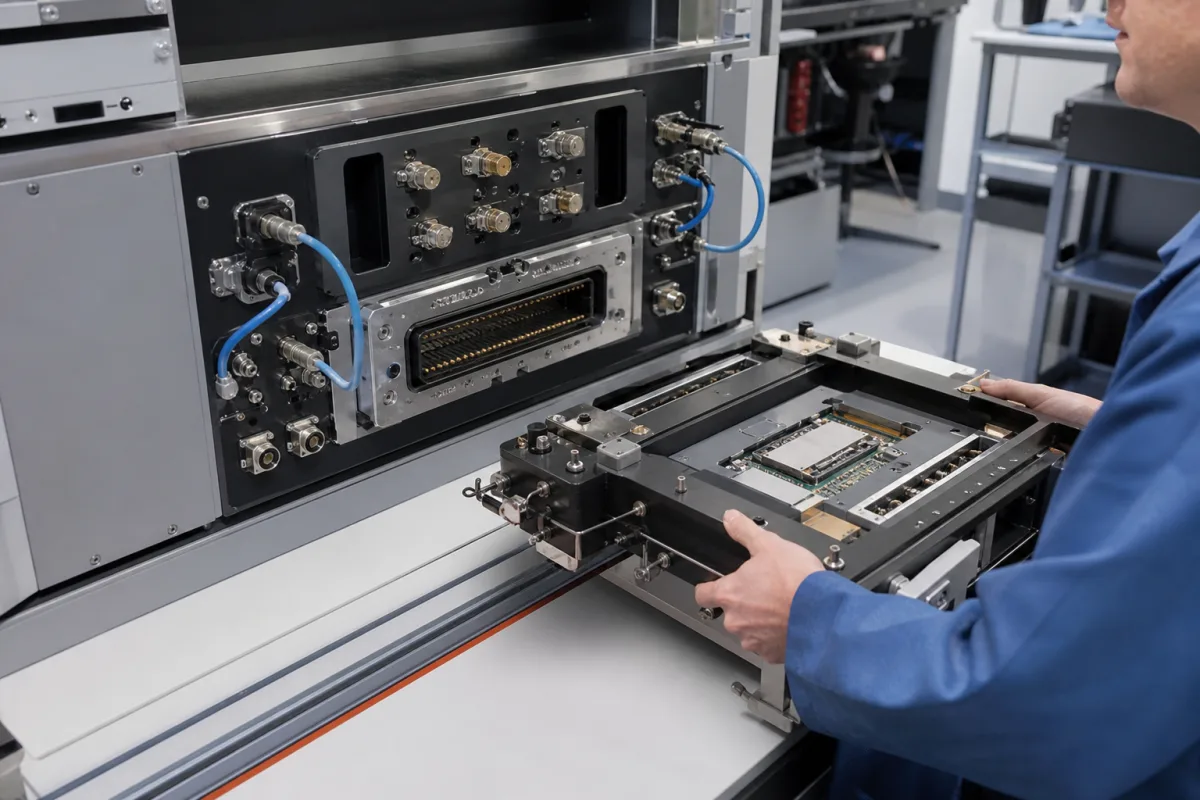
Interface component connecting the motherboard under test to the burn-in tester's control and measurement systems
Product Specifications

Technical details and manufacturing context for Test Fixture Interface

Definition
A specialized interface component within an Automated Computer Motherboard Burn-In Tester that provides the physical and electrical connection between the motherboard being tested and the tester's control, power delivery, signal generation, and measurement systems. It ensures precise alignment, reliable contact, and proper signal transmission during extended stress testing cycles.
Working Principle
The interface establishes multiple electrical connections (power, ground, data, control signals) between the tester and the motherboard's test points via precision contacts (pogo pins, sockets, or probes). It may include signal conditioning, isolation, or multiplexing circuits to route test signals accurately while protecting the tester from potential faults on the motherboard.
Common Materials
Phosphor bronze (contacts), FR-4 (PCB substrate), Stainless steel (housing/frame)
Technical Parameters
  • Number of contact points/pins (count) Standard Spec
Components / BOM
  • Contact Array
    Provides electrical connection to motherboard test points via spring-loaded pins or sockets
    Material: Phosphor bronze with gold plating
  • Interface PCB
    Routes signals between contacts and tester cables, may include conditioning circuits
    Material: FR-4 with immersion gold finish
  • Alignment Guide
    Ensures precise positioning of motherboard relative to contact array
    Material: Anodized aluminum or stainless steel
  • Housing/Frame
    Provides structural support and protection for internal components
    Material: Aluminum alloy or stainless steel
Engineering Reasoning
0-5 VDC signal range, 0-100 mA current capacity, -40°C to +85°C temperature range
Signal integrity loss at >2.5% voltage deviation from reference, contact resistance >50 mΩ, thermal runaway at >90°C junction temperature
Design Rationale: Electromigration at current densities >1×10⁶ A/cm² causing open circuits, differential thermal expansion (CTE mismatch of 16 ppm/°C between connector materials) causing contact separation, dielectric breakdown at >300 V/mil in insulation materials
Risk Mitigation (FMEA)
Trigger Electrostatic discharge (ESD) event exceeding 8 kV HBM
Mode: Gate oxide breakdown in interface ICs, immediate signal path failure
Strategy: Integrated TVS diodes with 5 ns response time, controlled impedance PCB routing with 50 Ω termination
Trigger Cyclic mechanical stress from 10,000+ mating cycles
Mode: Contact wear exceeding 0.1 mm depth, increased contact resistance causing signal attenuation
Strategy: Gold-plated contacts (50 µin minimum thickness), spring-loaded pogo pins with 100,000 cycle rating, anti-wear lubricant with 0.15 friction coefficient

Industry Taxonomies & Aliases

Commonly used trade names and technical identifiers for Test Fixture Interface.

Industrial Ecosystem & Supply Chain DNA

Complementary Systems
Downstream Applications
Specialized Tooling

Application Fit & Sizing Matrix

Operational Limits
pressure: 0 to 100 psi
temperature: -40°C to +125°C
mating cycles: ≥10,000 cycles
electrical rating: Up to 50V, 5A per pin
Media Compatibility
✓ Dry air/nitrogen purge environments ✓ Cleanroom assembly conditions ✓ Low-particulate industrial atmospheres
Unsuitable: Corrosive chemical or high-moisture environments without protective sealing
Sizing Data Required
  • Motherboard form factor and connector layout
  • Required number of test points/pins
  • Tester interface protocol compatibility (e.g., JTAG, I2C, GPIO)

Reliability & Engineering Risk Analysis

Failure Mode & Root Cause
Contact Surface Degradation
Cause: Repeated mechanical mating/unmating cycles causing wear, oxidation, or contamination buildup on electrical/mechanical contact points, leading to increased resistance, signal loss, or intermittent connections.
Structural Fatigue Failure
Cause: Cyclic loading from repeated test cycles, improper alignment during connection, or over-torquing causing stress concentrations, leading to crack initiation and propagation in housing, mounting points, or connector bodies.
Maintenance Indicators
  • Inconsistent or erratic test readings during operation, indicating potential contact issues or signal degradation
  • Visible wear, deformation, or discoloration on mating surfaces, housing, or mounting hardware
Engineering Tips
  • Implement regular cleaning and inspection protocols using appropriate contact cleaners and magnified visual inspection to maintain surface integrity and early defect detection
  • Establish and enforce proper connection procedures including alignment guides, torque specifications, and cycle counting to prevent misalignment and overstress conditions

Compliance & Manufacturing Standards

Reference Standards
ISO 9001:2015 - Quality Management Systems ANSI B4.1-1967 - Preferred Limits and Fits for Cylindrical Parts DIN 16742 - Plastics - Injection moulding of thermoplastic materials
Manufacturing Precision
  • Bore Diameter: +/-0.02mm
  • Surface Flatness: 0.1mm
Quality Inspection
  • Dimensional Verification with CMM
  • Dye Penetrant Test for Surface Defects

Factories Producing Test Fixture Interface

Verified manufacturers with capability to produce this product in China

✓ 94% Supplier Capability Match Found

T Technical Director from United Arab Emirates Jan 26, 2026
★★★★★
"Great transparency on the Test Fixture Interface components. Essential for our Computer, Electronic and Optical Product Manufacturing supply chain."
Technical Specifications Verified
P Project Engineer from Australia Jan 23, 2026
★★★★☆
"The Test Fixture Interface we sourced perfectly fits our Computer, Electronic and Optical Product Manufacturing production line requirements. (Delivery took slightly longer than expected, but technical support was excellent.)"
Technical Specifications Verified
S Sourcing Manager from Singapore Jan 20, 2026
★★★★★
"Found 24+ suppliers for Test Fixture Interface on CNFX, but this spec remains the most cost-effective."
Technical Specifications Verified
Verification Protocol

“Feedback is collected from verified sourcing managers during RFQ (Request for Quote) and factory evaluation processes on CNFX. These reports represent historical performance data and technical audit summaries from our B2B manufacturing network.”

12 sourcing managers are analyzing this specification now. Last inquiry for Test Fixture Interface from India (1h ago).

Supply Chain Compatible Machinery & Devices

Modular Industrial Edge Computing Device

Rugged computing platform for industrial data processing at the network edge

Explore Specs →
Industrial Smart Camera Module

Embedded vision system for industrial automation and quality inspection.

Explore Specs →
Industrial Wireless Power Transfer Module

Wireless power transfer module for industrial equipment applications

Explore Specs →
Industrial Smart Sensor Module

Modular industrial sensor with embedded processing and wireless connectivity

Explore Specs →

Frequently Asked Questions

What materials are used in this test fixture interface and why?

Phosphor bronze contacts ensure excellent conductivity and spring properties, FR-4 PCB substrate provides electrical insulation and mechanical stability, and stainless steel housing offers durability and EMI shielding for reliable testing environments.

How does this interface component connect to burn-in test systems?

The interface connects the motherboard under test to the tester's control and measurement systems through the contact array and interface PCB, enabling signal transmission, power delivery, and data acquisition during burn-in testing procedures.

What are the key components in the BOM for this test fixture interface?

The bill of materials includes: Alignment Guide for precise motherboard positioning, Contact Array with phosphor bronze pins, Housing/Frame for structural integrity, and Interface PCB for electrical routing and connection management.

Can I contact factories directly on CNFX?

CNFX is an open directory, not a transaction platform. Each factory profile provides direct contact information and production details to help you initiate direct inquiries with Chinese suppliers.

Get Quote for Test Fixture Interface

Request technical pricing, lead times, or customized specifications for Test Fixture Interface directly from verified manufacturing units.

Your business information is encrypted and only shared with verified Test Fixture Interface suppliers.

Thank you! Your message has been sent. We'll respond within 1–3 business days.

Need to Manufacture Test Fixture Interface?

Connect with verified factories specializing in this product category

Add Your Factory Contact Us
Previous Product
Test Fixture
Next Product
Test Interface Panel