Industry-Verified Manufacturing Data (2026)

Detector Array

Based on aggregated insights from multiple verified factory profiles within the CNFX directory, the standard Detector Array used in the Food Manufacturing sector typically supports operational capacities ranging from standard industrial configurations to heavy-duty production requirements.

Technical Definition & Core Assembly

A canonical Detector Array is characterized by the integration of Detector Element and Readout Circuit. In industrial production environments, manufacturers listed on CNFX commonly emphasize Cadmium Zinc Telluride (CZT) construction to support stable, high-cycle operation across diverse manufacturing scenarios.

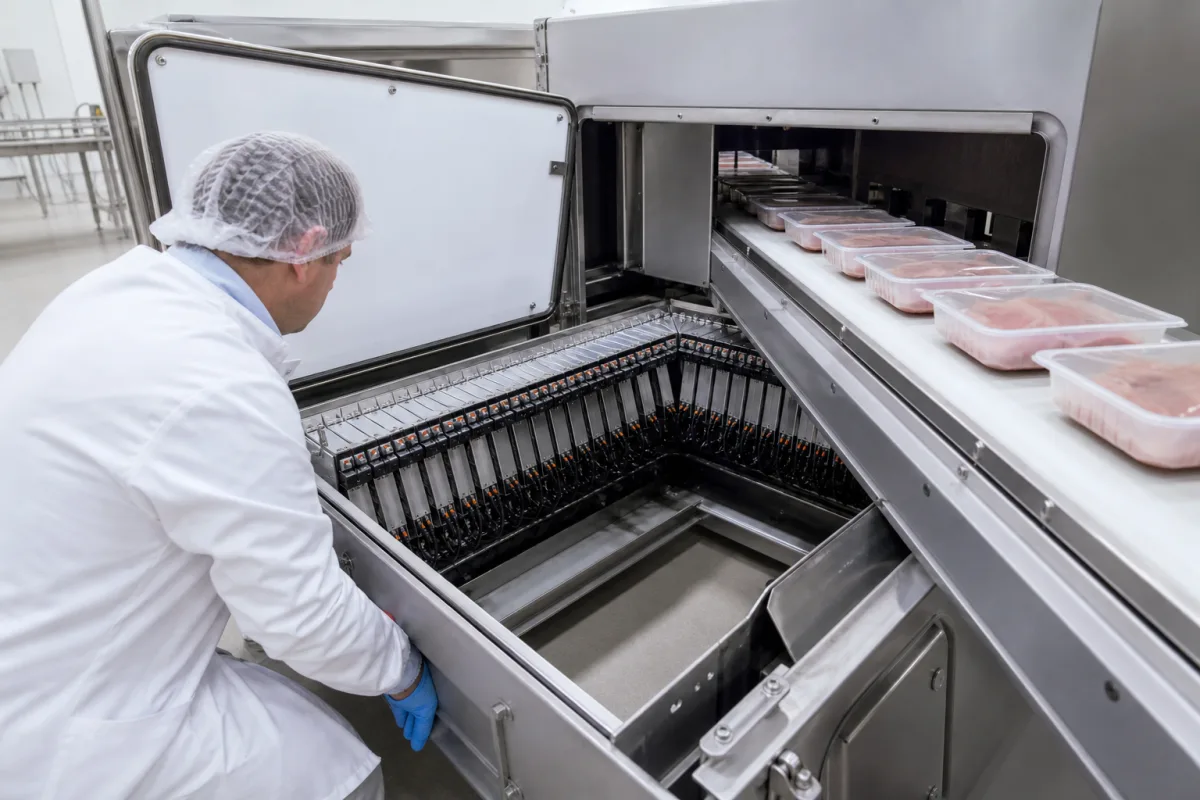
A multi-element sensing component that detects fish bones in food products through coordinated signal acquisition
Product Specifications

Technical details and manufacturing context for Detector Array

Definition
The detector array is the core sensing component within the Fish Bone Detection Sensor Module, consisting of multiple individual detector elements arranged in a specific pattern. It functions as the primary interface for detecting the presence, size, and location of fish bones in processed food products by capturing X-ray or electromagnetic signals that reveal bone density variations.
Working Principle
The detector array operates by converting incident radiation (typically X-rays) that have passed through food products into electrical signals. Each detector element in the array measures the attenuation of radiation caused by bone material, with the coordinated data from all elements creating a detailed spatial map of bone presence within the scanned product.
Common Materials
Cadmium Zinc Telluride (CZT), Silicon, Ceramic substrate
Technical Parameters
  • Element pitch and array dimensions (mm) Customizable
Components / BOM
  • Detector Element
    Individual radiation sensing unit that converts photons to electrical signals
    Material: Cadmium Zinc Telluride
  • Readout Circuit
    Processes and transmits signals from detector elements to the module's processing unit
    Material: Silicon
  • Array Substrate
    Provides structural support and electrical connections for all detector elements
    Material: Ceramic
Engineering Reasoning
0.5-3.0 mm detection resolution at 25-100 mm working distance
Signal-to-noise ratio drops below 15 dB at 0.1 mm detection threshold
Design Rationale: Photon shot noise exceeding 10^4 photons/pixel at 850 nm wavelength causes quantum efficiency degradation below 60%
Risk Mitigation (FMEA)
Trigger Electromagnetic interference exceeding 50 V/m at 2.4 GHz frequency
Mode: Cross-talk between adjacent detector elements exceeding -20 dB isolation
Strategy: Shielded twisted-pair wiring with 90 dB attenuation and ferrite chokes at 100 mm intervals
Trigger Thermal cycling between -10°C and 60°C at 5°C/minute rate
Mode: Differential thermal expansion causing 0.05 mm misalignment between optical elements
Strategy: Invar alloy mounting frames with 1.2×10^-6 /°C coefficient of thermal expansion

Industry Taxonomies & Aliases

Commonly used trade names and technical identifiers for Detector Array.

Applied To / Applications

This component is essential for the following industrial systems and equipment:

Industrial Ecosystem & Supply Chain DNA

Complementary Systems
Downstream Applications
Specialized Tooling

Application Fit & Sizing Matrix

Operational Limits
pressure: 0 to 10 bar
flow rate: 0.1 to 5.0 m/s
temperature: 0°C to 50°C
slurry concentration: Up to 40% solids by weight
Media Compatibility
✓ Food-grade stainless steel surfaces ✓ Polymer conveyor belts ✓ Aqueous food slurries
Unsuitable: High-viscosity pastes or pure oils without particulate flow
Sizing Data Required
  • Production line width (mm)
  • Target bone size detection threshold (mm)
  • Required throughput (kg/hour)

Reliability & Engineering Risk Analysis

Failure Mode & Root Cause
Sensor drift/calibration loss
Cause: Environmental contamination (dust, moisture, chemical exposure) degrading sensor elements or reference standards
Electronic component failure
Cause: Thermal cycling, vibration-induced fatigue, or power supply surges damaging circuit boards or connections
Maintenance Indicators
  • Inconsistent or erratic readings compared to baseline performance
  • Unusual audible buzzing, clicking, or complete silence from active components when powered
Engineering Tips
  • Implement regular calibration schedules with environmental compensation and use protective enclosures/seals appropriate for the operating environment
  • Install vibration damping mounts, ensure stable clean power supply with surge protection, and maintain thermal management within specified ranges

Compliance & Manufacturing Standards

Reference Standards
ISO 9001:2015 - Quality management systems IEC 61010-1:2010 - Safety requirements for electrical equipment for measurement, control, and laboratory use CE Marking - Conformité Européenne for EU market access
Manufacturing Precision
  • Element pitch: +/-0.005mm
  • Surface flatness: 0.01mm across active area
Quality Inspection
  • Functional electrical testing for all detector elements
  • Environmental stress screening (thermal cycling and vibration)

Factories Producing Detector Array

Verified manufacturers with capability to produce this product in China

✓ 96% Supplier Capability Match Found

P Procurement Specialist from Australia Jan 15, 2026
★★★★★
"The Detector Array we sourced perfectly fits our Food Manufacturing production line requirements."
Technical Specifications Verified
T Technical Director from Singapore Jan 12, 2026
★★★★★
"Found 15+ suppliers for Detector Array on CNFX, but this spec remains the most cost-effective."
Technical Specifications Verified
P Project Engineer from Germany Jan 09, 2026
★★★★★
"The technical documentation for this Detector Array is very thorough, especially regarding technical reliability."
Technical Specifications Verified
Verification Protocol

“Feedback is collected from verified sourcing managers during RFQ (Request for Quote) and factory evaluation processes on CNFX. These reports represent historical performance data and technical audit summaries from our B2B manufacturing network.”

9 sourcing managers are analyzing this specification now. Last inquiry for Detector Array from Brazil (1h ago).

Supply Chain Compatible Machinery & Devices

Intelligent Food Grade Metal Detector

Automated metal contamination detection system for food processing lines.

Explore Specs →
Automated Food Packaging Integrity Tester

Automated system for non-destructive testing of food package seals and integrity.

Explore Specs →
Automated Food Moisture Analyzer

Automated system for precise moisture content measurement in food products

Explore Specs →
Automated Food Color Consistency Analyzer

Automated inline system for real-time color measurement and consistency control in food processing.

Explore Specs →

Frequently Asked Questions

How does the detector array identify fish bones in food products?

The array uses coordinated signal acquisition across multiple CZT detector elements to detect density variations and structural anomalies characteristic of fish bones, providing high-resolution imaging for food safety inspection.

What are the advantages of using Cadmium Zinc Telluride (CZT) in this detector array?

CZT offers superior detection efficiency, high energy resolution, and room-temperature operation compared to traditional materials, making it ideal for precise bone detection in food manufacturing environments without requiring complex cooling systems.

How is this detector array integrated into existing food production lines?

The array features a modular design with standardized interfaces that connect to existing conveyor systems and quality control stations. The ceramic substrate provides durability for industrial environments, while the readout circuit ensures compatibility with common food manufacturing control systems.

Can I contact factories directly on CNFX?

CNFX is an open directory, not a transaction platform. Each factory profile provides direct contact information and production details to help you initiate direct inquiries with Chinese suppliers.

Get Quote for Detector Array

Request technical pricing, lead times, or customized specifications for Detector Array directly from verified manufacturing units.

Your business information is encrypted and only shared with verified Detector Array suppliers.

Thank you! Your message has been sent. We'll respond within 1–3 business days.

Need to Manufacture Detector Array?

Connect with verified factories specializing in this product category

Add Your Factory Contact Us
Previous Product
Dairy Flow Control Diaphragm Valve
Next Product
Die Head