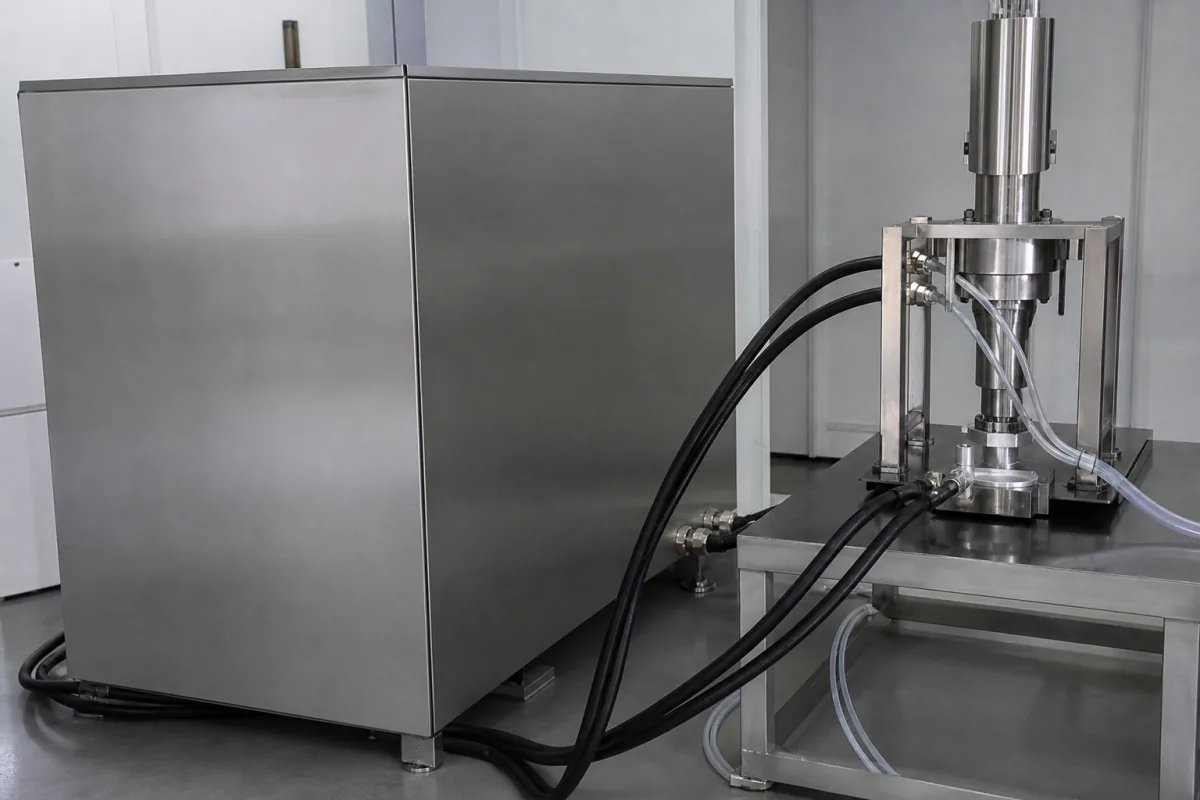
High-frequency generator for ultrasonic transducers: tracking resonance and holding amplitude for horn processors and cleaning tanks
Ultrasonic generators for piezoelectric transducers · Following the resonance as load and temperature move it, holding power or horn amplitude constant, 20 kHz horn stacks with flow cells, and frequency sweep for cleaning tanks from 25 to 170 kHz
This page covers the generators that drive power ultrasonic transducers: the cabinet that converts mains power into a high-frequency drive signal for a horn stack with a flow cell, or for transducers bonded to a cleaning tank. Ask three things first: how the generator finds and follows the resonance of the transducer and its load, whether it holds power or mechanical amplitude constant as the load changes, and which frequency, power and modulation features the process needs.
Ultrasonic generators (power supplies) for piezoelectric transducers in liquid processing horn systems and ultrasonic cleaning tanks. The transducers themselves are covered on the Piezoelectric ultrasonic transducer page, and RF generators for plasma processes on the RF power generator page. Electrosurgical generators, induction heating and RF wood-gluing generators, and signal generators for testing are outside this page.
CNFX editorial research · Sources checked October 12, 2026 · 5 sources
Resonance moves with the load, so the generator must follow it and hold real output
An Ultrasonic Power Corporation patent explains that the driver, transducer and the mechanical system they drive, including the liquid and immersed parts, have a resonant frequency that shifts with the mass and shape of the parts and the liquid temperature; as frequency moves off resonance, efficiency falls and less power reaches the load, so a shunt resistor in the input power circuit is at best a crude indicator of output power. Its generator uses a voltage-controlled oscillator tuned by a resonance follower, with a constant power control that holds the user's selected level even while tracking resonance; it lists frequency, power level, amplitude or frequency modulation and duty cycle of power bursts among adjustable parameters, and cites an earlier Puskas patent that also adjusts burst timing and degas on and off times. [1]
For horn processors Hielscher states that its UIP2000hd controls amplitude electronically so that the vibration at the sonotrode stays constant under all load conditions and at any pressure, adjustable from 50 to 100% at the generator with further ranges from booster horns, and that its automatic frequency tuning finds the operating frequency of the attached transducer, booster and sonotrode. [3]
Give the supplier the transducer or horn stack to be driven (make, frequency, impedance), the process (cleaning, emulsifying, extraction, flow-cell treatment), the power or amplitude needed, the liquid, temperature and pressure, cable length, duty cycle, and the control and data interfaces required.
02
20 kHz horn stacks with a flow cell, against 25–170 kHz tanks with frequency sweep
Hielscher describes the UIP2000hd as a 20 kHz, 2,000 W processor that, with a flow cell, gives a throughput of 1.0 to 8.0 L/min (typ.), runs 24 hours a day, and can be combined, as in a sewage-sludge disintegration system of 24 units totalling 48 kW for about 6 m³/h. [3] Its hdT series covers 500 to 4,000 W, with automatic recording of power, amplitude, sonication time and temperature, a plug-in temperature sensor, optional pressure sensing and browser remote control. [4]
For cleaning tanks, Branson's GCX lists auto tuning to hold the optimum operating frequency, a selectable sweep bandwidth and sweep rate to eliminate standing waves and spread activity, and a power modulation mode giving four times the peak power in the bath. [5] A patent by William Puskas defines a transducer's bandwidth as the frequencies over which its acoustic output stays between 50% and 100% of maximum, states that running at one fixed frequency can be undesirable because of the resonances it creates, and describes sweeping through the bandwidth, and varying or randomising the sweep rate itself, to reduce resonances in the liquid and in delicate parts such as semiconductor wafers, turbine blades and disk drive components. [2]
Editorial calculation: 48 elements at 50 W give a GCX tank generator 2,400 W; a 2,000 W horn at 8 L/min puts about 15 kJ into each litre, and at 1 L/min about 120 kJ, so the flow rate sets the energy dose as much as the generator rating. [5][3]
Explore company information and manufacturing capabilities, then discuss the scope of your project with a relevant supplier.
Share this page
Compiled and source-reviewed by the CNFX editorial team.
Each manufacturer above links to the page on that company's own website where the product is listed, with the date we checked it. How we source and review
· Page last updated 13 October 2026
Buyer questions
Why does an ultrasonic generator need resonance tracking?
An Ultrasonic Power Corporation patent explains that resonance shifts with part mass and shape and liquid temperature, and off resonance efficiency and delivered power fall. [1]
What does constant amplitude mean on a horn processor?
Hielscher states that the UIP2000hd holds the vibration amplitude at the sonotrode constant under all load conditions and at any pressure. [3]
Why do cleaning generators sweep frequency?
Branson's GCX uses selectable sweep bandwidth and rate to eliminate standing waves, and a Puskas patent explains that a single fixed frequency creates resonances. [5][2]
Sources and what still needs a direct check
Sources checked 2026-10-12. Two patents explain generator control; Hielscher describes its processors; a Plant Automation Technology listing reproduces Branson's GCX data.