Industry-Verified Manufacturing Data (2026)

Output Driver Circuit

Based on aggregated insights from multiple verified factory profiles within the CNFX directory, the standard Output Driver Circuit used in the Computer, Electronic and Optical Product Manufacturing sector typically supports operational capacities ranging from standard industrial configurations to heavy-duty production requirements.

Technical Definition & Core Assembly

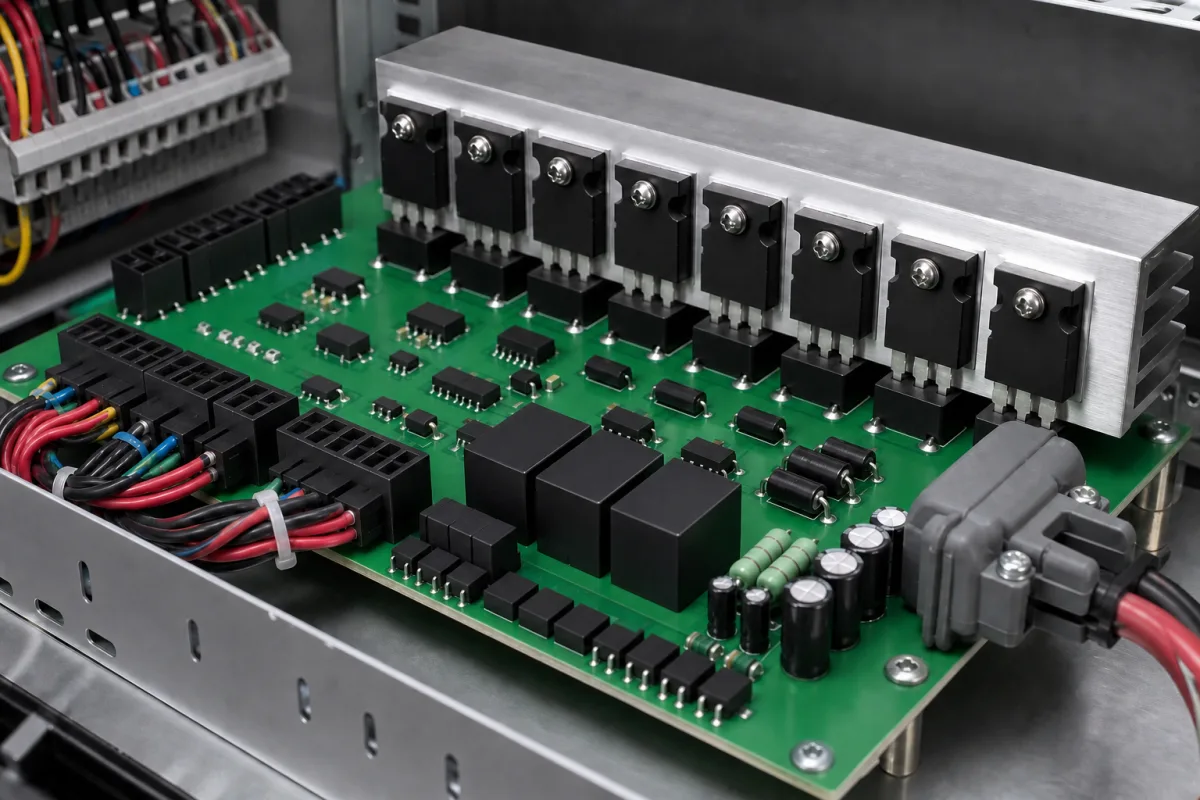
A canonical Output Driver Circuit is characterized by the integration of Power Transistor and Gate/Base Driver. In industrial production environments, manufacturers listed on CNFX commonly emphasize Semiconductor materials (silicon) construction to support stable, high-cycle operation across diverse manufacturing scenarios.

An electronic circuit that amplifies control signals to drive output devices such as motors, solenoids, or relays.
Product Specifications

Technical details and manufacturing context for Output Driver Circuit

Definition
A specialized electronic circuit on a Control PCB that receives low-power control signals from a microcontroller or processor and amplifies them to provide sufficient power and current to drive output devices like motors, actuators, solenoids, relays, or indicators. It serves as the interface between the control logic and the physical output components.
Working Principle
The circuit typically uses transistors (BJTs, MOSFETs), operational amplifiers, or dedicated driver ICs to amplify voltage and current from the control signal. It may include protection features like overcurrent protection, thermal shutdown, and flyback diodes for inductive loads. The amplified signal then activates the connected output device.
Common Materials
Semiconductor materials (silicon), Copper, FR-4 substrate, Solder
Technical Parameters
  • Maximum output current capacity (A) Per Request
Components / BOM
  • Power Transistor
    Amplifies current to drive the output load
    Material: silicon
  • Gate/Base Driver
    Provides proper voltage/current to switch the power transistor
    Material: silicon
  • Protection Diode
    Protects against voltage spikes from inductive loads
    Material: silicon
  • Current Sense Resistor
    Monitors output current for protection and feedback
    Material: metal alloy
Engineering Reasoning
5-24 VDC input voltage, 0-2 A continuous output current, -40°C to +85°C ambient temperature
Input voltage exceeding 30 VDC causes MOSFET gate oxide breakdown, output current exceeding 3 A for >10 ms causes thermal runaway, junction temperature exceeding 150°C
Design Rationale: Electromigration in copper traces at current densities >10^6 A/cm², dielectric breakdown at electric fields >10 MV/m in MOSFET gate oxides, thermal expansion mismatch between silicon die and copper substrate causing solder joint fatigue
Risk Mitigation (FMEA)
Trigger Inductive kickback from solenoid coil generating -50 V transient
Mode: MOSFET gate-source overvoltage causing dielectric breakdown
Strategy: Schottky diode clamp with 1N5819 providing <0.45 V forward voltage at 1 A
Trigger Prolonged operation at 2.5 A exceeding SOA (Safe Operating Area)
Mode: Junction temperature reaching 175°C causing thermal runaway
Strategy: Current limiting with 0.1 Ω shunt resistor and LM358 comparator triggering at 2.2 A threshold

Industry Taxonomies & Aliases

Commonly used trade names and technical identifiers for Output Driver Circuit.

Applied To / Applications

This component is essential for the following industrial systems and equipment:

Industrial Ecosystem & Supply Chain DNA

Complementary Systems
Downstream Applications
Specialized Tooling

Application Fit & Sizing Matrix

Operational Limits
current: Up to 10A continuous, 20A peak (output)
voltage: 5V to 48V DC (input control), up to 600V (output drive)
frequency: DC to 100kHz (switching)
isolation: Up to 2500Vrms (input-output)
temperature: -40°C to +85°C (operating), -55°C to +125°C (storage)
Media Compatibility
✓ DC motors (brushed/brushless) ✓ solenoid valves ✓ relay coils
Unsuitable: High-voltage AC mains (>600V) without additional isolation
Sizing Data Required
  • Load current (A)
  • Supply voltage (V)
  • Switching frequency (Hz)

Reliability & Engineering Risk Analysis

Failure Mode & Root Cause
Overheating and Thermal Stress
Cause: Excessive current draw, poor heat dissipation, or ambient temperature extremes leading to component degradation, solder joint failure, or insulation breakdown.
Electrostatic Discharge (ESD) or Voltage Surge Damage
Cause: Inadequate protection against transient voltage spikes, improper handling during installation, or power supply instability causing semiconductor failure or gate oxide breakdown.
Maintenance Indicators
  • Unusual audible buzzing, clicking, or high-pitched whining from the circuit, indicating arcing, loose connections, or failing components.
  • Visible signs such as discoloration (browning or blackening) of the PCB, bulging or leaking capacitors, or burnt odor, suggesting overheating or electrical faults.
Engineering Tips
  • Implement regular thermal monitoring using infrared cameras or sensors to ensure heat sinks and cooling systems are functioning optimally, and maintain clean, unobstructed airflow around the circuit.
  • Use proper ESD protection during handling and installation, and install surge protectors or voltage regulators in the power supply line to shield against transient spikes and ensure stable input voltage.

Compliance & Manufacturing Standards

Reference Standards
ISO 9001:2015 - Quality Management Systems IEC 61000-6-2:2016 - Electromagnetic Compatibility (EMC) - Generic Standards - Immunity UL 508 - Industrial Control Equipment
Manufacturing Precision
  • Voltage Regulation: +/- 2% of nominal output
  • Thermal Drift: +/- 0.5% over operating temperature range
Quality Inspection
  • High-Potential (Hi-Pot) Dielectric Strength Test
  • Thermal Cycling and Burn-In Test

Factories Producing Output Driver Circuit

Verified manufacturers with capability to produce this product in China

✓ 97% Supplier Capability Match Found

P Project Engineer from Canada Jan 01, 2026
★★★★★
"Found 39+ suppliers for Output Driver Circuit on CNFX, but this spec remains the most cost-effective."
Technical Specifications Verified
S Sourcing Manager from United States Dec 29, 2025
★★★★★
"The technical documentation for this Output Driver Circuit is very thorough, especially regarding technical reliability."
Technical Specifications Verified
P Procurement Specialist from United Arab Emirates Dec 26, 2025
★★★★★
"Reliable performance in harsh Computer, Electronic and Optical Product Manufacturing environments. No issues with the Output Driver Circuit so far."
Technical Specifications Verified
Verification Protocol

“Feedback is collected from verified sourcing managers during RFQ (Request for Quote) and factory evaluation processes on CNFX. These reports represent historical performance data and technical audit summaries from our B2B manufacturing network.”

8 sourcing managers are analyzing this specification now. Last inquiry for Output Driver Circuit from Thailand (1h ago).

Supply Chain Compatible Machinery & Devices

Industrial Smart Camera Module

Embedded vision system for industrial automation and quality inspection.

Explore Specs →
Industrial Wireless Power Transfer Module

Wireless power transfer module for industrial equipment applications

Explore Specs →
Industrial Smart Sensor Module

Modular industrial sensor with embedded processing and wireless connectivity

Explore Specs →
Surface Mount Resistor

Passive electronic component for current limiting and voltage division in circuits

Explore Specs →

Frequently Asked Questions

What is the primary function of an output driver circuit in electronic manufacturing?

An output driver circuit amplifies low-power control signals from microcontrollers or logic circuits to provide sufficient current and voltage to drive output devices like motors, solenoids, or relays in computer and optical product systems.

What protection features should be included in an output driver circuit design?

Essential protection includes flyback diodes for inductive loads, current limiting resistors, thermal protection for power transistors, and voltage spike suppression to prevent damage to both the driver circuit and connected devices.

How do material choices like FR-4 substrate and semiconductor silicon affect output driver circuit performance?

FR-4 substrate provides stable mechanical support and electrical insulation for circuit traces, while semiconductor silicon enables precise control of power transistors and driver ICs, ensuring efficient signal amplification and thermal management in electronic applications.

Can I contact factories directly on CNFX?

CNFX is an open directory, not a transaction platform. Each factory profile provides direct contact information and production details to help you initiate direct inquiries with Chinese suppliers.

Get Quote for Output Driver Circuit

Request technical pricing, lead times, or customized specifications for Output Driver Circuit directly from verified manufacturing units.

Your business information is encrypted and only shared with verified Output Driver Circuit suppliers.

Thank you! Your message has been sent. We'll respond within 1–3 business days.

Need to Manufacture Output Driver Circuit?

Connect with verified factories specializing in this product category

Add Your Factory Contact Us
Previous Product
Output Driver / Relay
Next Product
Output Driver Circuitry