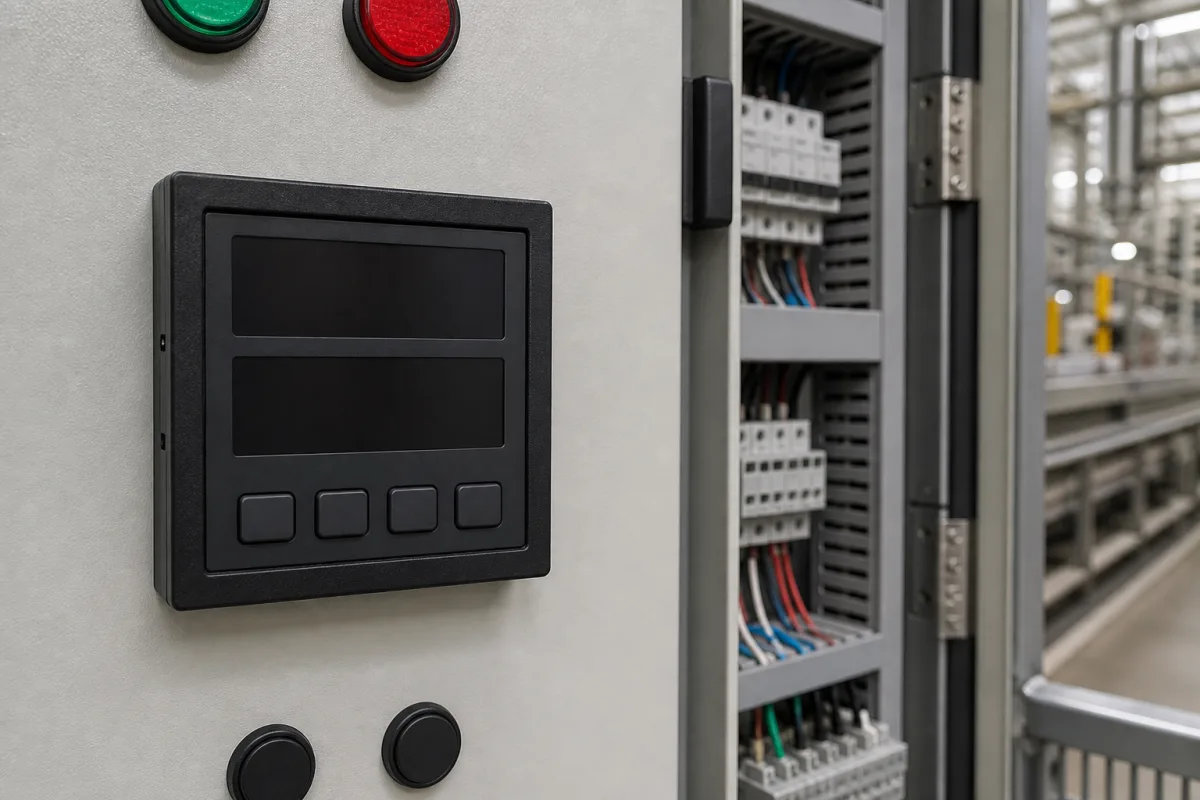
Tuning a panel-mounted PID controller at the keypad
A panel PID controller arrives with factory P, I and D values that belong to no particular process. Getting from there to stable control is done at the front keys: start an autotune, decide how hard the output may swing while it runs, then check what it set. This page follows that sequence using a Yamatake (now Azbil) patent that spells out a limit-cycle autotune, Omron's E5CC quick-start guide and Eurotherm's notes on PID terms and cutback.
Covers tuning of a single-loop panel PID controller: proportional band, integral and derivative time, limit-cycle autotune and its formulas, the output swing used during autotune, high and low cutback, time-proportioning cycle time and locking the tuned values. Sensor input matching, output types, accuracy and panel ratings for temperature controllers are on PID Temperature Controller (5233); multi-loop 4–20 mA process controllers, cascade and manual backup on Process Controller (821).
CNFX editorial research · Sources checked October 13, 2026 · 3 sources
The settings behind the keys: a 10 °C band gives 30% output at 3 °C error
Eurotherm describes the controller output as the sum of three terms, each with its own setting. What follows is how each one behaves, not a recommended value.
Halving the band to 5 °C would double the response, so the same 3 °C error would call for 60% output (Editorial calculation). A narrow band reacts harder; the integral rule from Eurotherm sets the lower limit on how fast the offset may be wound out.
The cycle time links tuning to hardware. At a 20 s cycle a relay closes 180 times an hour, about 1.58 million times in a year of continuous running (Editorial calculation); at 30% output it is on for 6 s and off for 14 s of each cycle. Eurotherm's reason for solid-state relays is the shorter cycle a small thermal mass needs; the switching count shows the wear side of the same choice.
Setting
What it does (Eurotherm)
Consequence when set wrong
Proportional band (P)
Output in proportion to error: with a 10 °C band, a 3 °C error gives 30% output
P alone holds an offset from setpoint where output power equals heat loss
Integral time (I)
Ramps output up or down with the size and duration of the error, removing steady offset
Eurotherm: must be longer than the process time constant, or the loop oscillates
Derivative time (D)
Acts on the rate of change of the process value; checks overshoot and recovers after a sudden demand change such as an opened oven door
—
High and low cutback
Degrees above and below setpoint at which the controller starts to cut back or raise output on large steps
PID values are tuned near setpoint; without cutback a large step can overshoot
Cycle time (time-proportioning outputs)
Converts a 0–100% output into on-time of a relay, triac or logic output; must be short enough for the load's thermal mass to smooth the pulses
Eurotherm cites 20 s; loads with small thermal mass need shorter cycles than a relay can give, down to 0.2 s with a solid-state relay
Eurotherm's statement that integral time must exceed the process time constant is a qualitative rule; it does not give a factor.
02
How a limit-cycle autotune arrives at Pb, Ti and Td
US 6,959,219 (Yamatake, 2005) names limit-cycle autotuning as a method used in general-purpose temperature controllers, citing a 1987 instrumentation text by Kazuo Hiroi, and gives the calculation step by step.
Two things follow from the formulas. First, Ti and Td come only from the timing of the oscillation, and their ratio is fixed: Td is always one fifth of Ti in this method (6 ÷ 1.2 = 5, Editorial calculation). If Th1 + Th2 is 60 s, the autotune sets Ti = 360 s and Td = 72 s (Editorial calculation).
Second, Pb is divided by the output swing used during tuning. The swing is a setting in its own right, and the patent's subject is keeping it separate from the output limits used in normal control, so the operator does not have to change and then restore the normal limits for each autotune.
Step
What the controller does
1
Compares process value PV with setpoint SP every control cycle
2
PV above SP: outputs the tuning lower limit OL_AT; PV at or below SP: outputs the tuning upper limit OH_AT
3
Detects extreme values of PV until four have been found
4
Takes the deviations at the two latest peaks (Er1, Er2) and the times from each sign change of the deviation to the following peak (Th1, Th2)
These formulas are the ones disclosed in this patent. Other makers' autotune routines are not published in this form and may calculate differently.
03
Choosing the tuning swing: Omron's at-2 (100%) and at-1 (40%)
An autotune pushes the process above and below setpoint on purpose. How far the output swings decides how far the temperature goes and how long the test takes.
The insulated-load case is lopsided. When holding power is 20%, a full-on tuning swing heats with five times the power needed to hold temperature, while full-off only lets losses bring it down (Editorial calculation from the patent's 20% figure). A smaller tuning swing, which is what the patent's separate tuning limits allow and what Omron's 40% option offers, reduces how far the temperature is driven; Omron does not say how its 40% is applied.
Omron's guide also covers what happens after tuning: a protect level decides which settings users may change, down to allowing only the setpoint. On a cabinet door like the one illustrated, locking P, I and D after the autotune keeps a retune from being started or overwritten by accident.
Situation
Source
What is stated
E5CC autotune at 100%
Omron
Select at-2 at the adjustment level; the tune indicator stays lit while it runs and the temperature varies; do not interrupt
Overshoot during tuning not acceptable
Omron
Select at-1: tuning at 40% of output capacity, slower and less excessive
Autotune still running after 2 hours
Omron
Contact Omron
Well-insulated load holding at 20% output or less
Yamatake patent
Tuning between 0% and 100% heats fast and cools slowly, so the limit cycle takes a long time
Start the autotune at the real working setpoint and load. The patent's method switches around SP, so tuned values reflect the process around that point.
04
What to ask a supplier about tuning functions
Paste it into your enquiry below or into an email to a maker, then replace every bracket.
Ask which autotune method the controller uses and whether the output swing during autotune can be limited separately from the normal output limits (for example a 40% option), whether cutback or another overshoot limit is available for large setpoint steps, the cycle-time range for relay and solid-state relay outputs, and which parameters a protect or lock level can hide from operators.
1 company lists this product among what they make. Company figures are quoted from each
company's own website; every card states where the relationship came from.
Xiamen Maxwell Automation Limited
TBC
Xiamen Maxwell Automation lists PID temperature controllers, panel-mount temperature controllers and a DIN Rail PID Controller category on its own site. Autotune method, tuning-swing options and lock levels are not stated on the category page and are TBC; location TBC.
Explore company information and manufacturing capabilities, then discuss the scope of your project with a relevant supplier.
Share this page
Compiled and source-reviewed by the CNFX editorial team.
Each manufacturer above links to the page on that company's own website where the product is listed, with the date we checked it. How we source and review
· Page last updated 13 October 2026
Buyer questions
What does a proportional band of 10 °C mean?
Eurotherm's example: with a 10 °C band, a 3 °C error produces 30% output. Proportional action alone leaves an offset; integral action removes it. [3]
How does a limit-cycle autotune calculate PID values?
In US 6,959,219 the output switches between tuning limits as PV crosses SP; after four PV peaks, Pb = 250·|Er2 − Er1| / (OH_AT − OL_AT), Ti = 6·(Th1 + Th2) and Td = 1.2·(Th1 + Th2). [1]
When should I choose at-1 rather than at-2 on an E5CC?
Omron's guide says at-2 may let the temperature rise above setpoint during tuning; at-1 tunes at 40% of output capacity, slower and with less overshoot. [2]
Why does autotune take so long on a well-insulated oven?
The Yamatake patent describes loads holding at 20% output or less: tuned between 0% and 100%, they heat fast and cool slowly, so each cycle is long. Its answer is a separate, narrower tuning limit. [1]
What is cutback?
Eurotherm's high and low cutback set how many degrees above and below setpoint the controller starts to reduce or raise output, limiting overshoot and undershoot on large steps. [3]
Sources and what still needs a direct check
Sources checked 2026-10-13. One patent that discloses an autotune calculation, one controller maker's quick-start guide and one controller maker's technical note.