Industry-Verified Manufacturing Data (2026)

Tension Controller / Regulator

Based on aggregated insights from multiple verified factory profiles within the CNFX directory, the standard Tension Controller / Regulator used in the Machinery and Equipment Manufacturing sector typically supports operational capacities ranging from standard industrial configurations to heavy-duty production requirements.

Technical Definition & Core Assembly

A canonical Tension Controller / Regulator is characterized by the integration of Control Unit / Processor and Sensor Input Interface. In industrial production environments, manufacturers listed on CNFX commonly emphasize Aluminum Alloy (housing) construction to support stable, high-cycle operation across diverse manufacturing scenarios.

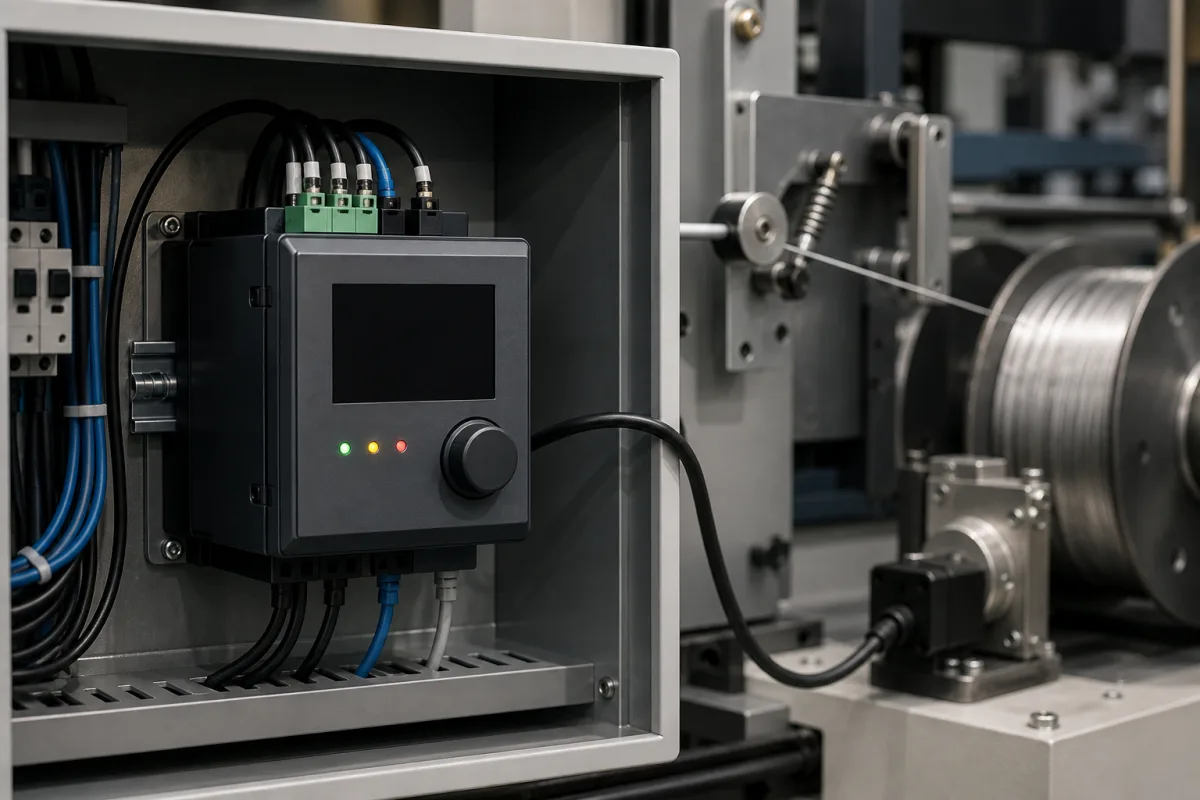
A device that monitors and adjusts the tension of wire or filament in a tensioning system to maintain consistent force.
Product Specifications

Technical details and manufacturing context for Tension Controller / Regulator

Definition
A critical component within a Wire Tensioning System responsible for continuously measuring the actual tension on a wire, comparing it to a preset target value, and automatically issuing control signals to an actuator (like a brake or dancer arm) to increase or decrease tension, thereby ensuring stable and precise wire handling during processes like winding, spooling, or feeding.
Working Principle
Typically uses a sensor (e.g., load cell, dancer position sensor) to measure tension. An electronic control unit processes this signal, compares it to the setpoint, and calculates an error. Based on this error and a control algorithm (like PID), it outputs a control signal (e.g., voltage, current, pneumatic pressure) to a tensioning actuator to correct the tension.
Common Materials
Aluminum Alloy (housing), Steel (internal components), Electronic Circuit Boards, Plastic (connectors/insulation)
Technical Parameters
  • The tension control range, specifying the minimum and maximum force the device can regulate. (N or cN) Standard Spec
Components / BOM
  • Control Unit / Processor
    Processes sensor input, runs control algorithm (e.g., PID), and generates the output control signal.
    Material: Electronic components on PCB
  • Sensor Input Interface
    Receives and conditions the electrical signal from the external tension sensor (load cell, dancer pot, etc.).
    Material: Electronic components (op-amps, ADCs)
  • Output Driver Circuit
    Amplifies the control signal from the processor to a level suitable for driving the actuator (brake coil, valve, motor).
    Material: Electronic components (transistors, relays)
  • User Interface (Display/Buttons)
    Allows operators to set the target tension, view current tension, and adjust control parameters.
    Material: Plastic, glass (display), electronic components
  • Power Supply Unit
    Converts incoming AC or DC power to the stable voltages required by the controller's internal electronics.
    Material: Electronic components (transformers, regulators)
Engineering Reasoning
0.1-100 N
150 N tensile load on load cell
Design Rationale: Piezoresistive strain gauge deformation beyond 0.3% strain limit causing permanent Wheatstone bridge imbalance
Risk Mitigation (FMEA)
Trigger Capacitive coupling from 400V AC motor leads inducing 50V transient on signal lines
Mode: ADC reference voltage corruption causing 25% tension overshoot
Strategy: Shielded twisted pair with 360-degree termination to chassis ground at both ends
Trigger Ambient temperature cycling from 20°C to 80°C over 8-hour production cycles
Mode: Thermal expansion mismatch between aluminum housing and steel load cell causing 0.15mm displacement
Strategy: Invar 36 alloy spacer with 1.2×10⁻⁶/°C CTE between mounting surfaces

Industry Taxonomies & Aliases

Commonly used trade names and technical identifiers for Tension Controller / Regulator.

Applied To / Applications

This component is essential for the following industrial systems and equipment:

Industrial Ecosystem & Supply Chain DNA

Complementary Systems
Downstream Applications
Specialized Tooling

Application Fit & Sizing Matrix

Operational Limits
pressure: 0-10 bar (system pressure), 0-100 N (tension range typical)
other spec: Wire diameter: 0.05-5 mm, Speed: 0-1000 m/min, Accuracy: ±0.5% FS
temperature: -10°C to +60°C (operating), -20°C to +80°C (storage)
Media Compatibility
✓ Copper wire ✓ Polymer filaments ✓ Steel cable
Unsuitable: Abrasive slurry environments (causes sensor/drum wear)
Sizing Data Required
  • Maximum wire tension required (N)
  • Wire diameter range (mm)
  • Line speed range (m/min)

Reliability & Engineering Risk Analysis

Failure Mode & Root Cause
Sensor drift or failure
Cause: Accumulation of dust, debris, or moisture on optical/mechanical sensors, leading to inaccurate tension readings and improper control responses.
Mechanical wear in actuator components
Cause: Continuous cyclic loading and friction in brake pads, clutches, or pneumatic cylinders, exacerbated by inadequate lubrication or misalignment.
Maintenance Indicators
  • Audible squealing, grinding, or irregular noises from the tensioning mechanism during operation.
  • Visual signs of overheating, such as discoloration or smoke from the controller housing or adjacent components.
Engineering Tips
  • Implement regular calibration and cleaning schedules for tension sensors and feedback systems to ensure accuracy and prevent drift.
  • Use condition monitoring techniques, such as vibration analysis or thermal imaging, to detect early signs of mechanical wear in actuators before catastrophic failure.

Compliance & Manufacturing Standards

Reference Standards
ISO 9001:2015 - Quality Management Systems CE Marking - Machinery Directive 2006/42/EC DIN EN ISO 13849-1:2015 - Safety of Machinery
Manufacturing Precision
  • Bore Diameter: +/-0.01mm
  • Shaft Runout: 0.005mm TIR
Quality Inspection
  • Torque Calibration Test
  • Vibration Analysis Test

Factories Producing Tension Controller / Regulator

Verified manufacturers with capability to produce this product in China

✓ 98% Supplier Capability Match Found

S Sourcing Manager from Singapore Jan 20, 2026
★★★★★
"The technical documentation for this Tension Controller / Regulator is very thorough, especially regarding technical reliability."
Technical Specifications Verified
P Procurement Specialist from Germany Jan 17, 2026
★★★★☆
"Reliable performance in harsh Machinery and Equipment Manufacturing environments. No issues with the Tension Controller / Regulator so far. (Delivery took slightly longer than expected, but technical support was excellent.)"
Technical Specifications Verified
T Technical Director from Brazil Jan 14, 2026
★★★★★
"Testing the Tension Controller / Regulator now; the technical reliability results are within 1% of the laboratory datasheet."
Technical Specifications Verified
Verification Protocol

“Feedback is collected from verified sourcing managers during RFQ (Request for Quote) and factory evaluation processes on CNFX. These reports represent historical performance data and technical audit summaries from our B2B manufacturing network.”

18 sourcing managers are analyzing this specification now. Last inquiry for Tension Controller / Regulator from Poland (1h ago).

Supply Chain Compatible Machinery & Devices

Heavy-Duty CNC Plasma Cutting Machine

Industrial machine for precision metal cutting using plasma arc technology

Explore Specs →
Automated Assembly Line System

Integrated production system for sequential component assembly operations

Explore Specs →
Automated Powder Coating System

Integrated industrial system for applying dry powder coatings to metal substrates.

Explore Specs →
Centrifugal Pump Impeller

Rotating component that transfers energy to fluid in centrifugal pumps.

Explore Specs →

Frequently Asked Questions

What materials are used in the construction of this tension controller?

The tension controller features an aluminum alloy housing for durability and lightweight protection, steel internal components for strength, electronic circuit boards for precise control, and plastic connectors/insulation for safety and connectivity.

How does this tension controller maintain consistent tension in manufacturing systems?

It continuously monitors tension via sensor input, processes data through its control unit, and adjusts output via the driver circuit to maintain precise, consistent force on wire or filament, ensuring quality in production processes.

What are the main components included in this tension controller's BOM?

Key components include a control unit/processor for data handling, an output driver circuit for adjustments, a power supply unit, a sensor input interface for monitoring, and a user interface with display/buttons for operation and settings.

Can I contact factories directly on CNFX?

CNFX is an open directory, not a transaction platform. Each factory profile provides direct contact information and production details to help you initiate direct inquiries with Chinese suppliers.

Get Quote for Tension Controller / Regulator

Request technical pricing, lead times, or customized specifications for Tension Controller / Regulator directly from verified manufacturing units.

Your business information is encrypted and only shared with verified Tension Controller / Regulator suppliers.

Thank you! Your message has been sent. We'll respond within 1–3 business days.

Need to Manufacture Tension Controller / Regulator?

Connect with verified factories specializing in this product category

Add Your Factory Contact Us
Previous Product
Tension Control System
Next Product
Tension Indicator (optional)