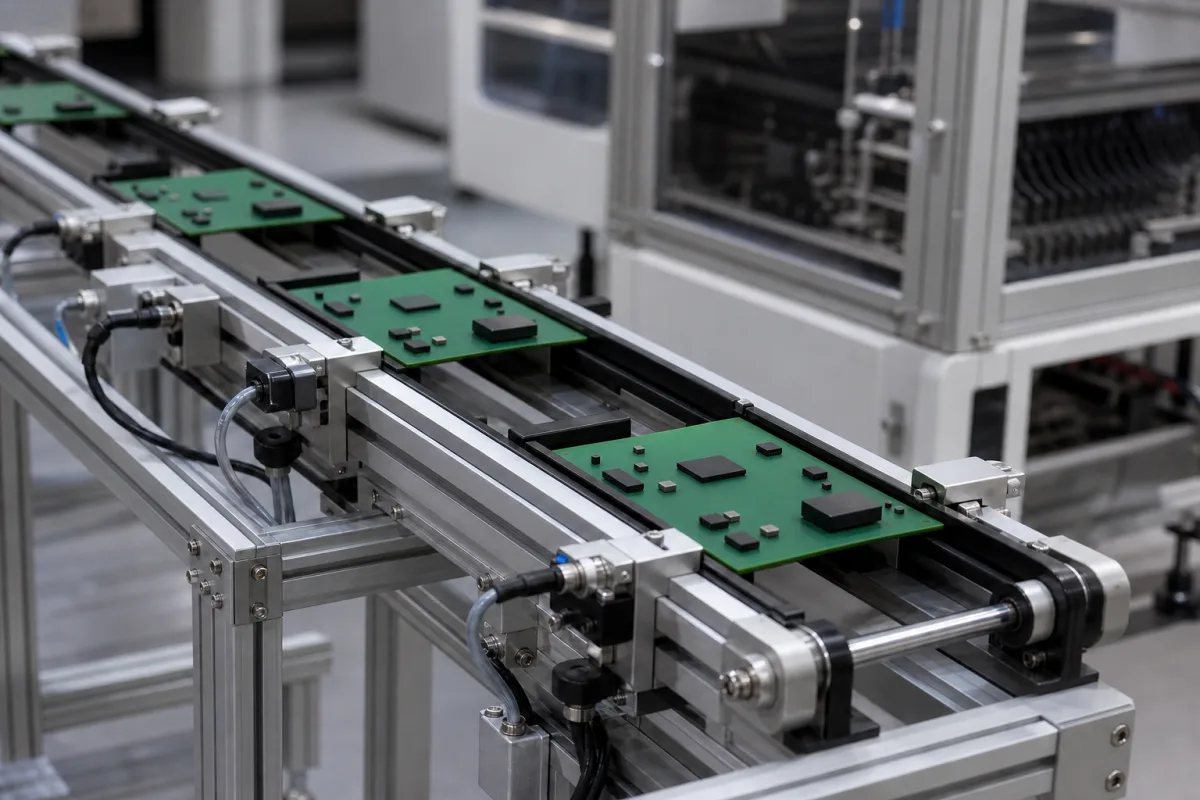
SMT and PCB assembly line handling · Link, buffer, shuttle, reject, turn and flip conveyors, barcode scanning conveyors, board size and rail width, transport height, SMEMA and IPC-HERMES-9852 interfaces, reading and traceability
A PCB conveyor system is the set of edge-belt conveyor modules that carries printed circuit boards between the machines of an SMT or through-hole assembly line — linking, buffering, shuttling, turning, flipping, rejecting and, in scanning conveyors, reading each board's identity — while exchanging ready and available signals with the machines on either side. Ask three things first: which functions the line needs at each position, what board size, mass and handoff height every module must handle, and which machine interface and traceability data the line uses.
Edge-belt conveyor modules for printed circuit board assembly lines: link, buffer, shuttle, reject, lifting, turn, inverter and barcode scanning conveyors. PCB loaders and unloaders, magazines, pick-and-place, reflow and wave-soldering machines, general industrial conveyors (see conveyor systems) and stand-alone barcode scanners (see barcode scanner) are outside this page except where compared.
CNFX editorial research · Sources checked October 11, 2026 · 7 sources
PCB conveyor systems are built from modules placed between SMT and through-hole machines. One supplier's PCB conveyor category lists link conveyors, NG/OK and buffer conveyors, cooling buffers, magazine buffers, shuttle conveyors, reject conveyors with covers, lifting conveyors, automatic PCB elevators, inverter (flip) conveyors, turn conveyors and angle conveyors, alongside loaders and unloaders [7]. A barcode scanning conveyor such as Hayawin's HY-SC460 adds identity reading to the same handling function [1].
Editorial note: list the line layout from loader to unloader, mark where boards must wait, turn, flip, be rejected or be read, and choose one module per function; then use the sections below to fix board size, handoff height, interfaces and reading.
Give the supplier the line layout, machines up and downstream, board sizes and populated mass, transport height and direction, functions needed at each position (link, buffer, shuttle, reject, turn, flip, scan), interface (SMEMA, IPC-HERMES-9852), cycle time, utilities and quantities.
02
Check the board size, rail width and line height
Hayawin, a Dongguan maker of SMT board-handling equipment, publishes the HY-SC460 smart code scanning conveyor with the figures below [1].
Rail travel is not the maximum board width
The rail adjustment extends to 480 mm, but the published maximum PCB width is 460 mm [1]. Use the complete panel outline, including breakaway rails. Minimum length, thickness, weight and component clearances are not supplied; a carrier needs its own approved drawing and does not waive the maximum envelope.
Match both handoff points
The listed transport height is 950 ±30 mm and either flow direction is offered [1]. Submit upstream exit and downstream infeed dimensions, support-edge requirements and which side operators must access.
Test the complete panel cycle
The ≤0.8 s item is called reading speed; 350 mm/s is widening speed [1]. Neither establishes board travel speed or sustained panels per hour. Ask for a timed run from receiving a panel to releasing it, including all required codes, upstream/downstream waiting and data acknowledgement. The listing does not establish whether reading overlaps transfer.
<85 dB; weighting, measuring distance and operating condition not stated [1]
03
Follow the panel and its identity through the station
The following structure uses the functions and construction named by Hayawin [1]. It is a functional component / BOM reference, not a manufacturing parts list. The listing gives no quantities, replacement part numbers or material grades.
Receive and position the panel
The adjustable rails and transport height establish the mechanical connection; verify support and clearance with the actual assembled panel [1].
Read the specified codes
The manufacturer describes 1D/2D reading, simultaneous top/bottom reading and missing, wrong, mixed or duplicate-code alarms [1]. Reader placement and coverage require a configuration drawing.
Hand off the board and record
The stated SMEMA interface handles connection to adjacent equipment; barcode logs and MES transfer are separate listed functions [1]. Agree which condition releases a board when a code or data link fails.
Functional block
Role / published evidence
Materials and configuration boundary
Adjustable rail / transport assembly
Accommodates the panel width and establishes the line transport plane [1].
Rail material, edge support width, transfer gap and carrying-belt construction not stated.
Servo / transmission assembly
The listing names a servo motor with a high-lead screw or high-tensile belt [1].
Which axis uses which drive, motor rating, belt composition and screw size are not identified. These are listed alternatives, not a confirmed combined drive.
Barcode-reading equipment
Decodes labels; top and bottom operation is listed [1].
Listed only as an imported scanner: brand, model, number, lighting and minimum resolvable module not supplied.
Software and line/data interfaces
Recalls product programmes, logs reads, signals code exceptions and transfers barcode data to MES; SMEMA is standard [1].
Controller hardware, software licences, MES message format and recovery logic not supplied; Hermes support unconfirmed.
Machine structure
Provides the station’s physical support; iron plate and aluminium profiles are described [1].
The source gives no alloy, plate grade, thickness or individual part-material allocation. “Aviation aluminium” is not a documented alloy specification.
Order the transport, optical and control spares against the delivered drawing and parts list. The source does not establish bulk-conveyor idlers, lagged pulleys, a reduction gearbox or a carrying chain as HY-SC460 equipment. Guard construction and safety functions also require machine-specific documentation.
04
Choose the line interface: SMEMA handshake or Hermes data
The HY-SC460 lists SMEMA as standard [1]. Hermes uses TCP/IP and XML to exchange board identity and related data between machines; its availability must be confirmed for each machine [2]. An Ethernet socket or a MES connection alone does not establish Hermes support.
Board flow plus identifiers and supported board/job data [2]
Identity along the line
SMEMA itself does not carry the barcode record; specify the separate data route.
A continuous implementation can forward identity rather than repeatedly scan. Mixed lines may need to recover data after a non-Hermes machine [2].
Product change
Obtain the actual width/programme-setting method.
Board data can support automated width or programme changes where the receiving equipment implements them [2].
Factory information system
The reviewed model separately lists direct MES barcode transfer [1].
Hermes concerns machine-to-machine flow; the initiative distinguishes it from vertical MES integration such as IPC-CFX [2].
The initiative describes a line needing at most one scanner as a potential benefit, not a prohibition on additional readers [2]. Confirm protocol version, supported messages, panel identity mapping and recovery across every handoff. Hayawin’s reviewed sheet confirms no IPC-HERMES-9852 implementation.
05
Plan what is read and where the data goes
The maker lists these reading and traceability functions for the HY-SC460 [1].
Give each expected code a place
Supply a panel map with board and panel IDs, top/bottom positions, symbology, X-dimension and expected code count. Ask the vendor to demonstrate the required 2D symbologies; the sheet does not name every supported type.
Separate an unread code from a wrong code
Proposed acceptance cases: absent label, unreadable label, readable ID for another job, duplicate ID and disconnected MES. Agree the expected alarm and release decision for each. These cases are an acceptance proposal, not verified delivered logic.
Keep the panel and message together
Agree how the system records which physical panel owns each read and how it handles retries, manual removal, line restart and missing acknowledgements. Request a log from the trial, not only a successful screen message.
Time the real reading arrangement
Trial the smallest module, reflective surface, largest panel and the required top/bottom code positions. Record complete-cycle timing and missed/wrong reads separately; there is no published model-specific read-rate guarantee.
Symbologies
1D and 2D codes, including EAN, UPC, Code 39, ITF25, Codabar, Code 93 and Code 128 [1]
Board sides / panel arrangement
Simultaneous TOP+BOT reading and “yin and yang board” are listed [1]. Submit the panel drawing; that wording does not establish optical mirror-code decoding.
Label positions / heights
Different label heights are described [1]. Confirm all code positions, optical access and component clearance using your samples.
Alarms
Missing, wrong, mixed and duplicate barcode alarms [1]
Data
Log output and direct transfer of barcode data to MES [1]
Programme recall
The maker claims programming under 10 seconds and switching by recalling a programme [1]. It gives no timing method or complete mechanical/optical changeover time.
06
A reader is not a verifier
A reader decodes data; a verifier measures code quality under controlled, calibrated conditions. Cognex’s 2018 guide explains why reader-specific process metrics cannot substitute for verification [3]. The current standard versions below were checked separately; the public catalogues do not supply their full test clauses.
Investigate both the mark and reader setup
Cognex notes that readers can decode the same mark differently and that process metrics depend on the reader setup [3]. Use a suitable verifier when a quality grade is required, while also testing the conveyor’s reading arrangement on your boards.
Give the optical supplier the smallest module
Cognex identifies the X-dimension, full symbol including quiet zone, and substrate as selection inputs [3]. The station’s 510 ×460 mm scan range does not establish the fitted reader’s optical resolution [1].
Mark being graded
Current published standard
Scope established by the public catalogue
Linear barcode
ISO/IEC 15416:2025
Measurement and overall assessment of linear-symbol quality [4].
Two-dimensional symbol
ISO/IEC 15415:2024
Two methodologies: multi-row symbols and matrix symbols; evaluation and overall quality [5].
Direct part mark
ISO/IEC 29158:2025, with ISO/IEC 15415
Modified quality methodology, alternative illumination and reporting for DPM [6].
Cognex’s cited guide is dated March 2018. Its ten-scan-line linear example and eight-parameter 2D example explain the older grading approach; they are not confirmation of the detailed requirements in the revised standards. Specify the contractual edition, application requirement, minimum grade and reporting conditions with the verifier supplier.
07
Keep board handling limits separate from bulk-conveyor ratings
These fields help complete a station specification. Published values apply only to HY-SC460; blank limits need the supplier’s delivered drawing, manual or acceptance record.
Field
Meaning for a PCB station
Available evidence / question to resolve
Transport length / mm
Useful panel-support path and handoff spacing.
800 mm is the listed overall machine length, not a stated useful transport length [1].
Carrying-belt width / mm
Width of the actual carrying surface, if fitted.
Not stated. Rail adjustment 50–480 mm is a different dimension [1].
Load / g per panel
Maximum populated panel mass and supported span.
No allowable load published; a bulk kg/m rating is not supplied.
Transport speed / mm/s
Panel travel velocity and complete-cycle timing.
Not stated. Widening 350 mm/s and reading ≤0.8 s describe different operations [1].
Motor power / W
Rating of each drive and required protection.
Not stated separately. The published 2500 W is the page’s whole-machine electricity-consumption item [1].
Incline / elevation
Entry/exit plane and whether an elevation change is required.
Transport height 950 ±30 mm; no inclined PCB-transport rating published [1].
Carrying-belt material
Contact material and any required ESD characteristics.
Not supplied; do not select a spare from a generic PVC/rubber category list.
Structure material
Approved structural grades and finish.
Iron plate and aluminium profile named, without grades [1].
Roller / pulley diameter / mm
Part geometry, where the delivered assembly uses these parts.
No dimensions or replacement specification published.
Belt thickness / mm
Exact belt cross-section, where applicable.
Not supplied; obtain the configured part number and drawing.
Operating temperature / °C
State whether a specified limit concerns equipment, contact parts or arriving panels.
No model limit or definition supplied. Confirm the actual upstream process and distinguish it from room temperature.
Noise
Comparable acoustic measurement and operating condition.
<85 dB listed, without weighting, distance or test method [1].
Service life
Wear-part replacement criteria, support and warranty scope.
No numerical service-life guarantee in the model sheet.
Duty / shifts
Required operating hours with refill, stop and service conditions.
No continuous 24/7 station rating established.
Room temperature / °C
Permitted equipment environment.
Range not published; obtain the delivered manual.
Humidity / % RH
Permitted room moisture and condensation condition.
Range not published; obtain the delivered manual.
Also obtain minimum panel length, board thickness/mass limits, component clearance above and below the board, ESD provisions, air consumption/quality and electrical connection details. None is established by the published rail width or footprint.
08
Make recovery and maintenance part of the handover
Hayawin’s model page does not provide a service manual or maintenance interval. The following is a proposed handover specification, not manufacturer instructions for servicing this machine.
Transport and adjustment
Request inspection limits, adjustment procedures and replacement identifiers for the supplied rails, carrying parts and servo transmission. Include safe isolation and jam-clearing instructions in the delivered manual.
Optics and reference samples
Obtain the scanner model, permitted cleaning method, lighting settings and a saved programme/reference sample set. Repeat agreed read checks after a relevant reader or programme change.
Data and restart
Request programme backups, MES mapping and a demonstrated restart after connection loss or manual panel removal. Specify how the system avoids attaching a stale ID to the next panel.
Acceptance record
Agree sample coverage, first-attempt read definition, wrong-ID detection, exception recovery and complete-panel cycle timing. Preserve the actual configuration and logs alongside the FAT/SAT record.
09
Hayawin's scanning conveyor and Oubel's module range
Hayawin's HY-SC460 is the one model reviewed here in detail, and its Hermes support is still unconfirmed; Oubel's category page supplies the module list in the first section. [1][7]
10
Copy this RFQ and fill in the brackets
Paste it into your enquiry below or into an email to a maker, then replace every bracket.
Product: HY-SC460 or equivalent SMT PCB barcode conveyor, quantity [ ]
Panel drawing: max L×W [mm], min L×W [mm], thickness [mm], populated mass [g]
Support and clearance: edge strip [mm], top/bottom component height [mm], carrier drawing [ ]
Handoff: entry/exit height [mm], direction [ ], upstream/downstream machines [ ]
Codes: type [ ], X-dimension [mm], quiet zone [mm], side/positions [drawing], codes per panel [ ]
Identity: panel ID / board IDs [ ], mapping and duplicate rule [ ]
Interfaces: SMEMA [ ], Hermes version/features if required [ ], MES message/acknowledgement [ ]
Cycle: complete receive-read-release time [s]; permitted waits [ ]
Exceptions: no-read / wrong ID / duplicate / offline / restart → [agreed response]
Utilities: supply/phase [ ], air pressure/flow/quality [ ], room conditions [ ]
Acceptance: sample mix [ ], distinct panels [n], first-attempt read target [ ], wrong-ID test [ ]
Handover: drawings, parts list, programme backup, safety/service manual and logs [ ]
Delivery: destination [ ], required date [ ]
Hayawin publishes the HY-SC460 scanning conveyor covered above; Oubel lists buffer, shuttle, NG/OK, reject, lifting, turn, inverter and angle conveyors among its SMT and DIP line equipment.
Hayawin
Manufacturing site to be confirmed for the order
The HY-SC460 page specifically presents an SMT PCB barcode conveyor, with 510 ×460 mm maximum PCB size, adjustable rails, top/bottom reading and SMEMA. This is the directly relevant reviewed model; reader configuration, Hermes support and your populated-panel fit still require confirmation.
Lists a PCB conveyor system category with buffer, shuttle, NG/OK, reject, lifting, turn, inverter and angle conveyors among SMT and DIP line equipment.
Explore company information and manufacturing capabilities, then discuss the scope of your project with a relevant supplier.
Share this page
Compiled and source-reviewed by the CNFX editorial team.
Each manufacturer above links to the page on that company's own website where the product is listed, with the date we checked it. How we source and review
· Page last updated 13 October 2026
Buyer questions
Which conveyor modules does an SMT line use?
One supplier lists link, buffer, shuttle, reject, lifting, turn, inverter and angle conveyors between machines, with loaders and unloaders at the ends. [7]
What is the difference between SMEMA and Hermes?
SMEMA connects board handover signals. Hermes can forward board identity and supported data over a machine-to-machine network. That benefit depends on the implementations and recovery across the line; the reviewed HY-SC460 sheet confirms SMEMA but not Hermes. [2]
What board size does a scanning conveyor take?
The HY-SC460 lists a maximum PCB of 510 ×460 mm, even though its rails adjust from 50 to 480 mm. Minimum length, thickness, mass and populated-board clearances require separate confirmation. [1]
Why do some barcodes fail to read on the line?
A successful decode is not a print-quality grade. Investigate the actual label and the scanner arrangement; use a suitable verifier where a quality grade is required. The current catalogued editions are ISO/IEC 15416:2025 and ISO/IEC 15415:2024. [3][4][5]
Can a scanning conveyor read both sides of a board?
Hayawin lists simultaneous top and bottom reading. Reader count, optical positions, component clearance and the complete-panel cycle must be checked for the ordered configuration. [1]
Sources and what still needs a direct check
Sources checked 2026-10-11. Hayawin's model page and Oubel's catalogue describe their own equipment; Hermes and ISO/IEC references describe interfaces and code quality. Values for your line must come from the supplier offered.