Industry-Verified Manufacturing Data (2026)

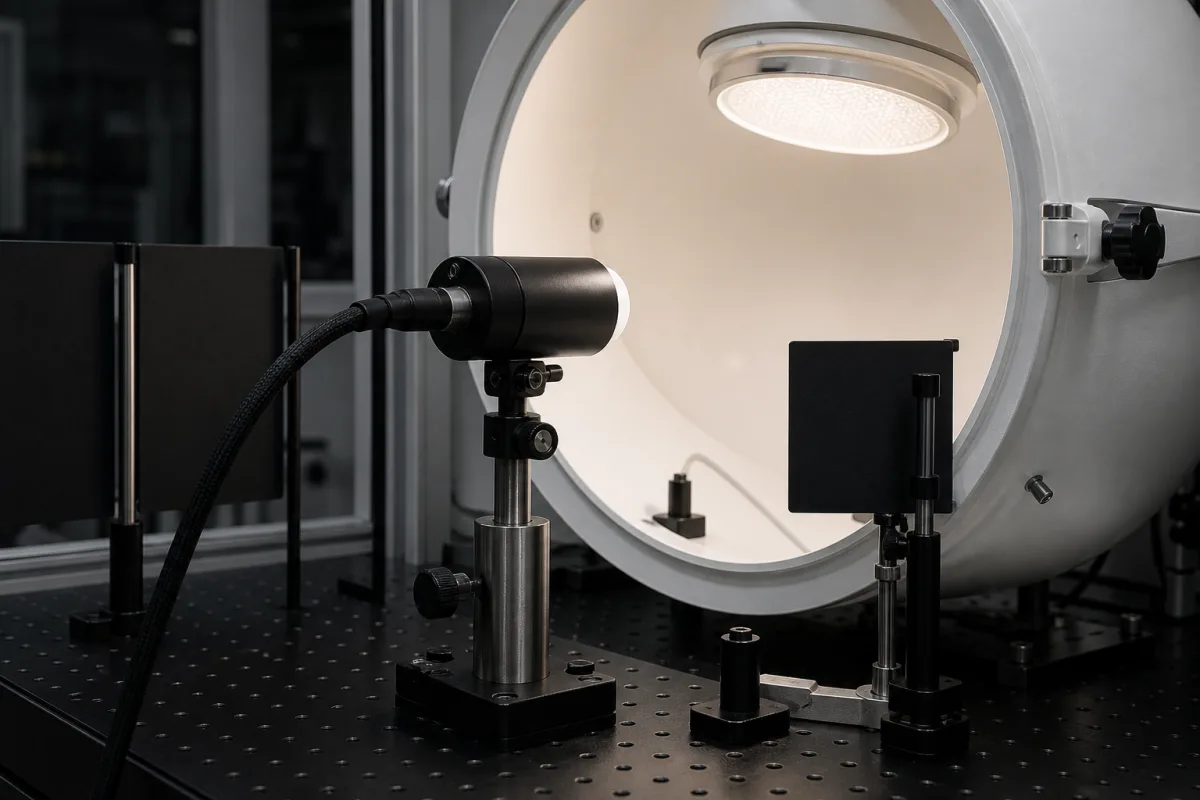
Photometric Sensor

Based on aggregated insights from multiple verified factory profiles within the CNFX directory, the standard Photometric Sensor used in the Computer, Electronic and Optical Product Manufacturing sector typically supports operational capacities ranging from standard industrial configurations to heavy-duty production requirements.

Technical Definition & Core Assembly

A canonical Photometric Sensor is characterized by the integration of Photosensitive Element and Optical Window/Lens. In industrial production environments, manufacturers listed on CNFX commonly emphasize Silicon photodiode construction to support stable, high-cycle operation across diverse manufacturing scenarios.

A sensor that measures light intensity or optical properties for testing purposes
Product Specifications

Technical details and manufacturing context for Photometric Sensor

Definition
A photometric sensor within an Electrical Testing Station is a precision optical component that detects, measures, and analyzes light characteristics such as intensity, wavelength, or spectral distribution. It converts optical signals into electrical signals for processing by the testing station's control system, enabling verification of light-emitting components, optical assemblies, or material optical properties during quality control and functional testing.
Working Principle
The photometric sensor operates by receiving incoming light through an optical input (lens, fiber, or window). The light interacts with a photosensitive element (photodiode, phototransistor, or CCD/CMOS array) that generates an electrical current proportional to the light intensity. This signal is then amplified, conditioned, and converted to digital data by integrated circuitry. The sensor may incorporate filters, gratings, or monochromators for spectral analysis, with calibration ensuring accurate measurement against known photometric standards.
Common Materials
Silicon photodiode, Optical glass lens, Aluminum housing, Copper electrical contacts
Technical Parameters
  • Spectral response range (typically 400-1100nm for silicon-based sensors) (nm) Customizable
Components / BOM
  • Photosensitive Element
    Converts incoming photons into electrical current through the photoelectric effect
    Material: Silicon or InGaAs semiconductor
  • Optical Window/Lens
    Transmits and focuses light onto the photosensitive element while protecting internal components
    Material: Optical glass or quartz
  • Signal Conditioning Circuit
    Amplifies, filters, and converts the weak photocurrent into a usable electrical signal
    Material: Printed circuit board with integrated circuits
  • Housing
    Provides mechanical protection, light shielding, and thermal management for the sensor assembly
    Material: Anodized aluminum or stainless steel
Engineering Reasoning
0.1-100,000 lux
Photodiode saturation at 120,000 lux causing non-linear response >5% deviation
Design Rationale: Photodiode quantum efficiency degradation due to prolonged exposure >100,000 lux causing lattice displacement in silicon PN junction
Risk Mitigation (FMEA)
Trigger Ambient temperature exceeding 85°C
Mode: Thermal noise increase to 50μV RMS, signal-to-noise ratio degradation below 20dB
Strategy: Peltier cooling element maintaining sensor temperature at 25±2°C
Trigger Moisture ingress exceeding 85% RH for >24 hours
Mode: Optical window condensation causing 40% light transmission loss
Strategy: Hermetic sealing with IP68 rating and desiccant chamber

Industry Taxonomies & Aliases

Commonly used trade names and technical identifiers for Photometric Sensor.

Applied To / Applications

This component is essential for the following industrial systems and equipment:

Industrial Ecosystem & Supply Chain DNA

Complementary Systems
Downstream Applications
Specialized Tooling

Application Fit & Sizing Matrix

Operational Limits
pressure: 0 to 10 bar
other spec: Light intensity range: 0.1 to 100,000 lux
temperature: -20°C to 85°C
Media Compatibility
✓ Clear liquids (water, solvents) ✓ Transparent gases (air, nitrogen) ✓ Optically clear solids (glass, acrylic)
Unsuitable: High-turbidity slurries or opaque media
Sizing Data Required
  • Required measurement range (lux/nm)
  • Required accuracy/precision (±%)
  • Required response time (ms)

Reliability & Engineering Risk Analysis

Failure Mode & Root Cause
Lens contamination
Cause: Accumulation of dust, dirt, or process residues on the optical lens, obstructing light transmission and causing false readings or signal loss.
LED degradation
Cause: Gradual reduction in light output from the emitter LED due to aging, thermal stress, or electrical overstress, leading to diminished signal strength and unreliable detection.
Maintenance Indicators
  • Intermittent or erratic output signals despite stable process conditions
  • Visible accumulation of contaminants on the sensor lens or housing
Engineering Tips
  • Implement regular cleaning schedules using appropriate lens-safe solvents and soft materials to prevent permanent contamination buildup
  • Ensure proper electrical installation with surge protection and stable power supply to prevent voltage spikes that accelerate LED degradation

Compliance & Manufacturing Standards

Reference Standards
ISO 15004-2:2007 (Ophthalmic instruments - Fundamental requirements and test methods for optical radiation safety) ANSI/IES LM-79-19 (Electrical and Photometric Measurements of Solid-State Lighting Products) DIN 5032-7:2017 (Photometry - Part 7: Classification of photometric sensors)
Manufacturing Precision
  • Spectral Response Accuracy: +/- 2% of specified wavelength range
  • Linearity Error: +/- 0.5% of full scale output
Quality Inspection
  • Dark Current and Noise Level Verification Test
  • Spectral Calibration Verification using Monochromator

Factories Producing Photometric Sensor

Verified manufacturers with capability to produce this product in China

✓ 97% Supplier Capability Match Found

P Project Engineer from Canada Feb 02, 2026
★★★★★
"The Photometric Sensor we sourced perfectly fits our Computer, Electronic and Optical Product Manufacturing production line requirements."
Technical Specifications Verified
S Sourcing Manager from United States Jan 30, 2026
★★★★★
"Found 37+ suppliers for Photometric Sensor on CNFX, but this spec remains the most cost-effective."
Technical Specifications Verified
P Procurement Specialist from United Arab Emirates Jan 27, 2026
★★★★★
"The technical documentation for this Photometric Sensor is very thorough, especially regarding technical reliability."
Technical Specifications Verified
Verification Protocol

“Feedback is collected from verified sourcing managers during RFQ (Request for Quote) and factory evaluation processes on CNFX. These reports represent historical performance data and technical audit summaries from our B2B manufacturing network.”

6 sourcing managers are analyzing this specification now. Last inquiry for Photometric Sensor from Turkey (1h ago).

Supply Chain Compatible Machinery & Devices

Industrial IoT Gateway

Edge computing device connecting industrial equipment to cloud platforms.

Explore Specs →
Modular Industrial Edge Computing Device

Rugged computing platform for industrial data processing at the network edge

Explore Specs →
Industrial Smart Camera Module

Embedded vision system for industrial automation and quality inspection.

Explore Specs →
Industrial Wireless Power Transfer Module

Wireless power transfer module for industrial equipment applications

Explore Specs →

Frequently Asked Questions

What applications is this photometric sensor suitable for in electronics manufacturing?

This sensor is ideal for quality control testing of displays, LEDs, optical components, and photometric calibration in computer, electronic, and optical product manufacturing environments.

How does the silicon photodiode and optical glass lens combination improve measurement accuracy?

The silicon photodiode provides high sensitivity across visible light spectra, while the optical glass lens ensures minimal distortion and maximum light transmission, resulting in precise, repeatable measurements.

What are the key durability features of the aluminum housing?

The aluminum housing offers EMI/RFI shielding, thermal stability for consistent performance, and industrial-grade protection against environmental factors in manufacturing settings.

Can I contact factories directly on CNFX?

CNFX is an open directory, not a transaction platform. Each factory profile provides direct contact information and production details to help you initiate direct inquiries with Chinese suppliers.

Get Quote for Photometric Sensor

Request technical pricing, lead times, or customized specifications for Photometric Sensor directly from verified manufacturing units.

Your business information is encrypted and only shared with verified Photometric Sensor suppliers.

Thank you! Your message has been sent. We'll respond within 1–3 business days.

Need to Manufacture Photometric Sensor?

Connect with verified factories specializing in this product category

Add Your Factory Contact Us
Previous Product
Photodiode Array
Next Product
Photovoltaic Panel