Editorial Technical Reference

Pickup Head

This page explains how Pickup Head is classified within Computer, Electronic and Optical Product Manufacturing. Technical values and manufacturer relationships are research references; confirm the current specification and supplier evidence for each order.

Technical Definition & Core Assembly

A precision component in automated die attach machines that picks up semiconductor dies from wafer tape and places them onto substrates.
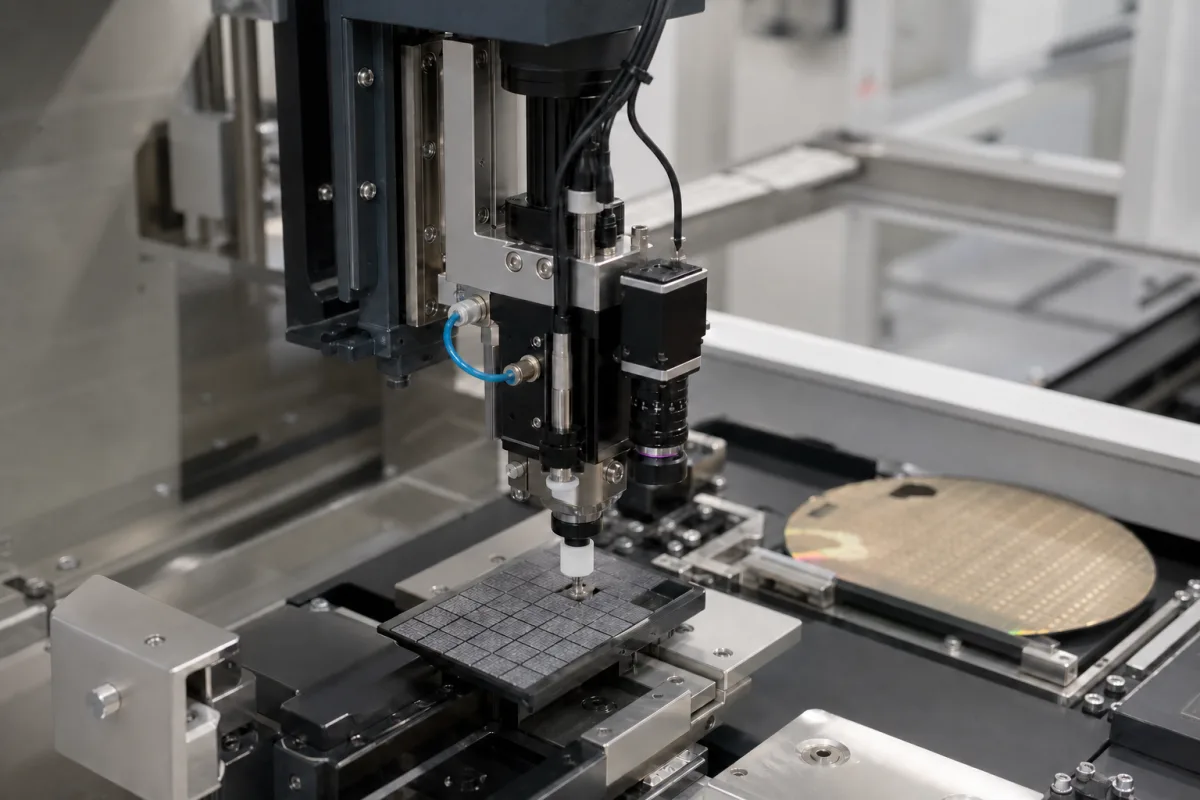
Pickup Head in a manufacturing environment
Representative product image. Confirm appearance and specifications with the manufacturer.

Product Specifications

Technical details and manufacturing context for Pickup Head

Definition
The pickup head is a critical component in automated die attach machines used in semiconductor packaging. It functions as the end-effector that precisely picks up individual semiconductor dies from wafer dicing tape using vacuum suction, then accurately places them onto leadframes, substrates, or other packaging materials. This component directly impacts placement accuracy, throughput, and yield in semiconductor assembly processes.

The pickup head operates using vacuum suction controlled by precision valves. When positioned over a die on wafer tape, vacuum is applied through nozzles to securely pick up the die. The head then moves to the target location, where vacuum is released to place the die. Some advanced versions incorporate vision systems for alignment verification and may include heating elements for thermal management during placement.

Typical materials include tungsten carbide, stainless steel, and ceramic. Key parameters include operating pressure (1.0–1.6 MPa), pickup force (0.5–5.0 N), positioning accuracy (±0.01 mm), repeatability (±0.005 mm), cycle time (0.5–2.0 s), operating temperature (15–35 °C), humidity (30–70% RH non-condensing), supply voltage (24 V DC ±10%), power consumption (10–30 W), material (SUS304 per ASTM A276), weight (0.5–2.0 kg), and IP rating (IP54–IP65 per IEC 60529). These values are reference ranges and must be verified for the specific model and application.

When selecting a pickup head, consider die size, placement accuracy requirements, cycle time targets, and environmental conditions. Verify compatibility with the die attach machine's interface, including vacuum supply, electrical connections, and control signals. Confirm that the operating pressure and vacuum flow meet the die pickup requirements. Ensure the pickup force is adjustable to avoid die damage. Check that the positioning accuracy and repeatability meet the required placement tolerances. Evaluate the cycle time to ensure it supports the desired throughput. Confirm that the operating temperature and humidity ranges are suitable for the cleanroom or factory environment. Verify the supply voltage and power consumption are compatible with the machine's power system. Assess the weight and inertia to ensure they do not adversely affect the machine's dynamics. Confirm the IP rating provides adequate protection against dust and moisture in the intended environment.

During operation, monitor for signs of wear or malfunction, such as inconsistent pickup or placement, increased cycle time, or visible damage to the nozzles or sealing surfaces. If the pickup head fails to hold dies securely, check vacuum pressure and nozzle condition. If placement accuracy degrades, inspect for mechanical wear or misalignment. If the head overheats, verify cooling and thermal management. Regular maintenance, including cleaning and replacement of worn parts, is essential to maintain performance. Failure to operate within specified parameters may lead to reduced yield or equipment damage.

Always verify model-specific values and standards with the legal manufacturer or supplier before procurement or use.
Working Principle
The pickup head operates using vacuum suction controlled by precision valves. When positioned over a die on wafer tape, vacuum is applied through nozzles to securely pick up the die. The head then moves to the target location, where vacuum is released to place the die. Some advanced versions incorporate vision systems for alignment verification and may include heating elements for thermal management during placement.
Common Materials
Tungsten carbide, Stainless steel, Ceramic
Technical Parameters
ParameterTypical rangeNotes & selection driver
Pickup Force0.5–5.0 NAdjustable per die size
Positioning Accuracy±0.01 mmCritical for fine-pitch placement
Repeatability±0.005 mmEnsures consistent placement
Cycle Time0.5–2.0 sFaster for high-throughput lines
Operating Temperature15–35 °COutside range may affect precision
Humidity Range30–70 % RHNon-condensing
Supply Voltage24 ±10% V DCStable voltage required
Power Consumption10–30 WDepends on actuation frequency
MaterialSUS304Corrosion-resistantASTM A276
Weight0.5–2.0 kgAffects inertia and speed
IP RatingIP54–IP65Protects against dust and water jetsIEC 60529

Ranges are indicative industry figures for RFQ preparation, not a supplier commitment. Confirm every value and standard with the legal manufacturer before ordering.

Components / BOM
  • Nozzle Tip Part
    Direct contact point for vacuum suction on die surface
    Material: Tungsten carbide
  • Vacuum Chamber
    Creates and maintains vacuum pressure for die pickup
    Material: Stainless steel
  • Mounting Flange Part
    Interface for attaching head to robotic arm
    Material: Aluminum alloy
  • Vacuum Valve
    Controls vacuum application and release
    Material: Stainless steel
  • Vision Alignment System Optional
    Checks die position before placement on the versions fitted with it.
  • Heating Element Optional
    Warms the die during placement where the process calls for it.

Applied To / Applications

This component is essential for the following industrial systems and equipment:

Industrial Ecosystem & Supply Chain Structure

Complementary Systems
Downstream Applications
Specialized Tooling

Application Fit & Sizing Matrix

Operational Limits
pressure: 0.1-0.5 bar (vacuum pickup pressure)
other spec: Die size range: 0.1-10 mm², Placement accuracy: ±5 μm, Cycle rate: up to 30,000 UPH
temperature: 15-35°C (operating ambient)
Media Compatibility
✓ Bare silicon dies ✓ Copper leadframes ✓ Organic substrates (e.g., BT, FR-4)
Unsuitable: Abrasive slurry environments (e.g., CMP processes)
Sizing Data Required
  • Die dimensions and thickness
  • Required placement accuracy (μm)
  • Machine cycle time (UPH)

Reliability & Engineering Risk Analysis

Failure Mode & Root Cause
Wear and Tear on Contact Surfaces
Cause: Repeated friction and impact during material pickup operations, often exacerbated by abrasive materials or misalignment.
Fatigue Failure of Structural Components
Cause: Cyclic loading from operational vibrations and stress concentrations, potentially due to poor design, material defects, or overloading.
Maintenance Indicators
  • Unusual vibrations or audible knocking during operation, indicating misalignment or component wear.
  • Visible cracks, deformation, or excessive wear on the pickup head's contact surfaces or mounting points.
Engineering Tips
  • Implement regular alignment checks and adjustments to ensure proper contact and reduce uneven wear.
  • Apply protective coatings or use wear-resistant materials on high-contact surfaces, and establish a preventive maintenance schedule based on operational cycles.

Indicative industry ranges for design and RFQ preparation. Confirm the exact figures and applicable standard with the manufacturer before specifying.

Compliance & Manufacturing Standards

Applicable Standards
ANSI B11.0 Safety of Machinery DIN 8580 Manufacturing Processes

Quoted from the published standard.

Manufacturing Precision
  • Bore Diameter: +/-0.01mm
  • Surface Flatness: 0.05mm
Quality Inspection
  • Dimensional Verification via CMM
  • Material Composition Analysis via Spectrometer

Manufacturers of Pickup Head

Manufacturer profiles associated with Pickup Head.

Sourcing Pickup Head from China?
Tell us your specification and target quantity — we will match it against manufacturer records and come back with the factories that fit.
Request manufacturers We manufacture this

Manufacturer listings support early research and capability understanding. They are not certification, ranking, or transaction guarantees.

Share this page
Technical documentation
Request current drawings, revision history, and a signed specification sheet.
Manufacturing capability
Verify equipment lists, process limits, capacity, and representative production evidence.
Inspection readiness
Confirm test methods, calibrated equipment, sampling plans, and traceable reports.
Supplier transparency
Check the legal entity, factory address, ownership, certifications, and direct contacts.

CNFX does not score or rank suppliers. Buyers must verify all claims and documents with the legal manufacturer before ordering.

Supply Chain Compatible Machinery & Devices

Industrial Smart Camera Module

The Industrial Smart Camera Module is a compact, self-contained vision processing unit designed for integration into industrial machinery and production lines.

Explore Specs →
Surface Mount Resistor

Passive electronic component for current limiting and voltage division in circuits

Explore Specs →
Surface Mount Capacitor

A surface mount capacitor is a fundamental electronic component used for energy storage, filtering, coupling, and decoupling in electronic circuits.

Explore Specs →
Surface Mount Technology (SMT) Pick-and-Place Machine

Automated machine that precisely places electronic components onto printed circuit boards.

Explore Specs →

Frequently Asked Questions

What is the function of a pickup head in die attach machines?

The pickup head is an end-effector that uses vacuum suction to pick up individual semiconductor dies from wafer tape and place them onto substrates or leadframes. It directly affects placement accuracy, throughput, and yield.

What materials are commonly used for pickup heads?

Common materials include tungsten carbide, stainless steel, and ceramic. The specific material grade, such as SUS304, should be verified with the manufacturer for the intended application.

What are typical operating parameters for a pickup head?

Typical reference ranges include operating pressure 1.0–1.6 MPa, pickup force 0.5–5.0 N, positioning accuracy ±0.01 mm, repeatability ±0.005 mm, cycle time 0.5–2.0 s, and operating temperature 15–35 °C. These are ranges and must be confirmed for the specific model.

How should I verify the pickup head's compatibility with my die attach machine?

Check the mechanical interface, vacuum supply, electrical connections, and control signals. Confirm that the operating pressure, voltage, and power consumption match your machine's specifications. Also verify that the pickup force and accuracy meet your process requirements.

Data Basis

Editorial classification, named public sources where available, and source-reviewed manufacturer records.

Preliminary Technical Classification
This page supports structured research, RFQ preparation, and supplier evaluation. It does not replace buyer-led supplier qualification, standards review, or technical approval.
Buyer enquiry

Request manufacturing insight for Pickup Head

Ask for use case, specification boundaries, supplier type, and RFQ preparation information for this product.

Where it goes
Straight to the CNFX editorial desk, and to the manufacturer if this product is linked to a claimed profile. Nothing is broadcast to a supplier list.
Your details stay here
We do not sell or rent enquiry data, and we do not add you to a mailing list. Used only to answer this request.
No commission, no middleman
CNFX is a directory. We take no cut of any order and never negotiate on a supplier's behalf.
What we don't claim
A listing is not an endorsement. Qualify every supplier and verify every figure yourself before ordering.

Your business information is used only to process this request.

Thank you! Your message has been sent. We'll respond within 1–3 business days.
Sorry, we couldn't send your message. Please try again, or email us at [email protected].

Need to Manufacture Pickup Head?

Compare manufacturer profiles with relevant product and process capability.

Previous Product
XY Positioning Stage
Last Product
Get QuotesChat