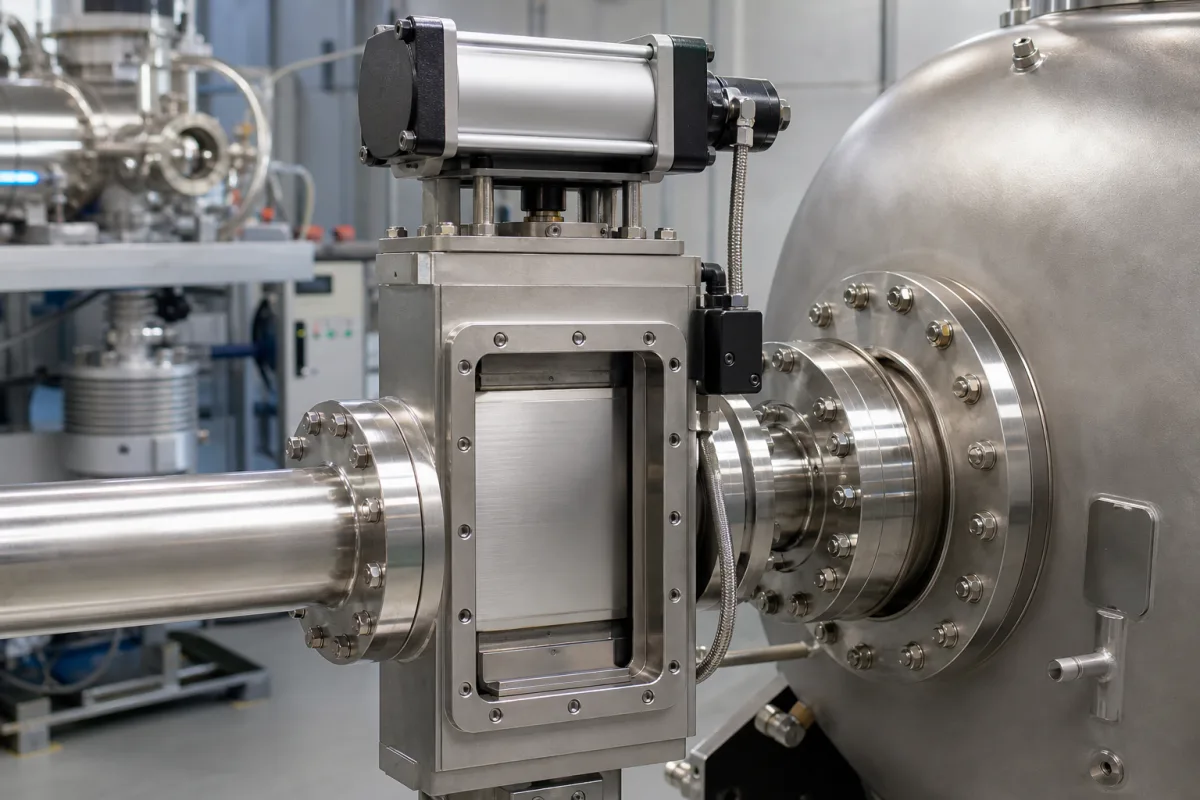
Vacuum systems · Valve type, seal, leak rate, conductance and actuation
A vacuum valve isolates, connects or vents parts of a vacuum system. Ask three things first: which valve body fits the line and the conductance you need, which seal suits your vacuum level and bake temperature, and what leak rate, cycle life and actuation the supplier will state.
Isolation valves for vacuum systems: gate, pendulum, angle, inline, butterfly and ball valves with manual, pneumatic or electromagnetic actuation. Throttling and pressure-control valves are noted only where suppliers list them. Automotive exhaust valves, irrigation air-release valves and vacuum-gripper valves are outside this page.
CNFX editorial research · Sources checked October 12, 2026 · 7 sources
Pfeiffer Vacuum, a vacuum equipment maker, describes angle valves as turning the gas flow through 90° and inline valves as having opposite flanges for straight lines; “Both variants usually use bellows as a seal”. Gate and pendulum valves give an unobstructed, optically free passage, “often open at low differential pressures”, and suit airlocks and pump inlets. [1]
Pfeiffer adds that the choice depends on the process sequence, process temperature, ultimate vacuum and gas composition, and lists butterfly, ball, vent and pressure-control valves alongside these. [1]
A gate valve datasheet shows the limits to check: VAT's Series 121 DN 63 manual gate valve covers 1 × 10⁻⁷ mbar to 1.6 bar absolute, takes 1.6 bar across the closed gate, but opens only at up to 30 mbar differential, with 400 l/s molecular-flow conductance. [2] Make sure the system can equalise pressure before opening.
Give the supplier the line size and flange, the pressure range, the maximum differential when closed and when opening, the gas, the bake temperature, the cycle rate and the actuation and control signals.
02
Check leak rate, seal and cycle life
Pfeiffer states that elastomer-sealed valves with ISO-KF or ISO-K flanges suit high vacuum, while metal seals with CF flanges suit ultra-high vacuum because metal seals have very low outgassing; it gives cost-optimised KF designs a leak rate of 10⁻⁶ mbar·l/s and a temperature limit of 80 °C. [1]
Suppliers quote leak rates in different units. Editorial calculation: 1 mbar·l/s = 100 Pa × 0.001 m³/s = 0.1 Pa·m³/s, and 1 Pa·L/s = 0.001 Pa·m³/s. So VAT's body and seat leak rates of < 1 × 10⁻⁹ mbar·l/s become < 1 × 10⁻¹⁰ Pa·m³/s [2], Baosi's ≤ 1.3 × 10⁻⁷ Pa·L/s for its DN 40 angle valve becomes ≤ 1.3 × 10⁻¹⁰ Pa·m³/s [3], and Pfeiffer's 10⁻⁶ mbar·l/s becomes 10⁻⁷ Pa·m³/s. [1] Ask which test method and which leak path (body or seat) each figure covers.
Cycle life is stated under conditions: VAT gives 5,000 cycles until first service for its manual DN 63 gate valve, unheated and clean [2]; Baosi gives 1,000,000 cycles with a bellows seal and 600,000 with a fluoro-ring seal for its pneumatic angle valve. [3] For bakeout, Super Q's all-metal CF angle valve seals with an oxygen-free copper gasket and lists 400 °C open and 300 °C closed. [4]
03
Gate, pendulum, angle, butterfly, ball and electromagnetic valves on the linked makers' sites
HTC lists pendulum, gate, angle, butterfly, slit, ball and metal valves; EVP lists electric UHV gate valves, flapper, ball, butterfly and electromagnetic valves; Super Q lists manual, pneumatic and electromagnetic angle valves, gate valves and all-metal CF angle valves; Baosi lists manual and pneumatic KF angle valves; VALUE lists bellows-sealed VEV valves with KF16, KF25 and KF40 flanges; RUBY lists angle and ball valves among KF fittings. [5][6][4][3][7]
Baosi's angle-valve page states two different pressure ranges and opening times in different tables; ask the supplier to confirm which applies. [3]
04
Body, closure, seat and stem seals, actuator and position indication
The seat seal sets the bake limit: VAT's DN 63 gate valve seals with FKM and lists ≤ 120 °C for the body, while Super Q's all-metal angle valve uses an oxygen-free copper gasket and lists 400 °C open and 300 °C closed. [2][4]
Part
Role
Fix in the order
Body
Carries the flanges and flow path; e.g. aluminium or stainless steel. [2][4]
DN, pressure range, leak rate, temperature, actuation time and solenoid data for a valve order
Normalise the leak-rate row first: VAT states it in mbar·l/s and Baosi in Pa·L/s, so convert both to Pa·m³/s as shown above and ask whether each figure is for the body or the seat. No source here gives an IP rating for the actuator parts.
Send the system, process and control data together
Paste it into your enquiry below or into an email to a maker, then replace every bracket.
Line: [DN; flange standard; angle, inline or gate]
Pressure: [range; differential closed; differential at opening]
Leak rate: [body and seat; unit; test method]
Process: [gas; temperature; bakeout; particles]
Seal: [elastomer type or metal; bellows or shaft feedthrough]
Actuation: [manual, pneumatic or electromagnetic; air pressure; voltage; position signals]
Life: [cycles per day; service interval]
Documents: [datasheet; leak test report; drawing]
11 companies list this product among what they make. Company figures are quoted from each
company's own website; every card states where the relationship came from.
Htc vacuum
Manufacturing site to be confirmed for the order
Lists pendulum, gate, angle, butterfly, slit and metal vacuum valves.
Explore company information and manufacturing capabilities, then discuss the scope of your project with a relevant supplier.
Share this page
Compiled and source-reviewed by the CNFX editorial team.
Each manufacturer above links to the page on that company's own website where the product is listed, with the date we checked it. How we source and review
· Page last updated 13 October 2026
Buyer questions
Angle valve or gate valve?
Angle and inline valves are compact; Pfeiffer says “Both variants usually use bellows as a seal”; gate and pendulum valves give an open, high-conductance path and suit pump inlets and airlocks. [1]
How do I compare leak rates in mbar·l/s and Pa·m³/s?
1 mbar·l/s equals 0.1 Pa·m³/s and 1 Pa·L/s equals 0.001 Pa·m³/s, so convert before comparing, and check body versus seat. [2][3]
Can a gate valve open against a large pressure difference?
Check the opening differential on the datasheet; one DN 63 gate valve holds 1.6 bar when closed but is rated to open at up to 30 mbar difference. [2]
Sources and what still needs a direct check
Sources checked 2026-10-12. Pfeiffer Vacuum and VAT are vacuum equipment makers; the VAT datasheet is hosted by distributor Kurt J. Lesker. Supplier pages describe their own offers and catalogue values.