Industry-Verified Manufacturing Data (2026)

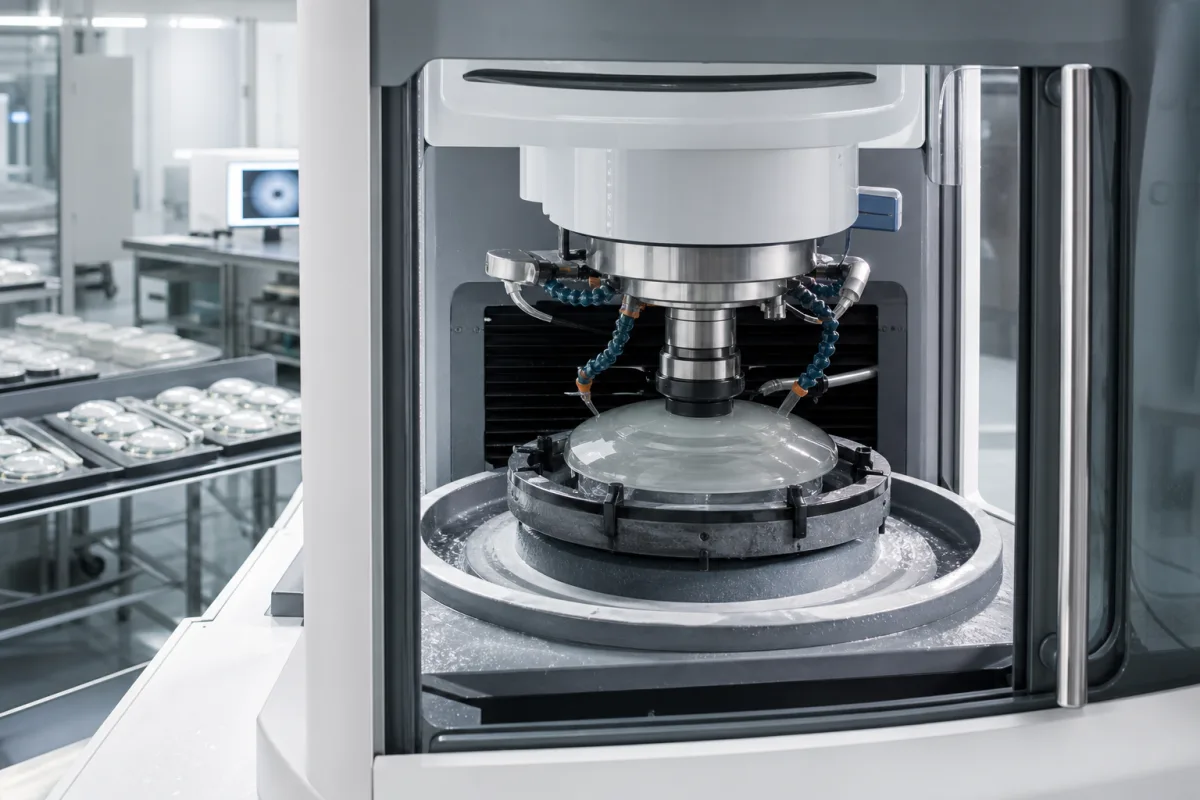
Precision Optical Lens Polishing Machine

Based on aggregated insights from multiple verified factory profiles within the CNFX directory, the standard Precision Optical Lens Polishing Machine used in the Computer, Electronic and Optical Product Manufacturing sector typically supports operational capacities ranging from standard industrial configurations to heavy-duty production requirements.

Technical Definition & Core Assembly

A canonical Precision Optical Lens Polishing Machine is characterized by the integration of Polishing Spindle Assembly and Lens Holding Fixture. In industrial production environments, manufacturers listed on CNFX commonly emphasize Stainless Steel 304 construction to support stable, high-cycle operation across diverse manufacturing scenarios.

Industrial machine for achieving nanometer-level surface finish on optical lenses through automated polishing processes.
Product Specifications

Technical details and manufacturing context for Precision Optical Lens Polishing Machine

Definition
The Precision Optical Lens Polishing Machine is a specialized industrial equipment designed for the final surface finishing stage in optical lens manufacturing. It employs advanced polishing techniques to achieve ultra-smooth surfaces with nanometer-scale roughness, critical for minimizing light scattering and maximizing optical performance. This machine serves as essential capital equipment in the optical instrument supply chain, enabling manufacturers to produce high-quality lenses for cameras, microscopes, telescopes, and medical imaging devices. Its automated operation ensures consistent results while reducing manual labor requirements in precision optics production facilities.
Working Principle
Utilizes rotating polishing pads with precisely controlled abrasive slurries to gradually remove microscopic material from lens surfaces through mechanical abrasion, achieving specified surface roughness and flatness through programmable pressure, speed, and motion patterns.
Common Materials
Stainless Steel 304, Aluminum Alloy 6061, Polyurethane Polishing Pads, Ceramic Abrasive Slurries
Technical Parameters
  • Final surface roughness achieved after polishing (nm) Standard Spec
  • Maximum deviation from perfect flatness in wavelength units (λ) Standard Spec
Components / BOM
Engineering Reasoning
0.1-2.0 μm Ra surface roughness, 10-1000 rpm spindle speed, 5-50 N polishing pressure
Spindle vibration exceeding 0.5 μm RMS displacement at 1000 rpm, polishing pressure exceeding 60 N causing subsurface damage >100 nm depth
Design Rationale: Resonant frequency excitation at 83.3 Hz (1000 rpm/60*5 harmonic) causing tool-workpiece chatter, Hertzian contact stress exceeding 1.2 GPa inducing brittle fracture in glass substrates
Risk Mitigation (FMEA)
Trigger Coolant pH drift below 8.5 causing cerium oxide abrasive agglomeration
Mode: Polishing pad glazing with 90% reduction in material removal rate
Strategy: Integrated pH monitoring with automated NaOH dosing maintaining 9.0-9.5 pH range
Trigger Thermal expansion mismatch between Invar spindle (1.2×10⁻⁶/K) and Zerodur workpiece (0.05×10⁻⁶/K) at ΔT>5°C
Mode: Astigmatic lens surface error exceeding λ/4 PV at 632.8 nm wavelength
Strategy: Active thermal compensation using Peltier elements maintaining ΔT<1°C between spindle and workpiece

Industry Taxonomies & Aliases

Commonly used trade names and technical identifiers for Precision Optical Lens Polishing Machine.

Industrial Ecosystem & Supply Chain DNA

Complementary Systems
Downstream Applications
Specialized Tooling

Application Fit & Sizing Matrix

Operational Limits
pressure: 0.1-0.5 MPa (polishing head pressure)
flow rate: 5-20 L/min (coolant/slurry circulation)
temperature: 15-30°C (operating environment)
slurry concentration: 5-15% by weight (abrasive content)
Media Compatibility
✓ BK7 optical glass ✓ Fused silica ✓ Zerodur ceramic glass
Unsuitable: High-vibration environments (e.g., near heavy stamping presses)
Sizing Data Required
  • Lens diameter range (mm)
  • Required surface roughness (Ra in nm)
  • Production throughput (lenses/hour)

Reliability & Engineering Risk Analysis

Failure Mode & Root Cause
Surface contamination and scratches
Cause: Improper slurry filtration leading to abrasive particle contamination, or worn polishing pads introducing micro-scratches during the polishing process.
Spindle bearing degradation
Cause: Continuous high-speed operation under load causing lubrication breakdown, thermal expansion, or particulate ingress leading to increased vibration and eventual bearing failure.
Maintenance Indicators
  • Audible high-frequency whine or grinding noise from spindle assembly during operation
  • Visual haze or inconsistent surface finish on polished lenses despite normal process parameters
Engineering Tips
  • Implement real-time slurry filtration and monitoring system with particle counters to maintain optimal abrasive particle size distribution and prevent contamination.
  • Establish predictive maintenance program using vibration analysis and thermal imaging on spindle bearings, with scheduled lubrication replenishment using manufacturer-specified high-temperature grease.

Compliance & Manufacturing Standards

Reference Standards
ISO 10110-5:2015 (Surface form tolerances) ANSI/OEOSC OP1.002-2009 (Optical component specifications) DIN 3140-7:2016 (Precision engineering tolerances)
Manufacturing Precision
  • Surface roughness: Ra ≤ 0.01 μm
  • Centering error: ≤ 0.005 mm
Quality Inspection
  • Interferometric surface testing
  • Coordinate measuring machine (CMM) verification

Factories Producing Precision Optical Lens Polishing Machine

Verified manufacturers with capability to produce this product in China

✓ 98% Supplier Capability Match Found

S Sourcing Manager from Singapore Feb 01, 2026
★★★★★
"The technical documentation for this Precision Optical Lens Polishing Machine is very thorough, especially regarding Maximum Lens Diameter (mm)."
Technical Specifications Verified
P Procurement Specialist from Germany Jan 29, 2026
★★★★☆
"Reliable performance in harsh Computer, Electronic and Optical Product Manufacturing environments. No issues with the Precision Optical Lens Polishing Machine so far. (Delivery took slightly longer than expected, but technical support was excellent.)"
Technical Specifications Verified
T Technical Director from Brazil Jan 26, 2026
★★★★★
"Testing the Precision Optical Lens Polishing Machine now; the Maximum Lens Diameter (mm) results are within 1% of the laboratory datasheet."
Technical Specifications Verified
Verification Protocol

“Feedback is collected from verified sourcing managers during RFQ (Request for Quote) and factory evaluation processes on CNFX. These reports represent historical performance data and technical audit summaries from our B2B manufacturing network.”

9 sourcing managers are analyzing this specification now. Last inquiry for Precision Optical Lens Polishing Machine from Mexico (58m ago).

Supply Chain Commonly Integrated Components

Optical Spectrometer

An analytical instrument that measures the intensity of light as a function of wavelength to determine the elemental composition of materials.

Explore Specs →
Stereo Camera Array

A multi-camera system that captures synchronized images from multiple perspectives to enable 3D depth perception and pattern recognition.

Explore Specs →
Structured Light Projector

Optical device that projects precisely controlled light patterns onto surfaces for 3D scanning applications

Explore Specs →
Main Processor Board

The central computing and control unit of a 5-axis CNC controller that processes motion commands, executes algorithms, and coordinates all system operations.

Explore Specs →

Frequently Asked Questions

What surface roughness can this optical lens polishing machine achieve?

This machine achieves nanometer-level surface finishes, specifically in the Ra (roughness average) range suitable for high-precision optical applications, typically below 10nm Ra for premium optical components.

What materials are compatible with this polishing machine?

The machine is designed for optical glass, crystals, and similar materials used in lens manufacturing. It uses ceramic abrasive slurries and polyurethane pads that are compatible with these materials without causing contamination.

How does the pressure control mechanism improve polishing results?

The precision pressure control system maintains consistent polishing force across the lens surface, ensuring uniform material removal and preventing edge rounding or center defects, which is critical for achieving optical-grade surface quality.

Can I contact factories directly on CNFX?

CNFX is an open directory, not a transaction platform. Each factory profile provides direct contact information and production details to help you initiate direct inquiries with Chinese suppliers.

Get Quote for Precision Optical Lens Polishing Machine

Request technical pricing, lead times, or customized specifications for Precision Optical Lens Polishing Machine directly from verified manufacturing units.

Your business information is encrypted and only shared with verified Precision Optical Lens Polishing Machine suppliers.

Thank you! Your message has been sent. We'll respond within 1–3 business days.

Need to Manufacture Precision Optical Lens Polishing Machine?

Connect with verified factories specializing in this product category

Add Your Factory Contact Us
Previous Product
Precision Optical Lens Mounting Ring
Next Product
Precision Placement Head