Industry-Verified Manufacturing Data (2026)

Precision Robotic Handling Module

Based on aggregated insights from multiple verified factory profiles within the CNFX directory, the standard Precision Robotic Handling Module used in the Computer, Electronic and Optical Product Manufacturing sector typically supports operational capacities ranging from standard industrial configurations to heavy-duty production requirements.

Technical Definition & Core Assembly

A canonical Precision Robotic Handling Module is characterized by the integration of Robotic Arm and End-Effector (Gripper). In industrial production environments, manufacturers listed on CNFX commonly emphasize Aluminum Alloy (frame/structure) construction to support stable, high-cycle operation across diverse manufacturing scenarios.

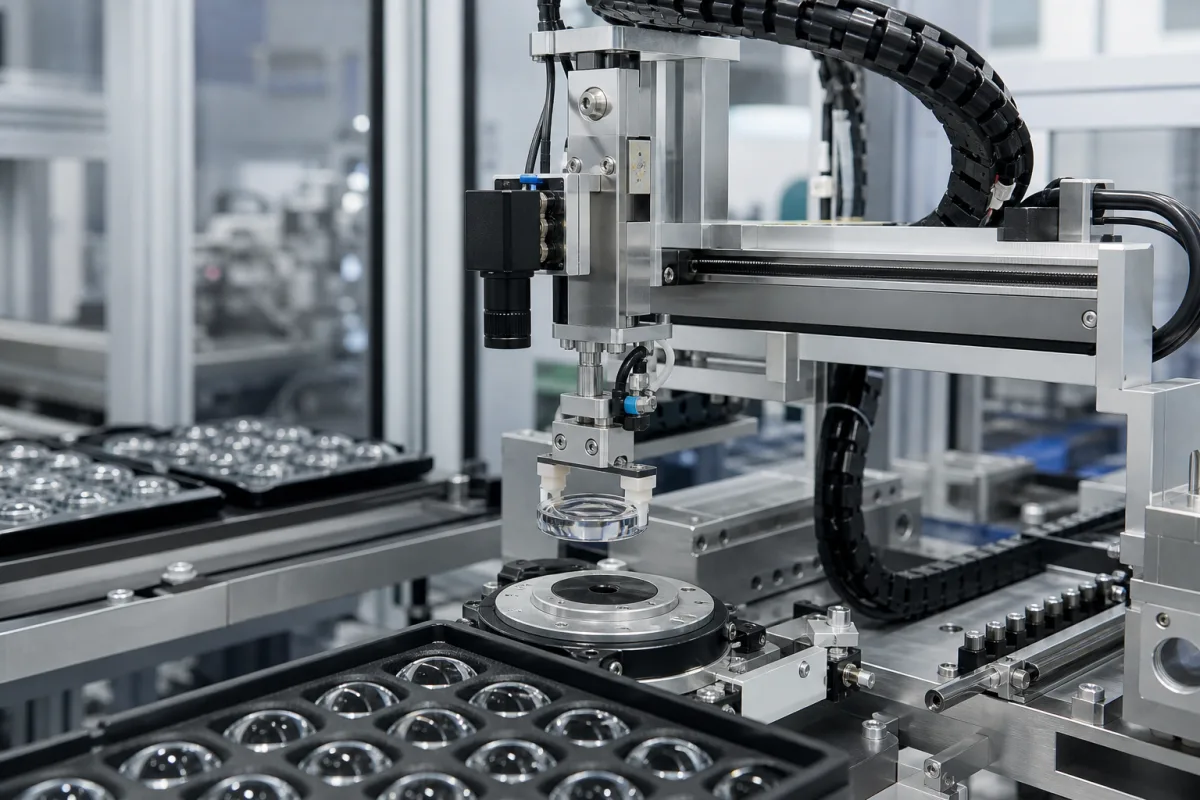
A robotic module designed for high-precision handling and positioning of optical components within automated assembly systems.

Product Specifications

Technical details and manufacturing context for Precision Robotic Handling Module

Definition
The Precision Robotic Handling Module is a critical component of the Automated Multi-Stage Lens Assembly and Testing System, responsible for the accurate, repeatable, and gentle transfer of lenses and other optical elements between different stages of the assembly and testing process. It ensures precise alignment and placement to maintain optical quality and system throughput.
Working Principle
The module utilizes a multi-axis robotic arm (e.g., SCARA or articulated) equipped with specialized end-effectors (e.g., vacuum grippers, soft-contact grippers) for handling delicate optics. It operates under programmed control from the system's central controller, receiving coordinates and handling instructions to pick, orient, and place components with micron-level accuracy. Integrated sensors (vision systems, force/torque sensors) provide feedback for closed-loop control and error correction.
Common Materials
Aluminum Alloy (frame/structure), Stainless Steel (guide rails, shafts), Engineering Plastics (cable management, covers)
Technical Parameters
  • Positioning Accuracy (mm) Standard Spec
Components / BOM
  • Robotic Arm
    Provides multi-axis movement for positioning the end-effector.
    Material: Aluminum Alloy / Carbon Fiber Composite
  • End-Effector (Gripper)
    Specialized tool for securely and gently gripping optical lenses without causing damage or contamination.
    Material: Stainless Steel / Ceramic / Soft Polymer
  • Servo Motors & Drives
    Provide precise torque and control for each axis of movement.
    Material: Various (copper windings, steel housings, rare-earth magnets)
  • Controller & I/O Module
    Processes movement commands from the main system and manages sensor feedback.
    Material: PCB, Electronic Components
  • Vision Guidance System
    Camera and lighting system used to locate and verify the position/orientation of components.
    Material: Optical Glass, Aluminum Housing, Electronic Sensors
Engineering Reasoning
0.1-1.5 m/s linear velocity, ±0.005 mm positioning accuracy, 0.1-10 N gripping force
Positioning error exceeds ±0.02 mm, vibration amplitude > 5 μm RMS at 100 Hz, servo motor temperature > 85°C
Design Rationale: Thermal expansion of linear guides exceeding 15 μm/m·K coefficient, bearing preload loss at >0.5 μm radial play, piezoelectric actuator depolarization at >150°C Curie temperature
Risk Mitigation (FMEA)
Trigger Encoder signal interference from 50-60 Hz electromagnetic fields at >10 V/m intensity
Mode: Position feedback loss causing 0.5 mm overshoot in Z-axis movement
Strategy: Shielded twisted-pair cabling with ferrite cores and differential signal transmission at 24 VDC
Trigger Lubricant degradation in recirculating ball screws after 5000 hours at >40°C ambient temperature
Mode: Increased friction torque > 2.5 N·m causing servo motor overload at 120% rated current
Strategy: Synthetic ester-based grease with 150°C drop point and automatic lubrication system with 0.1 ml/hour metering

Industry Taxonomies & Aliases

Commonly used trade names and technical identifiers for Precision Robotic Handling Module.

Industrial Ecosystem & Supply Chain DNA

Complementary Systems
Downstream Applications
Specialized Tooling

Application Fit & Sizing Matrix

Operational Limits
pressure: Atmospheric (non-pressurized environment)
other spec: Positioning accuracy: ±5 μm, Repeatability: ±2 μm, Max payload: 2 kg, Max speed: 0.5 m/s, Cleanroom class: ISO 5 (Class 100) or better
temperature: 15°C to 35°C (operational), 5°C to 45°C (storage)
Media Compatibility
✓ Optical lenses (glass/quartz) ✓ Laser diode assemblies ✓ Fiber optic connectors
Unsuitable: Abrasive slurry environments (sandblasting/polishing applications)
Sizing Data Required
  • Component dimensions and weight (mm, g)
  • Required positioning accuracy (μm)
  • Cycle time requirements (operations/hour)

Reliability & Engineering Risk Analysis

Failure Mode & Root Cause
Servo motor encoder drift
Cause: Contamination from dust/debris or thermal stress degrading encoder alignment, leading to positional inaccuracy
Ball screw backlash/wear
Cause: Inadequate lubrication, misalignment, or cyclic loading causing mechanical degradation in the linear motion system
Maintenance Indicators
  • Audible grinding or clicking noises during motion cycles
  • Visible misalignment or deviation from programmed paths during operation
Engineering Tips
  • Implement predictive maintenance using vibration analysis and thermal imaging to detect early mechanical wear
  • Establish strict environmental controls (cleanliness, temperature, humidity) and use high-quality, manufacturer-specified lubricants

Compliance & Manufacturing Standards

Reference Standards
ISO 9283:1998 - Manipulating industrial robots - Performance criteria and related test methods ANSI/RIA R15.06 - Industrial Robots and Robot Systems - Safety Requirements DIN EN ISO 10218-1:2011 - Robots and robotic devices - Safety requirements for industrial robots
Manufacturing Precision
  • Positioning repeatability: +/-0.05 mm
  • End-effector alignment: Angular tolerance +/-0.1°
Quality Inspection
  • Coordinate Measuring Machine (CMM) verification of geometric accuracy
  • Dynamic performance test for speed and acceleration compliance

Factories Producing Precision Robotic Handling Module

Verified manufacturers with capability to produce this product in China

✓ 95% Supplier Capability Match Found

T Technical Director from Brazil Jan 02, 2026
★★★★★
"Impressive build quality. Especially the technical reliability is very stable during long-term operation."
Technical Specifications Verified
P Project Engineer from Canada Dec 30, 2025
★★★★☆
"As a professional in the Computer, Electronic and Optical Product Manufacturing sector, I confirm this Precision Robotic Handling Module meets all ISO standards. (Delivery took slightly longer than expected, but technical support was excellent.)"
Technical Specifications Verified
S Sourcing Manager from United States Dec 27, 2025
★★★★★
"Standard OEM quality for Computer, Electronic and Optical Product Manufacturing applications. The Precision Robotic Handling Module arrived with full certification."
Technical Specifications Verified
Verification Protocol

“Feedback is collected from verified sourcing managers during RFQ (Request for Quote) and factory evaluation processes on CNFX. These reports represent historical performance data and technical audit summaries from our B2B manufacturing network.”

9 sourcing managers are analyzing this specification now. Last inquiry for Precision Robotic Handling Module from Mexico (1h ago).

Supply Chain Compatible Machinery & Devices

Modular Industrial Edge Computing Device

Rugged computing platform for industrial data processing at the network edge

Explore Specs →
Industrial Smart Camera Module

Embedded vision system for industrial automation and quality inspection.

Explore Specs →
Industrial Wireless Power Transfer Module

Wireless power transfer module for industrial equipment applications

Explore Specs →
Industrial Smart Sensor Module

Modular industrial sensor with embedded processing and wireless connectivity

Explore Specs →

Frequently Asked Questions

What level of positioning accuracy does this robotic handling module achieve?

The Precision Robotic Handling Module achieves micron-level positioning accuracy, typically within ±5 microns, making it ideal for handling delicate optical components in automated assembly systems.

How does the vision guidance system improve component handling?

The integrated vision guidance system provides real-time feedback for precise component alignment and verification, enabling adaptive positioning and quality control during optical assembly processes.

What materials are used in the construction and why?

The module uses aluminum alloy for lightweight structural rigidity, stainless steel for durable guide rails and shafts to ensure smooth movement, and engineering plastics for cable management and protective covers to maintain cleanliness in optical manufacturing environments.

Can I contact factories directly on CNFX?

CNFX is an open directory, not a transaction platform. Each factory profile provides direct contact information and production details to help you initiate direct inquiries with Chinese suppliers.

Get Quote for Precision Robotic Handling Module

Request technical pricing, lead times, or customized specifications for Precision Robotic Handling Module directly from verified manufacturing units.

Your business information is encrypted and only shared with verified Precision Robotic Handling Module suppliers.

Thank you! Your message has been sent. We'll respond within 1–3 business days.

Need to Manufacture Precision Robotic Handling Module?

Connect with verified factories specializing in this product category

Add Your Factory Contact Us
Previous Product
Precision Resistor Network
Next Product
Precision Rotary Chuck