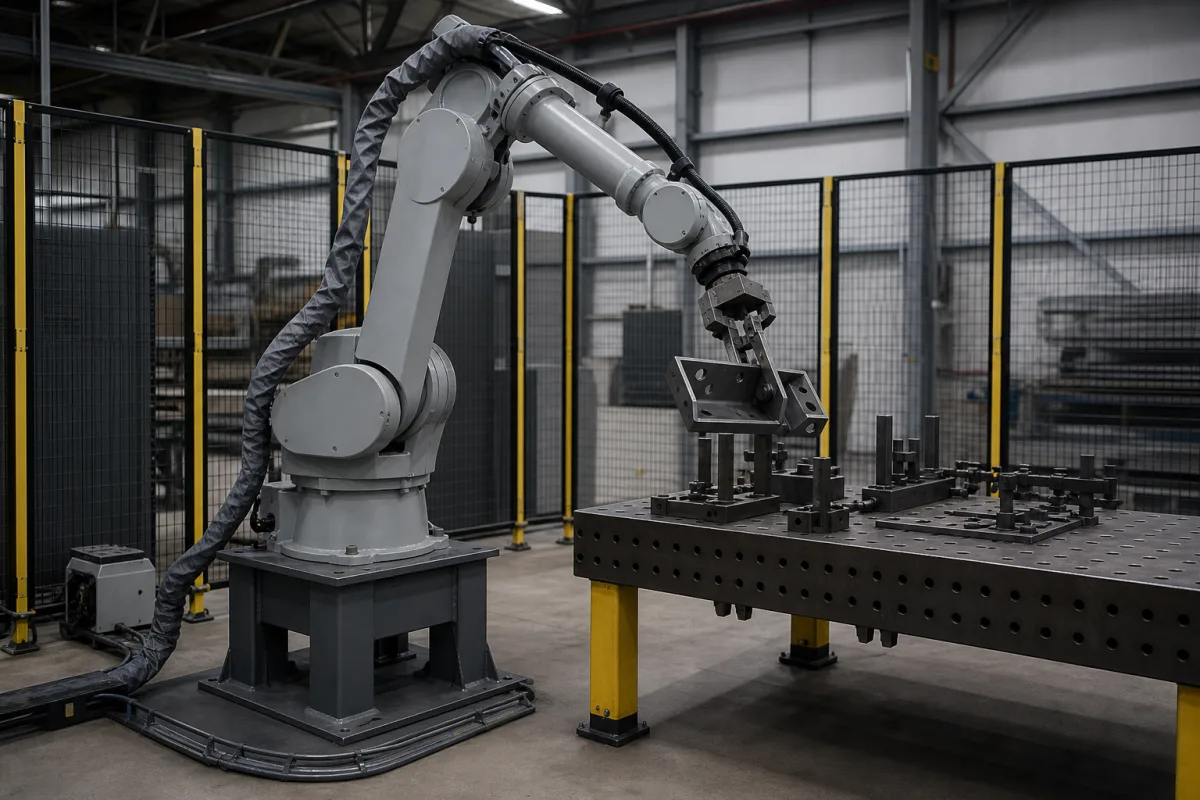
Robotic arm for welding: routing the torch cables over the arm or through it, and what that does to cable life and offline programming
Welding robot arms and their cable routing · Over-arm dress packs against through-arm hollow wrists, 1–2 against 4–6 years of cable life in three shifts, TCP stability for offline programming, torsion after axis 3, and how to hang an external pack so it does not fatigue
This page covers articulated robot arms used to carry welding torches and other process tools, seen through the cable package that feeds the tool: power, wire, gas and coolant routed over the arm in a dress pack or through a hollow upper arm and wrist. Ask three things first: whether the arm routes the package over the arm or through it, what cable life the maker states for your duty, and how an external package will be guided so it neither snags on fixtures nor fatigues.
Articulated robot arms for welding and tool-carrying cells, compared by how the process cable package is routed (over-arm dress pack or through-arm hollow wrist) and guided. Robot arms as a whole are covered on the Industrial robotic arm and Robotic manipulator pages, assembly and press-tending robots on their own pages, welding torches on the Welding torch page, fixtures on the Welding fixtures page and grippers on the Robot end effectors page. Complete welding cells such as trailer frame welding robots are outside this page.
CNFX editorial research · Sources checked October 12, 2026 · 3 sources
Over-arm or through-arm: swinging cables against torsion inside a hollow wrist
Binzel explains that an over-arm cable assembly is subject to constant swerving and skidding with the robot's movements, risks catching on the part or fixtures and tearing off, ages faster from spatter and arc UV, loads the torch's switch-off protection, and makes offline programming possible only to a limited extent because its movements are too complex to repeat, though its wear parts such as the liner are easy to reach. A through-arm cable assembly lies in a defined area and moves only a few centimetres, allowing offline programming and a stable TCP, but from the third axis onward it is exposed to strong torsion, for which Binzel makes special cables; it states that it decided against sliding contacts in the hollow arm because of high current transfer, abrasion and wear. [1]
ABB states that routing process cables inside the upper arm and along the wrist of its LeanID robots keeps them following every arm motion instead of swinging, protects them from spatter, heat and collisions, and raises service life to 4–6 years in three-shift operation against 1–2 years for an external dress pack, with predictable behaviour for off-line programming. [2] Editorial calculation: those figures put internal routing at two to six times the cable life of external routing on ABB's own comparison.
Give the supplier the welding process and torch, wire size and feeder position, coolant and gas lines, the part and fixture envelope, the shifts per day, whether programs will be made offline, and how cable packages will be serviced.
02
Hanging an external dress pack: radii, balancers, torsion stops and no cable ties
For external packages Binzel advises fastening or suspending them so that pendulum movements and bending moments stay small, avoiding the 'florist's wire' effect of breaking at stressed points; guiding them in the largest possible radii with balancers and suspension points to keep wire feeding good; never using home-made mountings such as cable ties; and letting the power cable, control cable, coolant hose and gas hose move freely against each other inside a dimensionally stable outer hose. It also lists programming habits that lengthen life: as few movements as possible, no jerky moves, minimal skidding and swerving, staying within axis limits and not driving close to devices. [1]
igus describes its triflex R robot dress packs as giving cable management a defined torsion stop, a defined bend radius of 50 to 182 mm depending on size, 360° of torsion at 10° per link, and a split cavity that separates lines; it comes in nine diameters from 30 to 125 mm with ball-and-socket links, so a damaged link can be replaced and links added or removed when a robot is repurposed. [3] Editorial calculation: at 10° per link, 360° of twist needs at least 36 links along the twisting section.
03
Send the process, package and duty together
Paste it into your enquiry below or into an email to a maker, then replace every bracket.
Process: [welding type; torch; wire; gas; coolant]
Routing: [over-arm or through-arm]
Cell: [part and fixture envelope; other robots]
Duty: [shifts; cycle]
Programming: [teach or offline]
Service: [liner change; cable replacement]
Compare welding robot arm and cable package suppliers
12 companies list this product among what they make. Company figures are quoted from each
company's own website; every card states where the relationship came from.
Romtronic International Co., Limited
Manufacturing site to be confirmed for the order
Lists high-flex, joint-torsion cable assemblies for articulated robotic arms and shielded power and feedback cables for welding robots, tested on bending fatigue rigs.
Explore company information and manufacturing capabilities, then discuss the scope of your project with a relevant supplier.
Share this page
Compiled and source-reviewed by the CNFX editorial team.
Each manufacturer above links to the page on that company's own website where the product is listed, with the date we checked it. How we source and review
· Page last updated 13 October 2026
Buyer questions
What is the difference between over-arm and through-arm welding robots?
Binzel explains that over-arm packages swing and can snag but are easy to service, while through-arm packages stay in a defined area and allow offline programming but face torsion. [1]
How long do robot process cables last inside versus outside the arm?
ABB states 4–6 years in three-shift operation for its internal routing against 1–2 years for an external dress pack. [2]
How should an external welding cable package be hung?
Binzel advises large radii with balancers, minimal pendulum and bending, no cable ties, and lines free to move inside a stable outer hose. [1]
Sources and what still needs a direct check
Sources checked 2026-10-12. Binzel, ABB and igus describe welding robot cable routing and dress packs from their own products and practice; suppliers list their arms and cables.