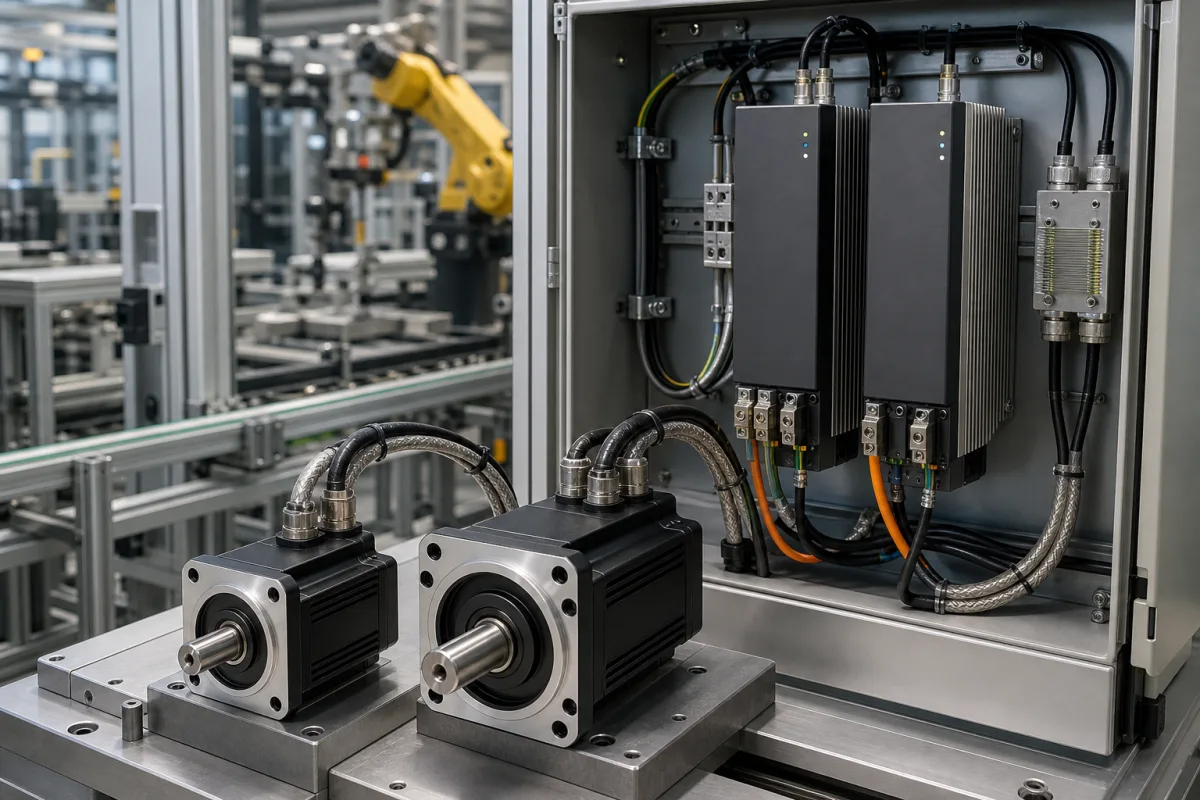
Servo motor and drive set: the cabled axis package from cabinet to motor
Servo motor and drive bought as one axis set, cabinet to machine · motor cable length against PWM frequency and shield capacitance, one-cable versus separate feedback cable, braking energy and the regenerative resistor
A servo motor and drive set is the axis package a machine builder or retrofitter orders as one item: a servo drive mounted in the control cabinet, a servo motor on the machine, and the motor power cable, feedback link, holding-brake wiring and braking resistor that join them. Motor and drive are chosen on their own pages; what this set adds is the run between them. Before ordering, fix the cable route length and the drive's switching frequency, whether feedback travels in the motor cable or in a separate cable, and where the energy goes when the axis brakes.
Matched servo motor and drive packages for machine axes, CNC retrofits and rotary tables, with the motor power and feedback cables, connectors, shield bonding, brake wiring and regenerative (braking) resistors that connect them. Sizing a servo motor against its speed–torque curve is covered on the Servo motor page, and drive current, feedback type, fieldbus and safety functions on the Servo drive page. Servo press modules with built-in force sensors are covered on the Servo motor actuator for press-fitting page. Stepper systems, spindle drives and variable-frequency drives for induction motors are outside this page.
CNFX editorial research · Sources checked October 12, 2026 · 3 sources
120 m at 4 kHz, 40 m at 16 kHz: the drive's switching frequency limits the motor cable
SEW-EURODRIVE's project planning data for its MOVIDRIVE technology drives sets a maximum motor cable length that depends on the drive size, the PWM (switching) frequency and whether the cable is shielded, and requires shielded motor cables to stay at or below 280 pF/m capacitance between core and shield. [1]
Editorial calculation: in the smallest size, going from 4 kHz to 16 kHz cuts the allowed shielded length from 120 m to 40 m, a third (120 → 80 → 40 m), and the unshielded limit is three times the shielded one at every frequency listed. [1]
Editorial note: a servo set is ordered with a drive in the cabinet and a motor somewhere along the machine, so measure the real cable route, including drag-chain loops, before choosing a higher switching frequency for smoother current control. If the route exceeds the drive's table, the supplier has to change the PWM frequency, the drive size or add output filtering.
Give the supplier the cable route length for each axis, drag-chain sections and bend cycles, the PWM frequency you intend to use, and whether pre-assembled cables of a fixed length are acceptable.
02
Feedback in the motor cable or a separate encoder cable: one connector, 100 m maximum
Beckhoff's One Cable Technology (OCT) uses the two thermal-contact wires inside a modified motor cable to carry digital encoder communication, so no separate feedback cable is needed. Beckhoff gives the maximum OCT cable length as 100 m, matching standard EtherCAT and Industrial Ethernet cabling, and says over 90% of its motors are now supplied with OCT. [2]
Beckhoff lists OCT for servo drives from 100 to 480 V AC and for compact 24 to 48 V DC drives, with PVC-sheathed cable for fixed installation, PUR-sheathed cable for drag chains and a PUR torsion cable for robot axes. [2]
Beckhoff's case for one cable: the encoder cable and its IP65/67 round plug are eliminated, an encoder cannot be plugged into the wrong motor, drag chains and cable channels can be narrower, and the separate cable channels it says the Machinery Directive requires for power and encoder cables are not needed. It names a hybrid cable with extra encoder wires as the alternative, but describes it as harder to assemble, less flexible, more expensive and larger in diameter, needing a larger drag radius. [2]
Through the same link the encoder reports its temperature, LED luminosity and operating hours, and Beckhoff's optional Smart System Diagnosis adds vibration measurement up to ±50 g and humidity. [2] Editorial note: a one-cable set ties the motor, cable and drive to one maker's interface; if the set may be mixed with another maker's motor later, ask whether the drive also accepts a separate encoder input.
03
Where braking energy goes: built-in or external regenerative resistor
Delta explains that when a servo motor brakes, regenerative power returns from the load to the drive and charges the DC bus capacitance; if it exceeds what the drive can process, its ASDA-A2 drives show fault ALE05 (regeneration error) and the energy has to be dissipated in a regenerative resistor. The ASDA-A2 has a built-in resistor as standard and accepts an external one for more capacity. [3]
Delta's notes for the ASDA-A2: set the resistance and capacity parameters (P1-52 and P1-53) to match the resistor fitted; give an external resistor the same resistance as the built-in one, and keep paralleled small resistors within the specified resistance; connect an external resistor between terminals P and C with the P–D link open. [3]
Delta warns that a resistor run continuously at its rated average regenerative power can reach 120 °C or higher, and recommends forced-air cooling and resistors with thermal switches. [3] Editorial note: mount the resistor where that heat cannot reach cables or plastic parts in the cabinet, and wire its thermal switch to a drive input or the safety chain.
Editorial note: give the supplier the load inertia, speed and deceleration time per axis so the set can be quoted with or without an external resistor.
State for each axis: load inertia, top speed, deceleration time and how often it brakes, whether it is vertical, the supply voltage, and whether two or more drives share a DC bus.
04
Send the axes, cable routes and braking duty together
Paste it into your enquiry below or into an email to a maker, then replace every bracket.
Axes: [number; application; vertical or horizontal; load inertia]
Motor: [rated and peak torque; speed; flange; brake]
Drive: [supply voltage; fieldbus; safety functions]
Cable: [route length per axis; drag chain; one-cable or separate feedback; shield capacitance pF/m]
Switching: [PWM frequency]
Braking: [top speed; deceleration time; duty; built-in or external resistor]
Cabinet: [space; cooling; resistor mounting]
1 company lists this product among what they make. Company figures are quoted from each
company's own website; every card states where the relationship came from.
SZGH
Manufacturing site to be confirmed for the order
Servo Motors and Drives category lists AC servo motors (for example a 3.7 kW, 35 Nm model) alongside servo drivers, including absolute-encoder 220 V AC and 380 V AC types and an EtherCAT servo controller.
Explore company information and manufacturing capabilities, then discuss the scope of your project with a relevant supplier.
Share this page
Compiled and source-reviewed by the CNFX editorial team.
Each manufacturer above links to the page on that company's own website where the product is listed, with the date we checked it. How we source and review
· Page last updated 13 October 2026
Buyer questions
How long can a servo motor cable be?
It depends on the drive and its switching frequency; SEW's smallest MOVIDRIVE technology size allows 120 m of shielded cable at 4 kHz, 80 m at 8 kHz and 40 m at 16 kHz. [1]
Can feedback run in the motor cable?
Yes, with one-cable systems; Beckhoff's OCT carries encoder data on two wires of the motor cable up to 100 m. [2]
When does a servo set need an external braking resistor?
When regenerated energy exceeds the drive's capacity; Delta's ASDA-A2 then signals ALE05 and an external resistor is added. [3]
How hot does a regenerative resistor get?
Delta says 120 °C or higher when it regenerates continuously at its rated average power. [3]
Sources and what still needs a direct check
Sources checked 2026-10-12. SEW-EURODRIVE, Beckhoff and Delta describe their own drives, cables and resistors; limits for other makers' sets differ and must come from their manuals.