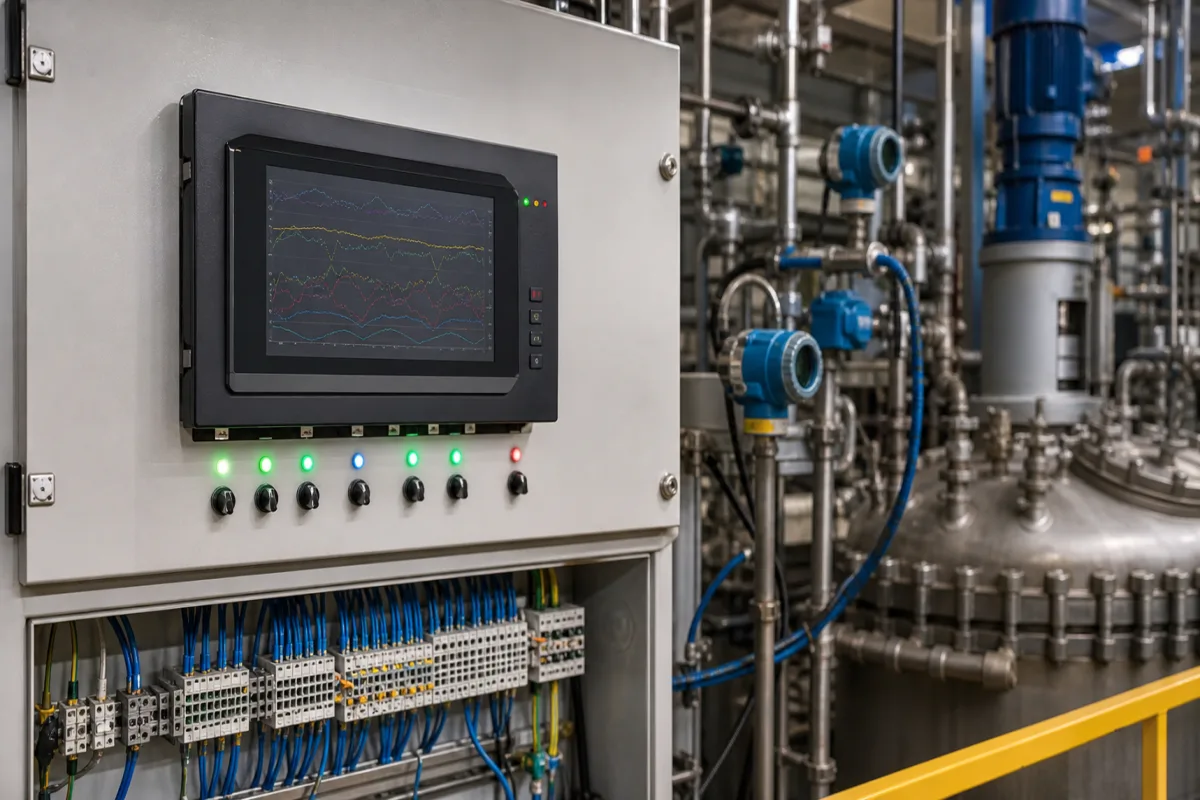
Panel-mounted process controller for 4–20 mA flow, pressure and level loops
Panel-mounted process controllers · 4–20 mA and 1–5 V loops for flow, pressure and level, cascade and selector control, manual backup
A process controller in this sense is a panel-mounted instrument that reads analog signals from field transmitters, such as flow, pressure or level on a 4–20 mA or 1–5 V loop, compares them with a setpoint and sends a 4–20 mA output to a control valve or drive. Ask three things first: how many analog inputs and outputs and which signal types the loop needs, what control functions (single loop, cascade, ratio or selector) and control period it must run, and what happens to the output if the controller fails.
Panel-mounted single- and multi-loop process controllers and indicating controllers working on analog transmitter signals (4–20 mA, 1–5 V) for flow, pressure, level and similar loops in process plants. Single-loop PID temperature controllers wired to thermocouples or RTDs and switching heaters are covered on the PID temperature controller page. PLCs, distributed control systems and field transmitters are outside this page.
CNFX editorial research · Sources checked October 12, 2026 · 3 sources
Count the analog inputs and outputs and check their loads
Yokogawa's YS1700 programmable indicating controller has, in its basic type, five 1 to 5 V DC analog inputs, one 4 to 20 mA output and two 1 to 5 V DC outputs (one convertible to 4 to 20 mA); the type with expandable I/O has eight analog inputs, four analog outputs and fourteen digital inputs and outputs. The 4 to 20 mA output accepts a load of 0 to 750 Ω, and the 1 to 5 V outputs at least 2 kΩ. [1]
Yokogawa states I/O conversion accuracy of ±0.1% of span for 1 to 5 V inputs and ±0.2% of span for analog current outputs, and gives the measurable range of the 4 to 20 mA output as 0.8 to 21.0 mA, with a tight-shutoff feature. [1] Editorial calculation: at 20 mA through the maximum 750 Ω load, the output must drive 0.020 × 750 = 15 V across the loop, so add up the resistance of the valve positioner, any isolator and the cable before checking it against that limit.
At the compact end, Maxwell's AU48, a 1/16 DIN (48 × 48 mm) universal-input controller, accepts 0–10 V, 4–20 mA, 0–5 V, 2–10 V and 0–20 mA as well as thermocouples and RTDs; it ships with a 250 Ω resistor to be fitted across two terminals when a mA input is used, and lists 0.25% F.S. accuracy and 0.001 maximum resolution for analog input. [2] Editorial calculation: 4–20 mA across 250 Ω gives 1–5 V, which is why mA and 1 to 5 V inputs are interchangeable through such a resistor.
Give the supplier each loop's transmitter signals (4–20 mA, 1–5 V, direct sensor), the final element and its input, the number of analog and digital inputs and outputs, the control functions, required control period, panel cutout and depth, power supply, communication protocol, and hazardous-area approvals.
02
Plan what the output does when the controller fails
Yokogawa describes the YS1700 as using two CPUs, one for control and one for display, so that display and manual operation remain available if either fails; a hard manual circuit independent of the digital circuits lets the operator adjust the controller output even if both CPUs fail. On a detected system failure the FAIL lamp lights, the FAIL contact opens and analog outputs are held. [1]
Yokogawa also lists the YS1700's front faceplate as dust- and splash-proof to IP54 for the basic type, optional FM and CSA nonincendive approvals, a 250 mm depth for the basic type, a weight of 1.6 kg, and operation from either 24 V DC or 100 V AC. [1] Editorial note: ask each supplier what the output does on power loss, CPU failure and input break, and whether a manual station is built in or must be added to the panel.
03
Choose the control functions and control period
In function-selection mode the YS1700 runs single-loop, cascade or selector control without programming at a 100 ms control period; in programmable mode the period is 50, 100 or 200 ms and the user program holds up to 1,000 text steps or 400 function-block modules, with more than a hundred calculation module types including temperature and pressure compensation. [1]
Add-on functions listed include self-tuning, non-linear PID, output limiters, alarm detection and a remote cascade setpoint input, with optional Modbus/TCP over Ethernet or RS485 communication. [1] Maxwell lists a 250 ms sampling rate for the AU48, with NPID, APID and on/off modes and auto-tuning, and power consumption below 2 W across a −30 to 75 °C ambient range. [2] For more loops in one unit, Maxwell's MF43HYC-652A runs up to four channels on a 4.3-inch touch screen, with relay, SSR drive or 4–20 mA output per channel and Ethernet, Wi-Fi and USB ports. [3]
04
Signal list, accuracy, control period and failure behaviour to request per model
Ask each supplier for the input and output signal list, accuracy as % of span, control period, failure behaviour and approvals of the model quoted.
05
Analog inputs, A/D and D/A, control CPU, outputs, hard manual backup and display
1 company lists this product among what they make. Company figures are quoted from each
company's own website; every card states where the relationship came from.
Xiamen Maxwell Automation Limited
Manufacturing site to be confirmed for the order
Lists a universal-input PID process controller accepting 4–20 mA and voltage signals, and multi-channel touch-screen controllers.
Explore company information and manufacturing capabilities, then discuss the scope of your project with a relevant supplier.
Share this page
Compiled and source-reviewed by the CNFX editorial team.
Each manufacturer above links to the page on that company's own website where the product is listed, with the date we checked it. How we source and review
· Page last updated 13 October 2026
Buyer questions
How is a process controller different from a PID temperature controller?
This page covers controllers built around 4–20 mA and 1–5 V transmitter loops, such as Yokogawa's YS1700 with five or eight analog inputs, 4–20 mA outputs and cascade or selector control; temperature controllers wired to thermocouples and heaters have their own page. [1]
What load can a 4–20 mA controller output drive?
Yokogawa lists 0 to 750 Ω for the YS1700's 4 to 20 mA output. [1]
Can a temperature-style controller take a 4–20 mA signal?
A universal-input unit can; Maxwell's AU48 accepts 4–20 mA through a supplied 250 Ω resistor and lists 0.25% F.S. accuracy. [2]
Sources and what still needs a direct check
Sources checked 2026-10-12. Yokogawa's general specification is the maker's published data for its YS1700; Maxwell's pages describe its own controllers. Figures are for the models named and must be confirmed for the unit you buy.